Other cities have encouraged walking and biking with ‘slow streets.’ Why not Fresno?
When it comes to taking steps that encourage safe walking and biking, Fresno is seldom proactive. Not when compared to other large cities in California, or even it’s smaller next-door neighbor.
Fresno’s inaction during the coronavirus pandemic is but another reminder. As Oakland, San Francisco, Los Angeles, San Diego and other cities launched “slow streets” initiatives to calm traffic in residential neighborhoods as people were staying close to home, leaders here gave a collective shrug.
So much for being proactive, but it’s still not too late to be reactive. Which is better than doing nothing.
Stepping up to help is the city’s Bicycle and Pedestrian Advisory Committee, which created a task force to compile a list of “slow streets” suggestions around Fresno.
Last week, the task force emailed that list, along with a letter detailing the concept and its benefits, to Fresno Mayor Lee Brand and the entire City Council. The letter was signed by more than two dozen local doctors, policy advocates and fitness experts.
What has been the response?
“So far the silence has been deafening,” said Anthony Molina, a retired physician who headed the task force and also chairs the Fresno County Bicycle Coalition “I have not received a hint of any sort of reply from any elected official.”
Let’s hope this helps amplify the message.
Before proceeding further, I should explain what “slow streets” actually means. Essentially, it’s creating more space for physically distant walking, jogging and biking by temporarily closing a few residential streets to through traffic using inexpensive means.
In Oakland, city officials used signs, traffic cones and portable barricades to create 20 miles of low-traffic streets in 19 different corridors. Another 50 miles are planned. In Los Angeles, residents, churches, PTAs and nonprofits can nominate their street and even apply to become sponsors responsible for coordinating with the city, spreading the word in the neighborhood and keeping signs erect.
There’s no reason why Fresno can’t do something similar. Well, besides the general reluctance of its city leaders to adopt anything progressive.
“People are hungry for opportunities to walk and bike,” Molina said. “During the last few months, the lack of parks and green space has been thrust into the bare light.”
Progress on Midtown Trail
The task force’s list of suggestions is broken down by council district and includes projects that don’t really meet the “slow streets” criteria.
For example, the Midtown Trail. Remember the Midtown Trail, the 7-mile pathway along canal banks in central Fresno? The project kicked off to great fanfare in 2016, only to never get off the ground despite having all the funding.
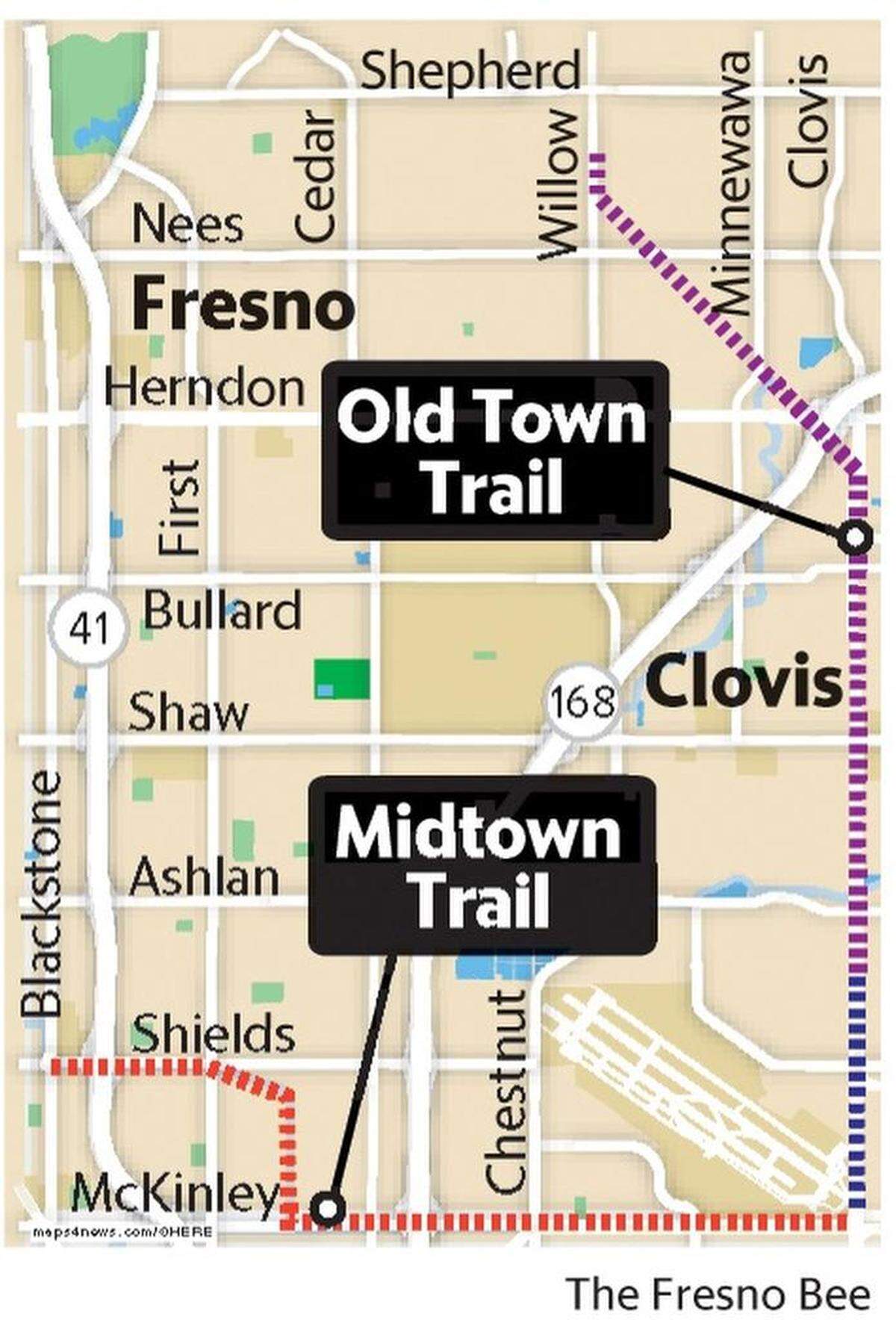
“This project has a lot of stakeholders, and everything is coming together to hold five different ground-breakings in the next year or year and a few months,” Mozier said.
Wonderful. The Midtown Trail is desperately needed. Still, there are numerous other projects, suggested by the task force, that could go ahead without millions in funding and months of planning and debate.
For example, Fresno’s first protected bike lane along Maple Avenue south of Fresno State is slated for construction next year. Why not accelerate that project, even if it means using traffic cones instead of permanent bollards?
Other potential “slow streets” recommended by the task force include Tulare Street between Sixth and Cedar avenues, Huntington Boulevard, Abby Street between Olive Avenue and downtown and Audubon Drive around Woodward Park.
Fix the Fruit Ave. ‘debacle’
What about Fruit Avenue, which has always made sense as a designated bicycling boulevard? Seven years after then-Councilmember Steve Brandau torpedoed years of community work on a bike lane by spending one hour in his truck doing an informal traffic “study,” now is the time to correct that ridiculous wrong. All it would take are some portable signs and traffic cones.
“The Fruit Avenue road diet debacle set bicycling back a generation in Fresno,” Molina said.
Also on the task force’s wish list: deactivating “beg buttons” at a few key intersections so that pedestrians don’t have to touch metal (and risk COVID-19 exposure) to get a walk signal.
Even though Fresno hasn’t implemented any “slow streets” measures, Mozier is paying attention to what other cities are doing. He noted Oakland spent “around $100,000” to create its slow streets network, a relatively paltry sum.
Can’t Fresno, despite dire revenue projections, afford something similar to enhance the quality of life for its residents? The answer, Mozier said, will depend on where elected leaders think any available money can be best spent.
Which, based on track record, doesn’t sound promising for anyone who likes to walk or bike.
“We have to seize the moment, and it’s being done all over except in Fresno,” Molina said. “Why is doing anything here so hard?”
Think I already answered that. But maybe this time, city leaders will surprise us.
This story was originally published June 5, 2020 at 9:39 AM.