
Her flight benefits revoked, she makes weekly drive to be with her recovering husband
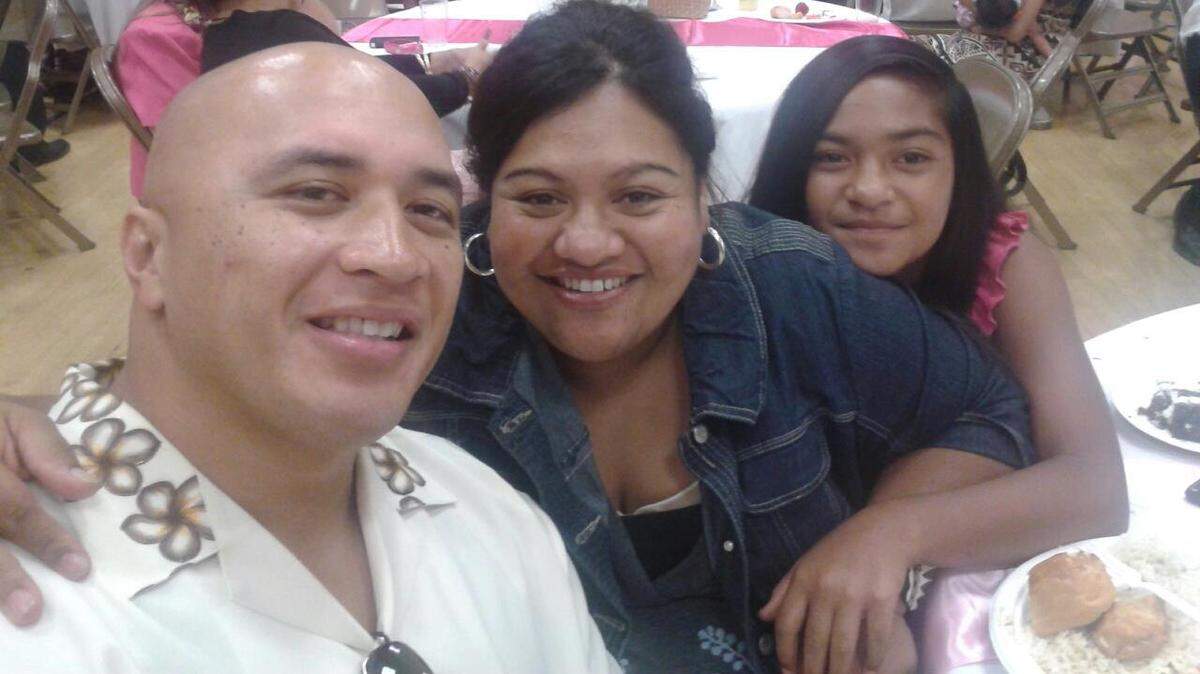
Every week, usually on Sunday night, Tepatasi Scanlan says goodbye to her children, exits her Clovis home and makes the four-hour drive to her husband’s bedside.
Flying from Fresno Yosemite International to LAX and taking a 15-minute Lyft to the Gardena recovery center would be so much more convenient.
Scanlan used to be able to fly for free each way, a perk of her job as an American Airlines supervisor for the past 5½ years. That benefit came as a special blessing following the events of Sept. 3, 2016, when when her husband, Fresno County correctional officer Toamalama Scanlan, was severely wounded in a shooting at the county jail. One of the bullets entered through the top of his head and exited through his cheek.
In the 22 months since the incident, Toamalama Scanlan has been treated by specialists in the Bay Area, Southern California and Texas. Through the surgeries, follow-up appointments and therapy sessions, Tepatasi Scanlan is by her husband’s side, a witness to every inch of thrilling progress and frustrating setback.
“It’s a lot of travel, but I need to be with him,” the mother of six said. “I need to be there.”
Tepatasi Scanlan went on medical stress leave from her airline job immediately after the shooting, took another leave of absence in 2017 and a third in April. She needed the time away to deal with her husband’s appointments, but the downside is that while on leave she lost her free flight benefits.
In stepped friend and fellow American Airlines supervisor Lita Thompson, who graciously offered to let Scanlan use her “buddy passes,” a benefit employees can bestow on family and friends. “Buddy passes” aren’t exactly free – the recipient must pay airport tax and has a lower boarding priority – but it sure beats driving.
Scanlan and Thompson each say they pored over company policy to ensure it wasn’t prohibited for an employee to allow a fellow employee on leave to use their “buddy passes.” Finding nothing, they went ahead and booked the flights. Scanlan made four or five round trips to LAX as Thompson’s “buddy.”
Much to their astonishment, American Airlines had a different take. Thompson received a suspension and was terminated, while Scanlan was also suspended and may lose her job as well.
“Honestly I was really shocked and heartbroken,” Thompson said. “This woman, she’s been through so much. I don’t know how anyone could be so heartless to deny her her flight benefits.”
That’s a good question, one that deserves asking.
How could you be so heartless, American Airlines?
“We’re not heartless,” company spokesman Ross Feinstein said.
When Scanlan contacted American Airlines human resources for clarification, she received an email reply that read, in part, “Although the AA Travel Guide does not explicitly state that employees cannot be added to another employees travel database as a Guest Traveler (D3), it is absolutely implied in the policies and guidelines that govern the program.”
The reply also contained a screenshot of an “important notice” that shows up every time an employee books a ticket through the “buddy pass” or Guest Traveler program. One of the nine disclaimers states that the person being authorized for travel is “not an employee whose travel privileges has been revoked or any employee on a leave of absence, which does not allow non-revenue travel.”
So, yes, there does appear to be some language prohibiting what Thompson and Scanlan did. But let’s look at the bigger picture.
It would be one thing if Scanlan was using Thompson’s “buddy pass” to go lie on some beach. She’s using them to be with her husband, a public servant wounded in the line of duty, as he recuperates from a traumatic brain injury.
One would think a company as large and profitable as American Airlines, which reported $10.4 billion in revenues and $186 million in net profits for the first quarter of 2018, could make an exception in this case. Evidently not.
A statement I received from Piedmont Airlines, a subsidiary that handles American Airlines’ ticketing, check-in and baggage in Fresno, read: “Piedmont has the deepest sympathies for the Scanlan family and has worked extensively to give Mrs. Scanlan the time she needs over the last 22 months to care for her husband. We cannot discuss details related to the employment records of our team members.”
When reached by phone, Piedmont Airlines spokesperson Jackie Jennings said there were “other issues, not related to travel, that led to the termination” of Thompson. Jennings said she could not disclose the nature of those “other issues” because they were a personnel matter.
“I know it makes a good headline, but there’s more to it,” Jennings said.
Scanlan said she did not know what “other issues” the company was referring to.
Furthermore, in discussions with American Airlines travel representatives, she was told exceptions to the company travel policy could be made for employees in her circumstances. Obviously, that didn’t happen.
“There are people who have abused the system,” Scanlan said. “They call in sick and travel the world. We see pictures of them in Vegas, and they get fired. That stuff happens all the time. We’re not trying to abuse the system. This is real. Where’s the common sense?”
Where, indeed?
With her job status in limbo and her flying benefits revoked, Scanlan has no choice but to drive back and forth every week to be with her husband. While Toamalama Scanlan continues to make progress, he still requires extensive care. Her goal is for him to come home, back to Clovis, by the end of the year.
“Every day is different,” Scanlan said. “You could get a day when he sits up and twitches his eyebrows when you’re asking questions. Or you can get a day when he’s not very responsive.”
It would be so much easier on Tepatasi Scanlan, and her family, if she could fly instead of drive.
C’mon, American Airlines. You say you’re not heartless. Now’s the chance to prove it.
Marek Warszawski: 559-441-6218, @MarekTheBee
This story was originally published July 17, 2018 at 2:21 PM.