
US rears its ugly side after fatal accident in Florida involving Sikh trucker | Opinion
AI-generated summary reviewed by our newsroom.
- Sikh drivers report increased threats and profiling following Florida crash.
- Industry leaders call for fair legal process, not politically charged trials.
- California's Sikh trucking sector faces operational strain amid safety fears.
It is a sad reflection on our country when a deadly Florida crash involving a Punjabi Sikh truck driver triggers an avalanche of racist, demeaning and uncalled for attacks on an entire immigrant community.
The fact the truck driver is from the Central Valley, where there is a significant Sikh community, makes the harassment more intolerable. This country’s behavior is appalling, and appears to be fanned by political winds.
Once again, the Punjabi Sikh community has been condemned based on the action of one driver. Harjinder Singh was arrested days after the Aug. 12 accident that showed him making an illegal U-turn in a Florida Turnpike that led to three fatalities when a minivan plowed into the semi-truck.
The Department of Homeland Security lashed out at California for issuing commercial driver’s licences to undocumented immigrants. California officials said Singh received a federal work permit in 2021 before obtaining his license legally.
Florida Gov. Ron DeSantis asked Congress to cut funding to sanctuary states, his attorney general announced that agricultural inspection stops would also serve as federal immigration checkpoints.
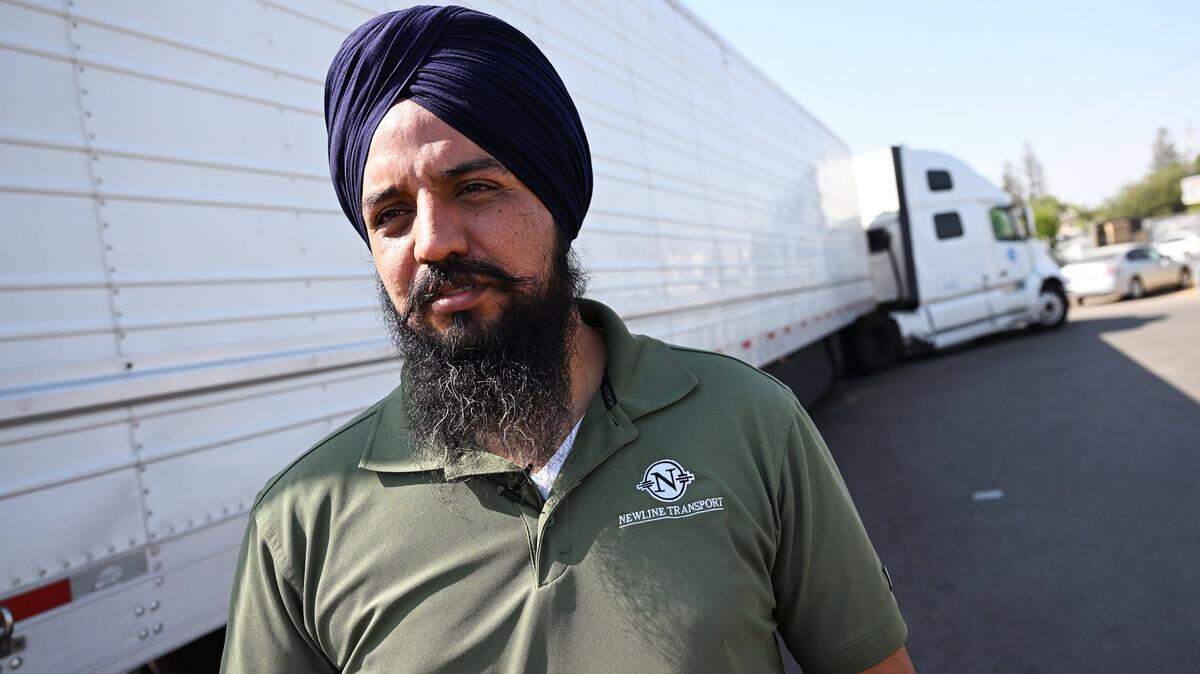
Sikh drivers have faced a surge in harassment and hostility at truck stops, and their trucks have been targeted by people throwing objects.
“We’re really concerned about the safety of our drivers,” Jasdeep Pannu told Fresno Bee reporter Melissa Montalvo. He is the CEO of Fresno-based Orbital Express Inc., an interstate general freight carrier. “There’s fear in the community about the misinformation, about being targeted because you wear a turban.”
North American Punjabi Trucking Association founder/CEO Raman Dhillon said a Sikh driver called 9-1-1 for help during a truck stop altercation, and police ordered him to leave instead of taking down a report.
The repercussions have hit California, which accounts for 30% to 40% of California’s trucking industry according to Dhillon. Many Sikh trucking operations are based in the Central Valley.
Pannu told Montalvo he upgraded security protocols for his 35 drivers and 26 trucks since the Florida crash. His drivers travel to the southeast, including Florida.
“Our community’s being targeted,” said Pannu, who had one of his drivers stopped and questioned about his immigration status by two officers in Florida. The driver was a U.S. citizen, “they had to let him go.”
“It’s extra harassment just based on the identity of the driver.”
The country can, and should, improve traffic standards for the trucking industry, but politics should not be part of it.
Sikh trucking company owners told Montalvo that Harjinder Singh should be held accountable, but that he should have “a fair transparent trial, not a political spectacle.”
Sadly, that might be difficult in today’s turbo-charged xenophobic approach to immigration.
Anti-Sikh messaging not new
We thought the harassment would have stopped at the height of the last presidential election when President Donald Trump made the false claim that Haitian immigrants were eating dogs and other pets in an Ohio town.
“They’re eating the dogs, the people that came in, they’re eating the cats,” Trump said during a televised presidential debate against Kamala Harris. “They’re eating the pets of the people that live there, and this is what’s happening in our country, and it’s a shame.”
There was no proof of immigrants eating pets, yet Trump backers eagerly spread the malicious rumor in an attempt to scare Americans of a nonexistent immigrant attack on our values.
It’s a shame that those types of preposterous rumors get repeated anytime something bad gets blamed on the immigrant community. Following 9/11, there was a significant increase in reports of hate-driven discrimination, violence and profiling because of religious attire that includes turbans.
“Although Sikhs are no strangers to discrimination, there was a noticeable uptick in incidents following the September 11 attacks as Sikhs became targets of xenophobic violence based on perceived similarities in the visible identity of Sikhs and ‘terrorists,’” the American Bar Association said in a 2024 report. “Specifically, the Sikh dastaar and kesh were conflated with the keffiyeh and beard maintained by Osama bin Laden and members of al-Qaeda and the Taliban.”
This should not be allowed in a country built by immigrants.