
Californians pay too much for electricity. Guess who’s getting blamed | Opinion
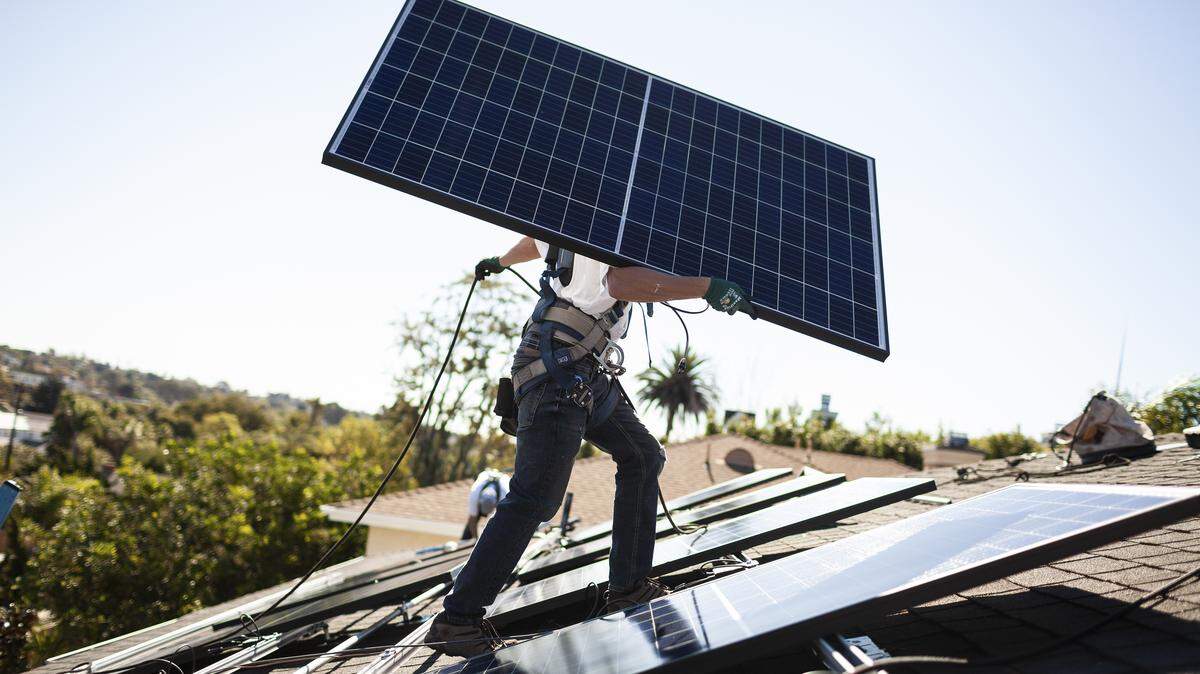
State officials have unveiled a list of suggestions aimed at reducing outrageous electric bills — but it largely leaves utilities like PG&E off the hook.
Instead of recommending ways that utilities could actually cut costs for all ratepayers, a report from the California Public Utilities Commission suggests shifting the financial burden from one group of customers to another, with rooftop solar households taking the biggest hit.
The report — prepared in response to an executive order from Gov. Gavin Newsom — suggests reducing the compensation for “legacy” solar customers who installed systems prior to April 2023, when the incentives for solar were greatly reduced.
That would bring down the bills of non-solar customers who are picking up some of the fixed costs that solar customers avoid. That can cost non-solar customers, by one estimate, well into the hundreds of dollars per year.
That’s excessive, yet reneging on an agreement with legacy solar customers is not the answer.
They typically invested tens of thousands of dollars in rooftop systems, under the impression they would recoup the cost through savings on monthly electric bills by selling the excess power they generate back to the grid.
Now that the deal for regulators and those without solar roofs doesn’t pencil out — which suggests the CPUC should never have approved it in the first place — the state could come along and change it?
Here’s an idea: Instead of merely shifting costs, rein in profits earned by investor-owned utilities like PG&E, which reported a record-breaking $2.4 billion in profits for 2024.
Why go after solar customers?
The CPUC report says solar customers who installed their systems before April 2023 are not paying their fair share of the fixed costs associated with distribution and transmission.
On top of that, as the retail price of electricity rises, the credits earned by pre-2023 solar customers grow right along with it.
As a result, other ratepayers are forced to carry solar customers, costing non-solar customers anywhere from $200 to $400 per year, according to the nonpartisan Legislative Analyst’s Office.
Clearly, that’s unfair and needs to be corrected, but demonizing solar customers as wealthy elites is not the way to do it.
Contrary to what the CPUC report implies, it’s not just high-income households that would be taking the hit.
According to a report from the Lawrence Berkeley National Laboratory, 61% of California’s solar customers earned less than $150,000 in household income in 2023. The percentage was even higher in some areas. In Sacramento County, 70% of solar customers earned under $150,000; in Fresno County, 74%; in Stanislaus County, 79%; and in San Luis Obispo County, 68%.
In each county, at least 10% of solar customers earned less than $50,000 per year. So much for the wealthy homeowner scenario.
What’s more, many customers installed solar at the urging of the state, which actively encouraged homeowners to switch to solar to aid the transition to clean energy. (Remember former Gov. Arnold Schwarzenegger’s Million Solar Roofs initiative?)
Reducing bills for non-solar customers
The CPUC already has taken one step that will transfer some of the burden of fixed costs to solar customers.
Last year, it approved a monthly flat fee of $24.15 per month, to be paid by solar as well as non-solar customers. (Customers eligible for subsidized rates will pay less.)
When the fee goes into effect next January, the cost of electricity will be reduced 5 to 7 cents per kilowatt hour, benefiting heavy electricity users. For example, according to the San Francisco Chronicle, that could save a customer in Fresno $33 per month during the summer months, when sweltering heat means near-constant use of air conditioning.
The CPUC report includes other sensible suggestions that would avoid blowing up agreements with pre-2023 solar customers.
Tying the solar agreement to the customer, rather than the system, is one.
Here’s how it would work: As a solar home is sold, the buyer would not be eligible for the more generous “legacy” credits.
Reallocating the climate tax credit funded through the state’s cap-and-trade program also would help.
Cap-and-trade is expected to generate nearly $1.4 billion for ratepayers in 2025, which works out to a yearly credit of $120 per residential customer.
But if credits were limited to low-income ratepayers and to those customers living in the hottest climate zones, the payments would be $445.
Ratepayers need relief, not more studies
But realigning the burden is not enough. Unfortunately, the CPUC’s suggestions on how to save money are weak at best.
Those include approving lower-cost wildfire prevention methods “where appropriate”; assessing energy-related mandates for “cost effectiveness”; and subjecting wildfire mitigation plans to “coordinated cost review and evaluation.”
Is the state not already doing these things?
Apparently not, which could partially explain why our electric bills are the second-highest in the nation, exceeded only by Hawaii’s.
Instead of scapegoating solar customers, the Public Utilities Commission should show more restraint in approving rate increases for PG&E and other major utilities.
Too often, they are authorized to go ahead with controversial capital projects, such as burying power lines in locations where insulating overhead lines would provide sufficient fire protection at a much lower cost.
As for Gov. Newsom, ordering studies is the easy way out. Ratepayers do not need to be placated, they need financial relief.
It’s past time for the governor, the Legislature and the Public Utilities Commission to provide tangible support to ratepayers who are literally struggling to keep the lights on.
Don’t make them wait any longer.
This story was originally published March 3, 2025 at 5:00 AM with the headline "Californians pay too much for electricity. Guess who’s getting blamed | Opinion."