Fresno email scam case reflects a basic truth: The public’s right to know is paramount
Jerry Dyer is not the first elected executive to get angry over leaks and publication of sensitive information.
The Fresno mayor was livid recently when The Bee asked about an email scam that, it was initially thought, snookered the city out of $400,000 of taxpayer money. Dyer himself upped the ante in a subsequent press conference by saying the city had actually lost $600,000 to an unknown criminal or criminals who used an email process known as phishing to grab the funds.
The scam took place two years ago, but The Bee recently was able to confirm its existence through some emails between city officials who discussed it, and confirmation by City Councilmember Miguel Arias. The criminal(s) submitted fake invoices that looked authentic and thus got the money transferred to bogus accounts.
Dyer said the scam took place under the watch of his predecessor, Lee Brand. Dyer learned about it in late 2020, shortly before he was sworn in. But at the request of the FBI, which was investigating the theft, Dyer kept it confidential.
So he was upset when Bee staff writer Brianna Calix began asking about it; his main beef was that someone inside City Hall had leaked her the info.
It should be noted that Dyer did not try to stop The Bee from its story. But it should also be clear that the city did not fulfill a public records request about the emails that Calix submitted. The city’s reasoning? The keywords used by the city did not produce any records, when, in fact, the emails existed and could have been found had the city made a more diligent search for the materials, as is required.
Dyer and the FBI have shown no justification for upholding confidentiality other than to claim that disclosure of the phishing case could jeopardize an investigation. This despite the case being two years old, with no arrests and almost no money recovered.
Bee columnist Marek Warszawski recently took Dyer to task for prioritizing the instincts of his law enforcement career — he is Fresno’s former police chief — rather than being transparent in his new one. It is hard to dispute that point.
Pentagon Papers
The principle of citizens having a right to know what their government is doing was cemented into American law more than 50 years ago. That is when then President Richard Nixon and his Justice Department sued The New York Times and The Washington Post over leaks of classified information that detailed America’s involvement in the Vietnam War.
Nixon sought to stop The Times from publishing what became known as the Pentagon Papers. He lost early rounds in court, but pushed the matter to the U.S. Supreme Court. There, the justices found 6-3 that the administration failed to justify keeping The Times and The Post from their First Amendment rights to publish the information.
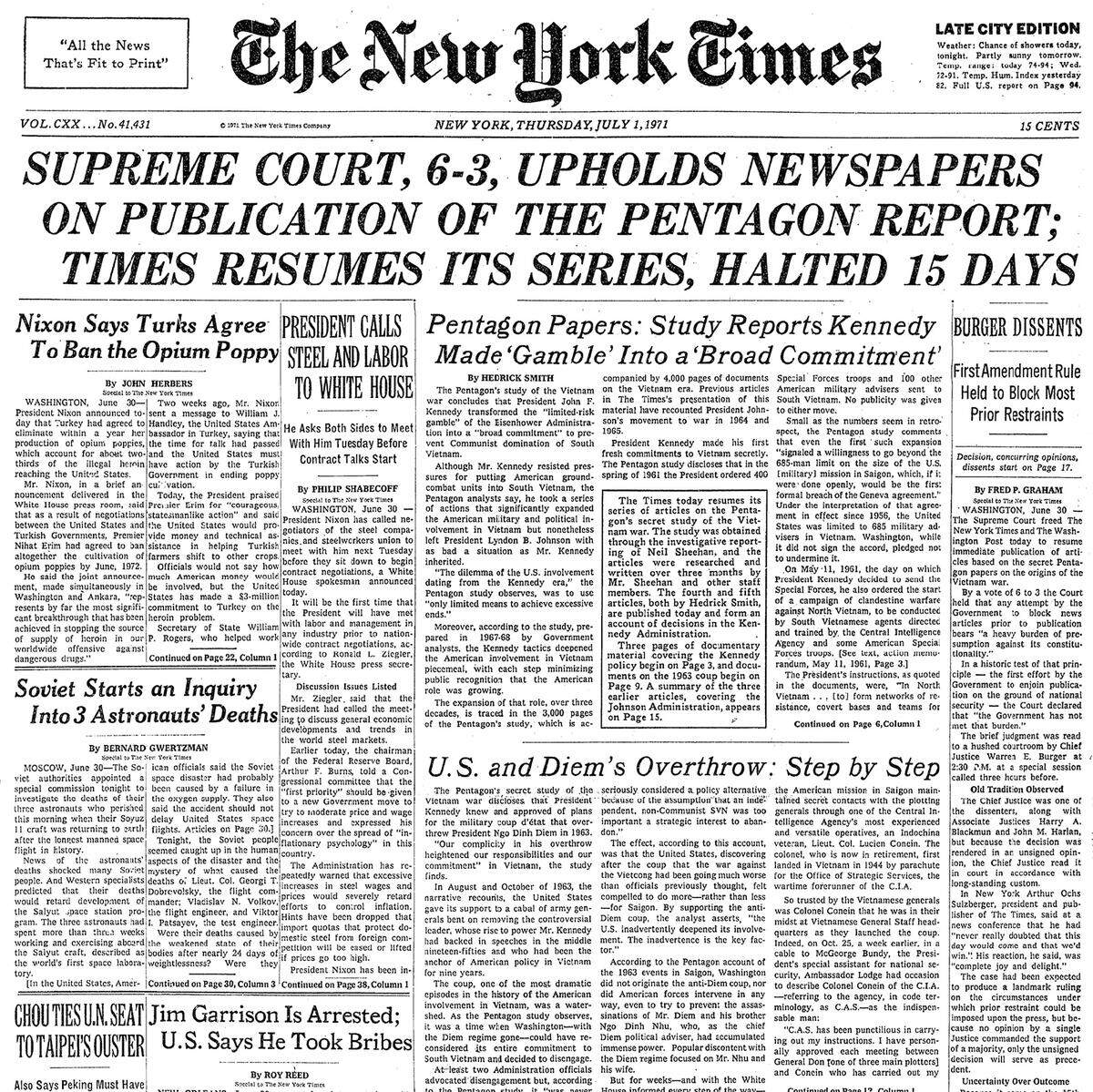
“Any system of prior restraints of expression comes to this court bearing a heavy presumption against its constitutional validity,” the court said in citing lower courts’ rulings.
Disclosing future scams
Arias now wants to guarantee disclosure in the future when the city suffers losses of public money. The benefit of such an approach is clear, but any policy would need vetting to make sure it can accomplish its goal.
Really, the matter seems more simple than a formal policy. Here is how it should have gone down:
Dyer would have checked in with the FBI shortly after he took over as mayor to find out the latest with the phishing case.
If the FBI agent said there is nothing new to report, Dyer would have then said this:
“You have had more than a year to track this down. I understand the needs of confidentiality of an investigation. But as mayor, I now have a responsibility for full disclosure to the citizens of Fresno. This was their money, so I am going to tell them that this scam happened. Keep your investigation going and let me know any updates.”
Dyer would have scored a political win if he had handled it this way. Simply saying the theft occurred would not have jeopardized the case. Dyer would not have needed to go into detail.
Instead, he kept quiet, then had to address the scam when The Bee found out. He chose secrecy over transparency, despite his public pronouncements that he is all for being up front.
Dyer may criticize this column as naive and ignorant of the needs of police work. I have no doubt the mayor strongly believes keeping the matter quiet is still the proper and only course, at least until the investigation is over.
The problem is, FBI cases can linger into the indefinite future, with no resolution.
Should Fresnans know that their city lost $600,000 in a scam? Without question, the answer is yes.