
Limit smoke pollution and support a healthy ag future. It’s time to ban field burning
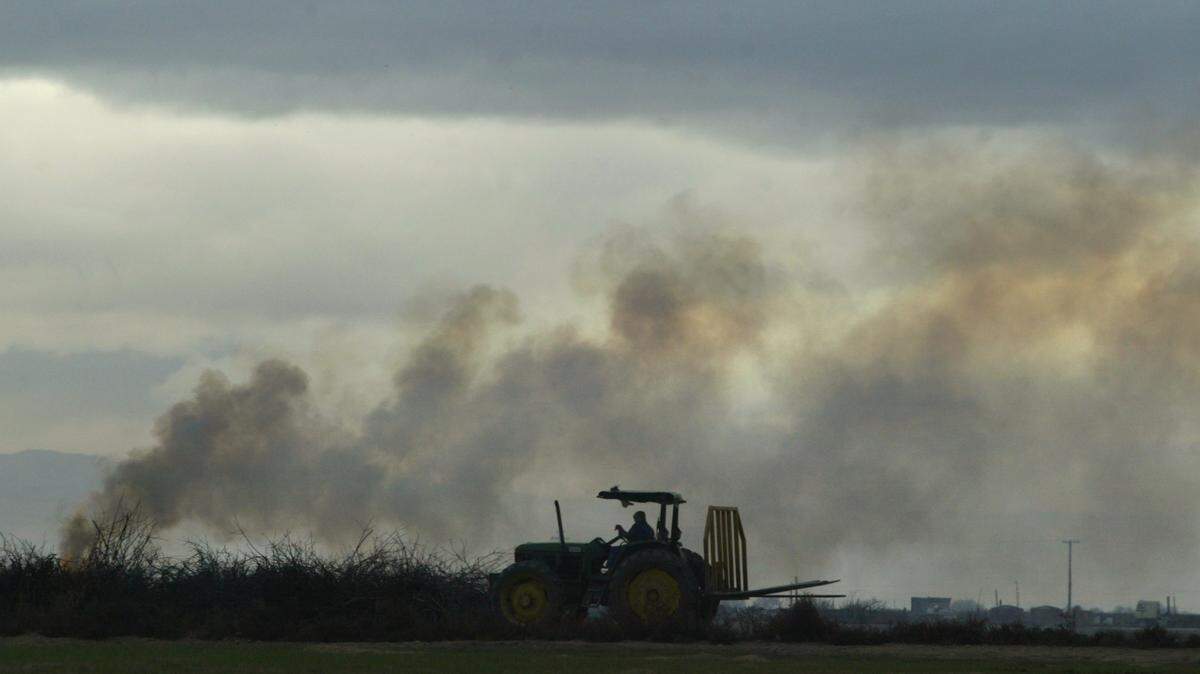
San Joaquin Valley old-timers can recall that scent of wood-fire smoke in the fall, wafting over the region where farmers lit fires to harvested fields, piles of old trees and uprooted vines, and other ag waste. It was a time-tested way to get rid of diseased material and pests.
But those days of field burning have been steadily disappearing, and now a new proposal by the San Joaquin Valley Air Pollution Control District would end the practice entirely by 2025.
The California Air Resources Board will take up the district’s plan at its meeting Thursday, and as much as a ban on ag burning would impose higher costs on agriculture — the Valley’s leading economic force — such a proposal should be approved. The impacts of smoke pollution in the Valley extract an even higher price on human health.
Valley’s bad air
The San Joaquin Valley is one of the nation’s most polluted air basins. Part of that is caused by geography: the fertile valley lies between the Sierra Nevada range to the east, the Coast Range to the west and the Tehachapis to the south. Air gets trapped in the region, especially in the summer, when daytime highs often exceed 100 degrees. With little air movement, the Valley develops polluted air that hangs in a gray pall.
Farming contributes in the form of diesel emissions by tractors and other equipment, though the air district has for years had an aggressive campaign of retiring older machinery for new, cleaner-burning models. Farming also generates dust, which the district says is the leading constituent of fine-particulate air pollution in the region. That fine-particulate pollution is known as PM 2.5. Such particles can be inhaled deep into a person’s lungs and even enter the bloodstream.
In 2017, about six tons of PM 2.5 were generated by open burning in the state every day. Of that, two tons came from the Valley. Put another way, about 600,000 tons of farming material are burned in the Valley every year.
The Valley is classified as a “serious non-attainment” area for four federal standards. Almost one in six children in the Valley have asthma or some type of respiratory problem — compared with a national average of one in 12. Asthma also hits many adults hard.
End of agricultural burning
Against this health backdrop is the plan being taken up by the state board Thursday. A state law enacted in 2003 was supposed to end burning in the region by 2010. But the district has granted five postponements since then and the state board has gone along.
Now the Valley air district wants to transition farmers away from burning to a “near complete phase-out of agricultural burning in the Valley by January 1, 2025,” according to an air resources board staff report.
Rather than burn piles of waste, the district wants growers to chip or compost that material and put it back in the soil. But that costs more, either to haul the waste to a composting plant or hire a chipping service. To help, the state says farmers will need between $15 million to $30 million a year as incentive funding. That can come from federal, state and local sources.
Certainly, the new deadline should go no later than 2025, which is far beyond the original 2010 target. The Valley’s air pollution problems have been long known and well-documented. Among the hardest hit are lower-income people who live near major freeways and rail lines and daily breathe pollution along those corridors, on top of the Valley’s already poor air.
In a CalMatters report on the plan, Nayamin Martinez, executive director of the Fresno-based Central California Environmental Justice Network, said enough time has passed to bring about the burning ban.
“You don’t need more time, I’m sorry,” Martinez said. “That’s an insult.”
You can watch
The California Air Resources Board meeting will be conducted online via Zoom starting at 9 a.m. Thursday. Interested persons can register to offer comments and get information on how to watch by going online to https://ww2.arb.ca.gov/ma022521.
This story was originally published February 23, 2021 at 5:00 AM.