
A silver lining that’s getting lost in the rush to cancel Cesar Chavez | Opinion
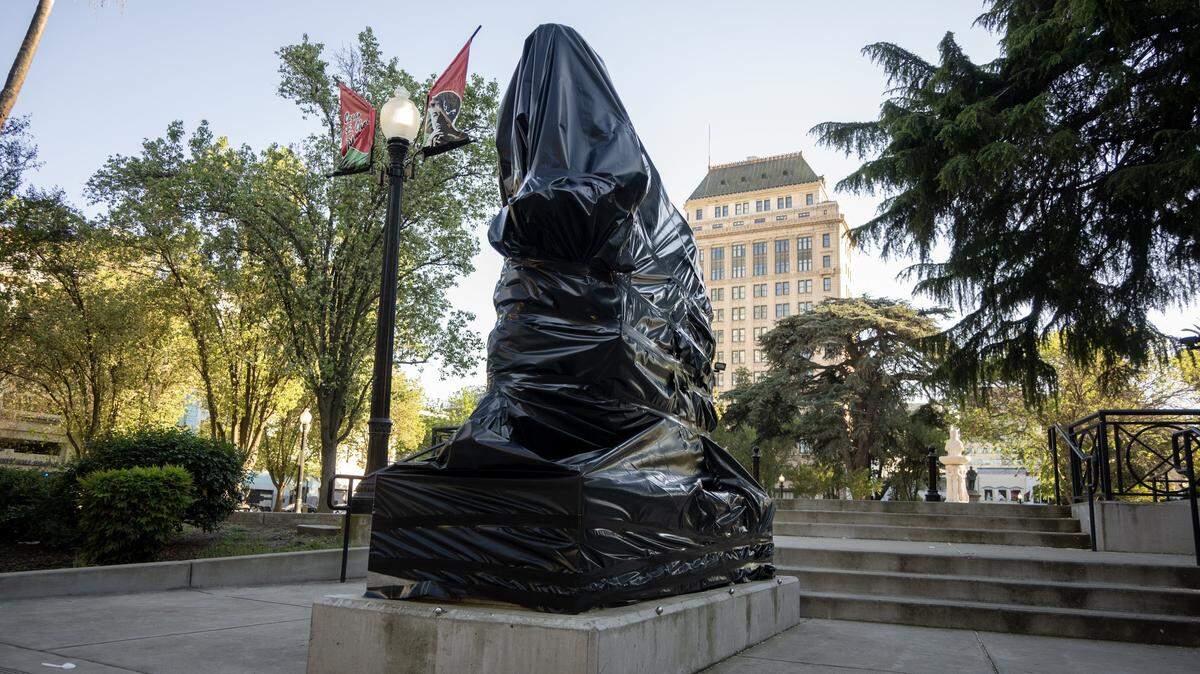
Bringing down statues is much harder work than building them up.
Removing the names of the heroes we once revered requires a painful acknowledgment that our hopes have been dashed. It’s as if cynicism and despair have won out over faith.
In the long arc of American social movements, few figures have loomed as large as Cesar Chavez. This is particularly true in the Mexican American community of California. Iconic images of Chavez fasting, marching and praying for farmworker rights in his 1960s and 1970s heyday became synonymous with sacrifice, dignity and justice. Streets and parks were dedicated to him and his mission, schools taught students about his work and a state holiday was dedicated to his March 31 birthday.
The rapid cancellation of Chavez is disorienting.
Recent credible allegations against Chávez have forced a reassessment of him. It is also forcing a stress test of whether Latino political leadership has matured enough to hold its own icons accountable and whether Latinos can politically transcend the fall of a Mexican American figure whose name and likeness became more widely known than any other figure from that community.
Fortunately, the answer to these questions appears to be yes. The condemnations and commitments to remove public memorials have been swift. This says something profound about the maturation of Latino voices in our society, some of whom drew inspiration from Chavez.
We venerate saints because we need them. Movements, nations and communities have always personified their highest aspirations in individual human beings. It is easier to understand justice and organize around it when justice has a face. Chavez became that vessel — not just a labor leader, but a moral symbol. He would preach that the powerless could move mountains.
There is real power in that kind of symbolism. It inspires. It endures.
But it also distorts and eventually breaks because it is human and not divine. It always breaks.
When we construct human beings as figures above reproach, leaders become icons. Icons become myths. Myths become untouchable. And then reality intrudes.
What is different here — and what deserves recognition — is how Latinos in prominent roles responded.
There is something genuinely significant about a community with the integrity to bring a statue down. Erecting a statue is an act of aspiration. Taking one down is an act of honesty. It is an admission that our understanding was incomplete.
To its credit, Latino political leadership has not rushed to minimize the seriousness of these allegations. There has been no reflexive circling of the wagons, no organized effort to deflect or rationalize. That is profound and a healthy example of leadership too often a rarity in modern America and particularly in modern American politics.
This is also not the first time. When Los Angeles City Council President Nury Martinez and other prominent labor and political leaders were caught on tape using racist language, the response was equally swift and unambiguous. Condemnations were immediate. There was no broad effort to protect the perpetrators or construct elaborate defenses. The community drew a line.
This is not weakness, but evolution.
A once marginal political movement reflexively protective of one man is demonstrating something different now — self-awareness. That is not painless. It is not politically costless. But it is necessary.
And that stands in sharp contrast to the current broader American impulse that still struggles to look itself in the mirror.
Across the country, we continue to see efforts not to interrogate the past, but to sanitize it — to resurrect statues and symbols tied to slavery, rebellion, and exclusion. Monuments to Confederate generals are defended not as artifacts of history, but as objects of pride. The impulse is not to learn from the past, but to preserve a version of it that is easier to live with.
And let us not forget that leaders in Washington D.C., including President Donald Trump, have been linked to convicted sex offender, Jeffrey Epstein. Trump was found liable for sexual abuse in a 2023 federal civil case. Meanwhile, allies of Trump have been accused of actively working to conceal evidence in the Epstein case.
This avoidance comes at a destructive cost.
A country, like a people, that cannot confront its past cannot fully understand its present. And a movement that cannot question its icons cannot sustain its moral authority.
In the current moment of pain and acknowledgement, Latinos have lost their most recognized leader.
But they are also showing they don’t really need him after all.
Mike Madrid is a political analyst and a special correspondent for McClatchy Media.
This story was originally published March 25, 2026 at 5:00 AM with the headline "A silver lining that’s getting lost in the rush to cancel Cesar Chavez | Opinion."