
Under Trump, we are entering a new, troubling era of domestic militarization | Opinion
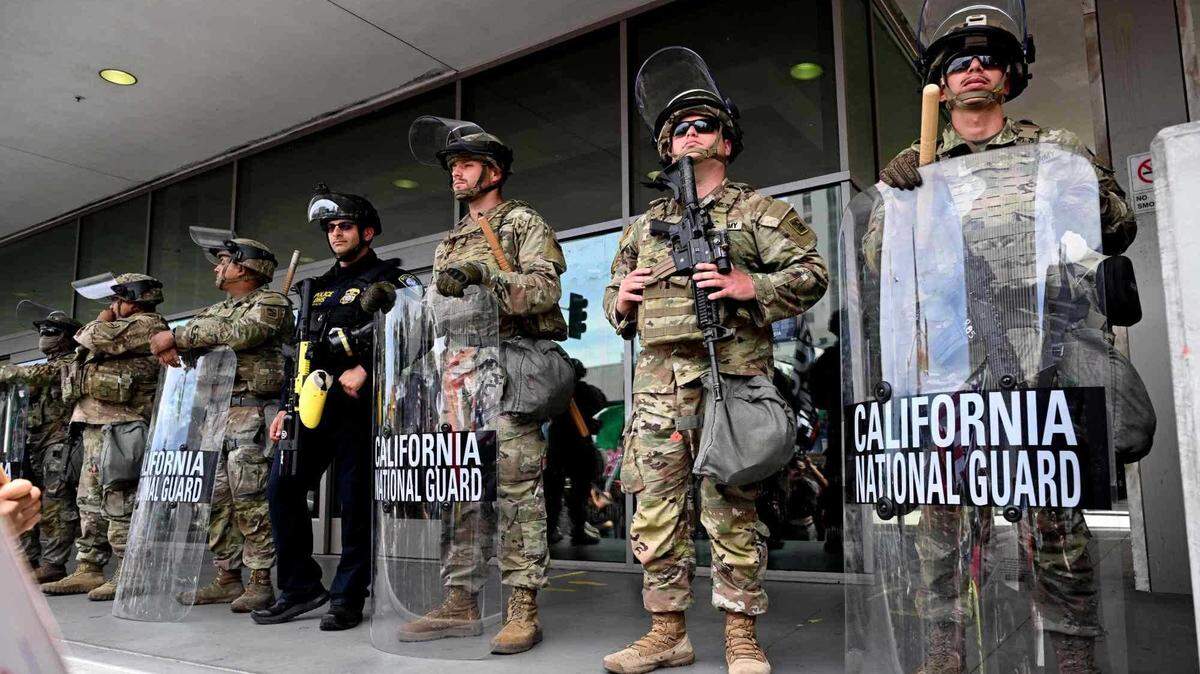
Authoritarian countries are characterized by having troops in their streets and using their military for domestic law enforcement. Thankfully, rarely has this happened in the United States. But this country took a major step toward this reality with a decision of the U.S. Court of Appeals for the Ninth Circuit that permits the president broad authority to call up a state’s national guard.
On Saturday, June 7, President Donald Trump federalized 2,000 members of the California National Guard. He subsequently called up into federal service another 2,000 California Guard members.
Trump invoked authority under a federal statute, 10 U.S.C. § 12406, which was adopted as part of the Militia Act of 1903. That provision authorizes the president to “call into federal service members and units of the National Guard of any state in such numbers as he considers necessary,” but only if the United States, or any of the Commonwealths or possessions, is invaded or is in danger of invasion by a foreign nation; there is a rebellion or danger of a rebellion against the authority of the U.S. government; or the president is unable to execute U.S. laws with regular forces.
Gov. Gavin Newsom challenged the legality of this. The U.S. District Court for the Northern District of California carefully reviewed each part of the law and found that the requirements for this statute were not met in the circumstances of the anti-Immigration and Customs Enforcement (ICE) protests in Los Angeles. And that there was no proof that state and local law enforcement were unable to adequately deal with the anti-ICE protesters.
On Thursday, June 19, however, the U.S. Court of Appeals for the Ninth Circuit reversed this ruling and expressed the need for great deference to the president in federalizing a state’s national guard. The court relied heavily on an 1827 Supreme Court decision involving another federal statute, the Insurrection Act. In Martin v. Mott, the Supreme Court said that “the authority to decide whether (an exigency requiring the militia to be called out) has arisen belongs exclusively to the president, and . . . his decision is conclusive upon all other persons.”
The Ninth Circuit said that this decision required great judicial deference to a president’s choice to nationalize a state’s guard. It stated: “Martin does not compel us to accept the federal government’s position that the president could federalize the National Guard based on no evidence whatsoever, and that courts would be unable to review a decision that was obviously absurd or made in bad faith.”
But that is a standard that gives enormous deference to the president: He can federalize a state’s national guard so long as there is some evidence justifying the action and doing so is not absurd or in bad faith.
Based on this deferential approach, the court concluded that Trump had sufficient basis for federalizing the national guard based on his conclusion that he was “unable, with the regular forces, to execute the laws of the United States.” The court said that under “a highly deferential standard of review, defendants have presented facts to allow us to conclude that the president had a colorable (reasonable) basis for invoking § 12406(3).”
For many reasons, the Ninth Circuit’s decision is wrong and dangerous. The statute expressly limits when the president can federalize a state’s guard. Those limits are meaningless if the court basically allows the president almost unlimited authority.
It is stunning that the Ninth Circuit paid no attention to American history and how rare it is for a president to federalize a state’s national guard. It last occurred without a request from a governor 60 years ago, when President Lyndon B. Johnson used this authority to protect civil rights demonstrators in Selma, Alabama.
Meanwhile, Trump and Secretary of Defense Pete Hegseth have said that what is being done in Los Angeles is a prelude to what they have planned across the country. On June 8, Trump said, “Well, we’re gonna have troops everywhere.” The Ninth Circuit’s ruling opens the door to just that.
But it is important to emphasize that the Ninth Circuit did not address an even more important question: How can the president use troops within the United States? The Posse Comitatus Act prohibits the military from being used for domestic law enforcement.
But here, too, the Ninth Circuit’s ruling has troubling implications: The Insurrection Act, which allows the president to use troops for domestic law enforcement to suppress “any insurrection, domestic violence, unlawful combination or conspiracy” in a state that “opposes or obstructs the execution of the laws of the United States or impedes the course of justice under those laws,” creates an exception to the Posse Comitatus Act.
Although Trump has not invoked the Insurrection Act, he has suggested he might do so. The Ninth Circuit’s reasoning, and its reliance on Martin v. Mott, indicates that it will likely leave it to the president to decide whether the requirements of the Insurrection Act are met.
All of this justifies the fear that we are entering a new, unprecedented era of the military on the streets of the United States. This is a characteristic of authoritarian nations, not American democracy.
This story was originally published June 24, 2025 at 6:00 AM with the headline "Under Trump, we are entering a new, troubling era of domestic militarization | Opinion."