
Latino graduates of Fresno State enter ag fields, but not to tend crops | Opinion

A couple of decades ago, I attended a Le Grand High School graduation ceremony that broke my heart. The graduation program listed each student and what college, vocation or military branch awaited them.
Many of the estimated 100 graduates listed Merced College, Fresno State or the U.S. Army. Those were notably next steps for the graduates, most of them the first in their family to earn a high school diploma and go on to college.
However, a handful shocked me. “Field” was the next destination for them. Not an academic field, but a field where they’d pick grapes or cantaloupes just like their parents and grandparents.
Don’t get me wrong. Field labor is noble work that requires skills, but is far from providing year-round employment with benefits.
Last Friday, the feeling was much better.
Upon earning her bachelor’s in agricultural business from Fresno State’s Jordan College of Agricultural Sciences and Technology, Vanessa Jauregui-Salgado won’t be going to the fields to handle the difficult work of planting, harvesting and pruning familiar to those who grow up in the San Joaquin Valley.
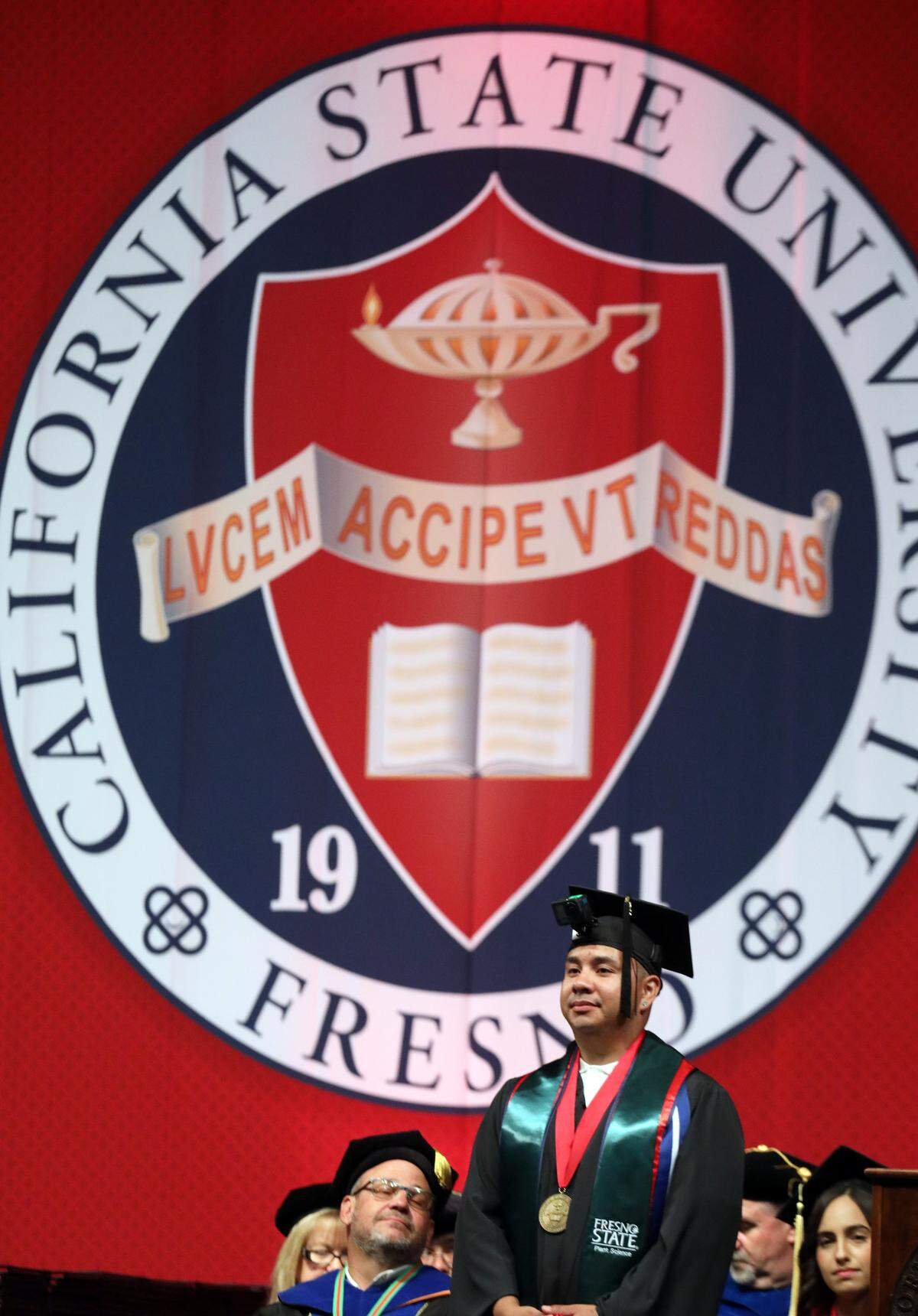
Neither will Mauricio Soriano, who earned his master’s of science in plant science.
Jauregui-Salgado, 21, works for the California Agave Council and would love to grow, distill and market her own agave.
Soriano, 33, a U.S. Army veteran, has developed a passion for plants and will conduct scientific research that supports the environment, agriculture and community.

Neither has worked in the fields, but they are aware of the role Latino farmworkers play in the state’s $59.4 billion agricultural industry.
“It’s a welcoming industry (for Latinos),” said Jauregui-Salgado of agriculture. “The reason you didn’t see a lot of Latinos was because there’s a big stigma about how we’re just a bunch of laborers and you can’t make a career out of it.”
Newer generations, she said, “are realizing that there is a possibility of getting a career in it and making the industry better.”
Having Latinos in agriculture outside the fields, said Jauregui-Salgado, could even improve field worker experiences.
Fields that weren’t available to their elders
Their career path is what frozen Mexican food pioneer Fred Ruiz envisioned when he donated $15 million in 2022 to UC Merced to help create a new wave of entrepreneurs.
“I’m seeing young Latino students coming in and they want to go to UC Merced, not to work driving a tractor or picking fruit, but to run a ranch,” Ruiz, a former UC trustee, told me. His El Monterrey brand of frozen burritos and other Mexican food has annual sales north of $1 billion.
“A very sophisticated type of farming requires a higher understanding of the opportunities for saving water, for growing things, and the economics of it that were not really important in the days of their parents and grandparents.”
Ruiz’s definition of a future in agriculture for Latinos beyond the vineyards and orchards is happening in the Central Valley.
In 2022, Vida en el Valle staff writer María G. Ortiz-Briones wrote about a wave of children and grandchildren of farm workers who were looking to return to the fields in capacities other than picking crops.
“And going on and getting a master’s degree or even coming back and being a professor and teaching agriculture and showing the younger generation like, ‘Hey, this is where I came from. I was maybe a first-generation student, and now here I am with my Ph. D.,” Fresno State student Michelle Pérez told Ortiz-Briones.
Latinos accounted for 55.3% of the enrollment at the Jordan College of Agricultural Sciences and Technology in the fall of 2024.
Jauregui-Salgado, Soriano thrive
Jauregui-Salgado, who graduated in three years as a 2022 valedictorian at Edison High, and Soriano, who graduated from Santa Maria High in 2009, are not average college students. Jauregui-Salgado earned her Fresno State degree in three years, including a minor in precision agriculture technology, with a 4.0 GPA.
The former was honored with the dean’s medalist as the top undergraduate in the class of 2025. Soriano was given the dean’s medalist as the best at the graduate level.
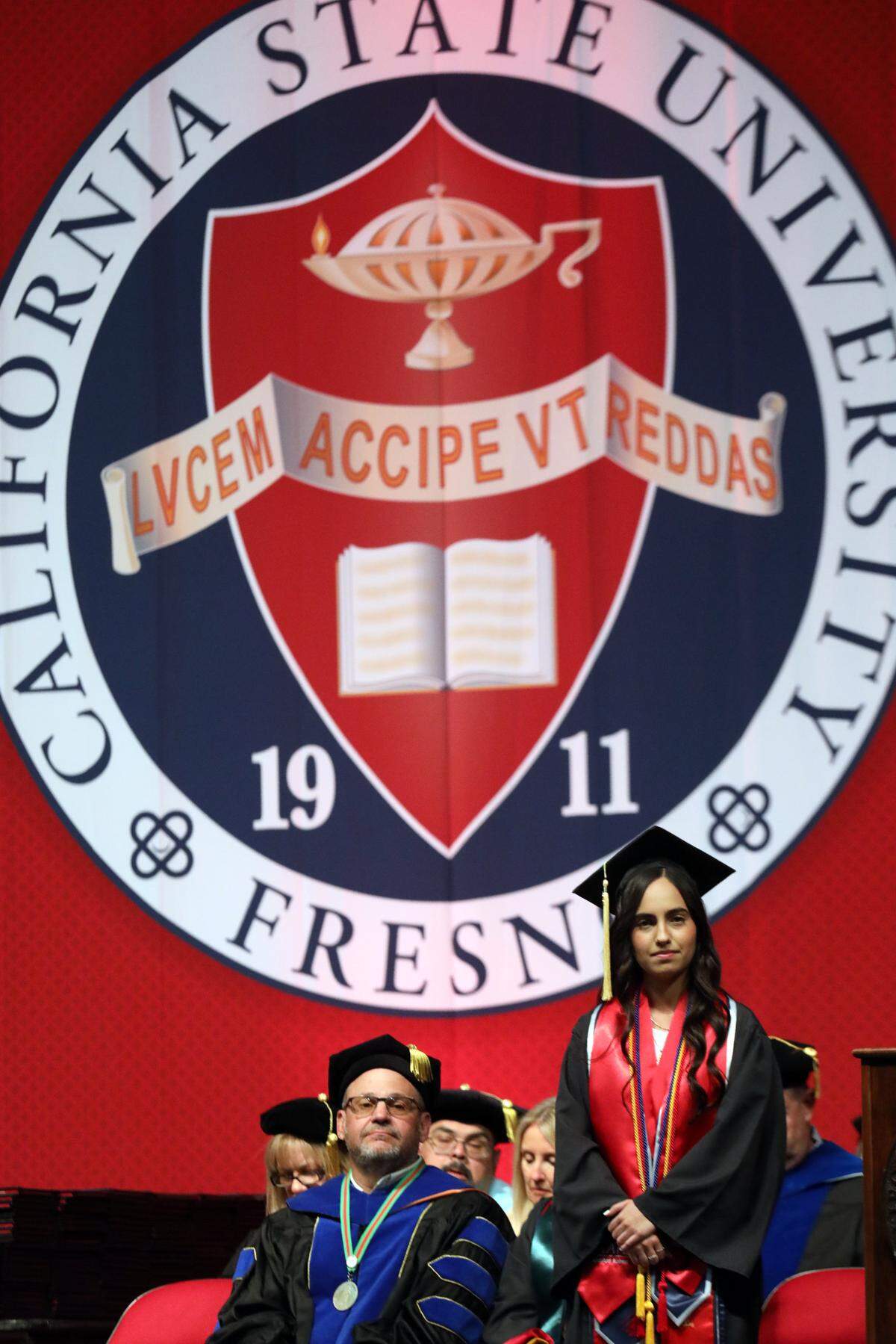
Jauregui-Salgado has never picked crops, but she lived in a Kerman ranch surrounded by raisin vineyards and remembers going back to San Felipe, Jalisco, México where her late father’s family grew corn. Agave was grown in nearby ranches.
“I want to plan agave someday and then hopefully grow my own spirit,” she said. The product would be named Jauregui after her father, José Luis, a truck driver who died in 2019. Jauregui-Salgado remembers her father was a fan of tequila, which is derived from agave plants.
She spent a few weeks in Spain learning about the wine market and consumer sensory analysis. “I don’t love wine, but it’s a fascinating industry.”
Soriano, who graduated with a 3.8 GPA, enlisted in the Army straight out of high school. He earned a bachelor’s degree in biological sciences at the University of Colorado, then moved to Fresno to study plant science. His research has focused on the use of satellite imagery to estimate forage yields in high-salinity soils irrigated with reused drainage water.
“I want to investigate other areas of research, like soil health, crop nutrition, nutrient management,” said Soriano, who is married with two daughters.
Soriano, whose parents came to the U.S. to escape a civil war in El Salvador, grew up surrounded by strawberry fields and became friends with the children of those who picked the fruit.
“As a kid, everyone told me it was hard work,” said Soriano. “I was naive at the time and wondered why people chose to work there? It wasn’t until I was overseas in Afghanistan that I found my appreciation for that work.”
Jauregui-Salgado and Soriano are becoming the new face of Latinos in agriculture.
This story was originally published May 20, 2025 at 2:26 PM.