Can Valley farmers use water wisely & re-purpose land when needed? That’s the question | Opinion
After the exceptionally wet and snowy winter that California enjoyed, it is tempting to forget that droughts that have challenged San Joaquin Valley farmers for decades.
But as any grower knows, droughts are a fact of life in California’s semi-arid climate, which is now being made more so by climate change.
Climate scientists say the boom-bust cycle of precipitation will continue. So it was logical that a conference held this past week at Fresno State, “Managing water and farmland transitions in the San Joaquin Valley,” drew a large crowd of growers and water district managers.
The event was sponsored by the Public Policy Institute of California, a nonpartisan group that provides analysis on key issues facing the state.
There could be no more important topic for the San Joaquin Valley than water availability and use. The region has three of the nation’s top farming counties in Kern, Tulare and Fresno, which together earn billions in gross revenues in agricultural sales each year. The region’s economy is directly linked to the success of its growers.
Will Valley farmers be able to properly manage ever-tighter water supplies and learn how to transition less-productive land to other uses when necessary? That was the main question of the conference.
Floods add to water storage
The past winter featured a statewide snowpack over 200% of normal; in the southern Sierra, the snowpack was nearly 300% of normal. Once the snow started melting and runoff filled rivers, Tulare Lake re-formed in parts of Kings and Tulare counties, flooding farming operations in the process.
Don Cameron, general manager of Terranova Ranch — which grows fruits, vegetables, nuts and seeds near Helm on Fresno County’s west side — told the conference that Terranova took floodwater flows on some of its property for recharging the underground aquifer. But it came with a cost.
“We had a lot of water on 300 acres of pistachios,” he said. “It was four feet deep, and killed 50 to 100 trees.”
Cameron said an executive order signed by Gov. Newsom allowed farmers and water districts to take the flood runoff without going through the cumbersome permitting process. “The executive order was a game changer,” Cameron said.
Westlands Water District, located on the west side and the nation’s largest public water district, also took flood runoff for recharging. On Thursday the agency announced that it has recharged 127,000 acre-feet into its aquifers since March (an acre-foot covers an acre with water one foot deep). Westlands hopes to reach a total goal of 200,000 acre-feet by the end of next February.
“The district is committed to utilizing and making the most of the abundance of water we received this past winter to plan for future dry years,” said Westlands board president Jeff Fortune. “The district’s recharge projects will provide a lifeline to hundreds of family-owned farms during periods of prolonged drought.”
Adding solar
Droughts lasting years can still be punishing, which is why there are serious discussions now in Valley farming circles about “re-purposing” some farmland to other uses.
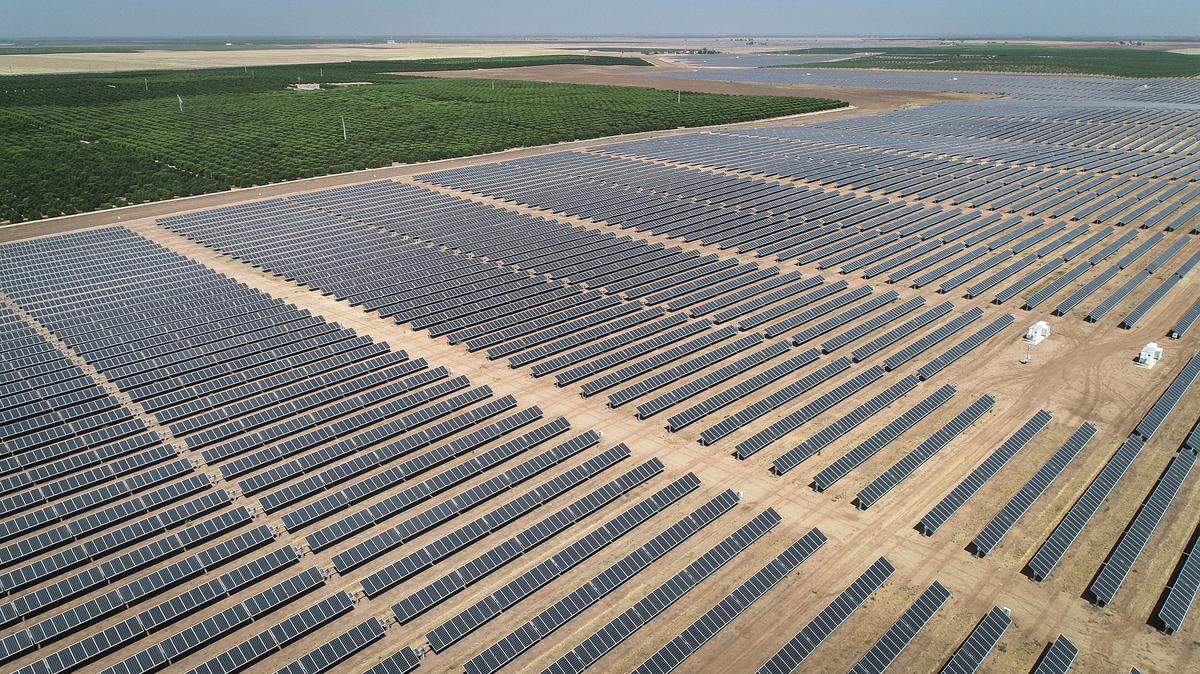
In Westlands, that has meant covering some less productive land with solar panels. Allison Febbo, Westlands’ general manager, told the conference that there is the potential for solar panels to be installed on 100,000 acres in the district, which spans the west side of Fresno and Kings counties.
The district will also consider utility-scale solar projects using 75,000 acres owned by Westlands. Growers might add some of their own land to push the total to 125,000 acres.
The idea is to stop delivering water to less-productive soil, but still find a way to have a good use that can also generate revenues.
Other ideas for converting farmland include creating wildlife habitat. Government grants would help in that process.
Two challenges to these ideas: Large-scale solar projects need utility transmission lines to achieve clean energy goals, and there are not enough of those currently in the Valley. Second, panelist Ann Hayden of the Environmental Defense Fund said significant land re-purposing will require billions in government funding.
Water needs multiple uses
Cameron said the long-held belief of growers was “if they owned the land, they owned the water” underneath it.
But the state’s 2014 landmark law to better regulate underground pumping, the Sustainable Groundwater Management Act, has made that concept obsolete. Farmers now have to worry about pumping too much and pushing their aquifer out of balance.
Nor is it correct to simply think of using water just to irrigate crops, said Sarah Woolf, who helps operate a family farm on Fresno County’s west side and is a water consultant.
“Today every drop of water we have in California has to be used for multiple purposes,” she said.
The PPIC’s report on the Valley’s water situation makes clear the stakes: Even if growers do everything right, a half million acres could go out of production because of water-supply shortages. That would be a hit to the economy, including job losses of agricultural workers, and pose environmental problems, such as blowing dust from empty fields.
Using water wisely while re-purposing land properly will be the key issue facing San Joaquin Valley farmers for years to come.