
RFK reflected our best aspirations. Today, baby boomers are reminded the cost of his death
In the opening paragraph of his magnum opus “Robert F. Kennedy and His Times,” Pulitzer Prize-winning historian Arthur M. Schlesinger, Jr. observed that 1960 was “a hell of a long time ago.” He wrote that in 1980.
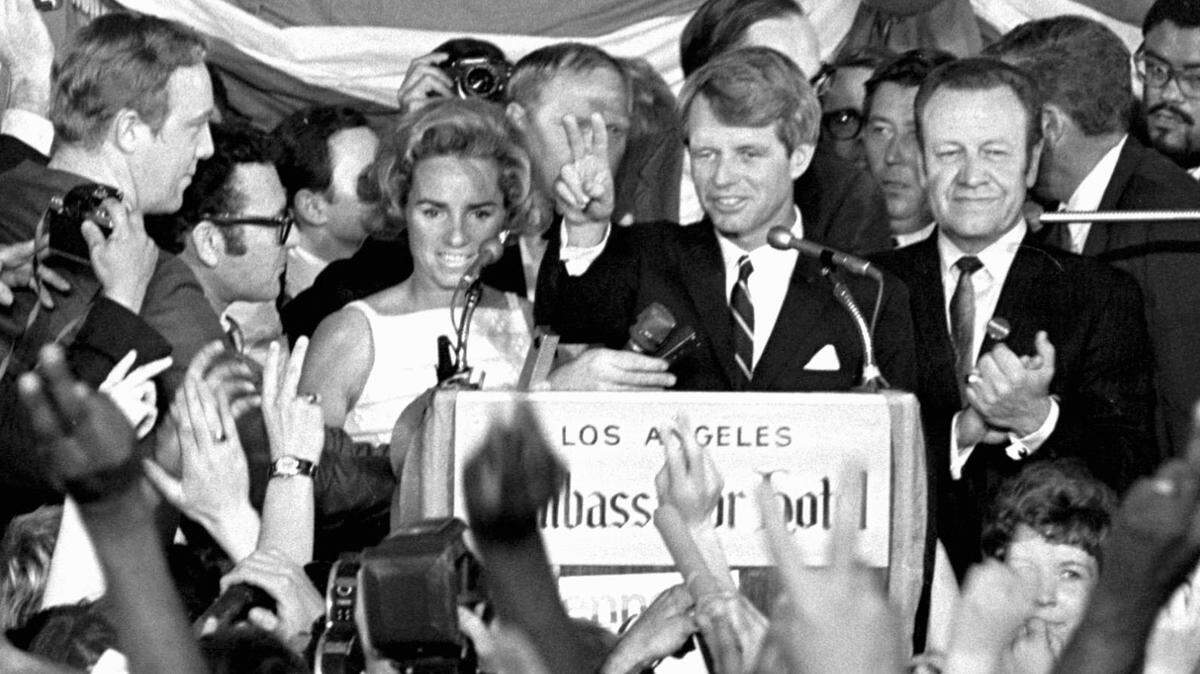
This Sunday, our country will be 53 years removed from June 6, 1968, the day Robert F. Kennedy died — shot and killed on the wet cement floor of a pantry in the now-demolished Ambassador Hotel in Los Angeles.
Although a hell of a long time has indeed passed, RFK’s memory has not faded for countless Californians who had some brush with Sen. Kennedy as he campaigned here prior to the California presidential primary of 1968.
They remember — we remember — RFK with increased poignancy at each anniversary of his assassination at the hands of Sirhan Sirhan, a native of Jerusalem who was convicted of killing RFK and has been denied parole repeatedly over the years.
The anniversary of RFK’s death reminds us of what we lost as a nation and never fully recovered. RFK still resonates today because he was unimaginably too young to die at 42, and yet he reflected our best aspirations while rejecting our worst impulses. His rhetoric was never cheap or false; it was lofty yet accessible.
The hope of RFK for our nation was murdered along with him after he had won over California primary voters 53 years ago. RFK is mournfully recalled by those of us who were there, who shed tears then and many more times in the ensuing years.
In 2018, I hosted a Bee event at the downtown Sacramento Public Library commemorating June 6. What I thought was going to be a somewhat academic discussion turned into a profoundly moving séance.
Several women who worked in RFK’s Sacramento campaign office showed up and shared their memories. Once young women in their 20s working for RFK, they were now in their 70s. They were warm and evocative as we sat with them at dinner afterwards.
I was 7 in June 1968. After the assassination, my parents took me to RFK’s burial at Arlington National Cemetery. We lived in Alexandria.
I vividly remember thousands of people streaming over hills to get to the grave site at dusk, carrying coolers and lawn chairs.
We were a stone’s throw away from the RFK grave site, adjacent to President John F. Kennedy’s grave. To my right, a television light nearby practically blinded me. It hyper-illuminated everything in stark relief.
The light stands out 53 years later in my memory, still uncomfortable.
Then Sen. Kennedy’s hearse pulled slowly next to us.
I saw Ethel Kennedy and Jackie Kennedy in the front seats, and the television light and flashbulbs lit up the bright red, white and blue of the flag on RFK’s coffin with a strobe-like effect.
Many Californians with whom I am personally acquainted had similar experiences with the California primary and the RFK assassination.
One is Craig McNamara, the son of Kennedy Johnson-era Defense Secretary Robert S. McNamara.
Craig is now a farmer and international expert on agricultural reform who lives outside of Sacramento. He was 17 in 1968. He asked his prep school headmaster for time off to go to the funeral. The headmaster declined, so Craig quit the school on the spot and hitchhiked down to Arlington. We determined in conversation that we were mere yards apart from each other that night.
Sacramento columnist Ed Goldman was in Los Angeles that final week and saw RFK speak. He wrote, “I was about to turn 18 and even though I’d been to rock concerts I’d never encountered a fan frenzy of this magnitude. I remember wondering afterward how they ever kept him safe.”
As a 9-year-old, my friend Michael Sicilia watched the RFK funeral train pass in Philadelphia. His wife, Lucinda Hitchcock Cone, saw RFK in San Francisco, introduced by a nervous Raquel Welch, who accidentally called him JFK. Sherry Bebich Jeffe rode an elevator with RFK and Assembly Democratic leader Jesse Unruh, who admonished her not to joke around with the senator, saying, “He’s not that kind of cat.”
My neighbor Bob Roe, a retired school principal, was a 12-year-old in Modesto in 1968. He saw the RFK campaign train there, “and stood so close to the tracks that a lady yanked me back just in time to prevent my being hit by the train. He spoke to the crowd for 15 minutes and then was gone.”
The train was headed to Los Angeles, RFK’s final campaign stop. Ever since, the phrase “California Primary,” has had a haunting resonance.
As long as anyone in California who lived through June 6, 1968 survives, that phrase is burned into our state’s collective memory.
It’s like an unpleasant, glaring light we can’t unsee.
This story was originally published June 4, 2021 at 3:15 PM with the headline "RFK reflected our best aspirations. Today, baby boomers are reminded the cost of his death."