
CA legislators want measures to expand accountability for ICE and other federal agents
AI-generated summary reviewed by our newsroom.
- California senators advance the No Kings Act to allow state suits against federal agents.
- Measure allows monetary damages, attorney fees and expert costs in state court.
- Senate advanced the bill 30-10 amid Fresno and Central Valley enforcement tensions.
California Democratic legislators are advancing anti-ICE legislation, as criticism mounts over the Trump administration’s immigration enforcement tactics.
One of these bills is the highly debated proposal to permanently bar certain former federal immigration officials from serving as police officers or public school educators in the state.
This proposal is one of several immigration-related bills lawmakers are advancing this year, including measures to tax for-profit detention companies and curb courthouse arrests.
The measure, Assembly Bill 1627, formally titled the Misconduct Ends Law-Enforcement Trust Act—or the “MELT ICE Act”—would prohibit anyone who worked for U.S. Immigration and Customs Enforcement between September 1, 2025, and January 20, 2029, from holding positions in California law enforcement agencies or public schools.
Assemblymember Anamarie Avila-Farias, who authored the bill, argues that individuals involved in ICE operations during that period should not be entrusted with roles that require safeguarding civil liberties. “California’s peace officers and teachers must be defenders of constitutional rights, not actors in their dismantling,” she said, adding that such service reflects values “California cannot afford to institutionalize.”
If enacted, the legislation would direct the California Department of Justice and the Department of Education to modify background-check procedures to explicitly identify prior ICE employment. The prohibition would apply automatically, without regard to an applicant’s personal behavior, performance history, or criminal record. AB 1627 would also extend similar restrictions to former employees of the Alabama and Georgia Departments of Corrections who served between 2020 and 2026.
Legal analysts have raised concerns about whether a state can impose a lifetime employment ban on a defined group of former federal workers without running afoul of constitutional due-process protections or federal labor law. There’s also questions about how the bill would treat individuals who held non-enforcement roles within ICE, such as administrative or technical positions.
Another bill known as the “No Kings Act” has also recently advanced in the California legislature. That bill would make it easier for people to sue federal agents that violate human rights.
The legislation from Sens. Scott Wiener and Aisha Wahab, both Bay Area Democrats, took on added weight after federal agents fatally shot Alex Pretti, a U.S. citizen and ICU nurse, in Minnesota on Jan. 24.
Under the measure, California would create a state-law cause of action allowing people to sue federal officers — including ICE, Border Patrol, and others — for violations of constitutional rights, a gap its authors say exists because recent U.S. Supreme Court decisions have sharply limited federal remedies.
The push for the bill comes amid heightened tensions over immigration enforcement in Fresno and the Central Valley, where increased federal actions have unsettled immigrant communities. Recent operations by U.S. Immigration and Customs Enforcement and related federal agents in Fresno and surrounding counties have included detentions at routine check-in appointments and traffic stops, drawing alarm from immigrant rights groups who say even people complying with legal processes are being taken into custody.
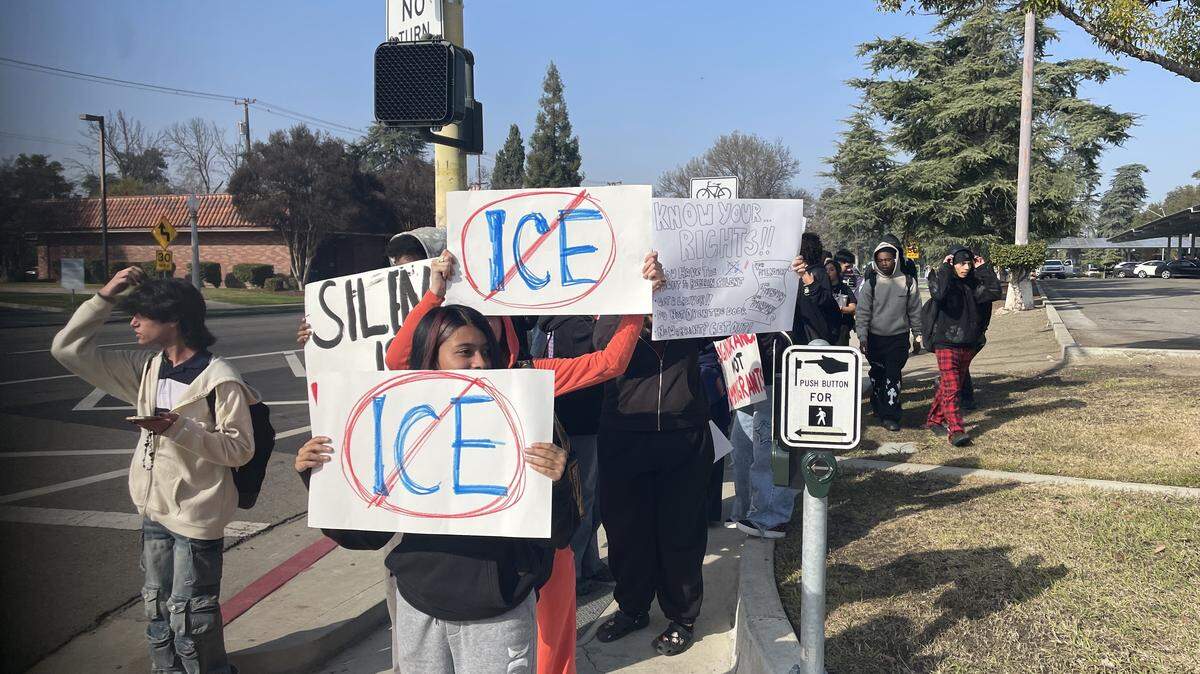
These enforcement activities have sparked community protests outside the ICE office in downtown Fresno, River Park Shopping Center and other parts of the Central Valley.
“This bill stands for the basic proposition that no one, no one is above the law,” Wiener said. “That the rule of law still exists in this country even under this brutal, fascist authoritarian regime.”
Wiener argued the legislation is needed in part because ICE has helped create what he described as a “terrorist state,” and that current legal barriers often make it nearly impossible for victims to hold federal agents accountable for abuses.
The measure would add a new provision to California’s civil rights code, allowing individuals to seek monetary damages in state court when an officer acting “under color of law” deprives them of rights secured by the U.S. Constitution, including protections under the First, Fourth, or Fifth Amendments. It also specifies how suits may be filed, allows courts to award attorney fees and expert costs, and applies retroactively to March 1, 2025.
Senators debated the bill for more than 90 minutes before voting along party lines, 30-10, to send it to the Assembly. Wiener expressed disappointment that opposition broke down by party.
“It’s a sad statement on where we are in this country that this has to be a partisan issue,” Wiener said before the vote. “Red, blue — everyone has constitutional rights. And everyone should have the ability to hold people accountable when they violate those rights.”
These efforts follow a slate of laws Gov. Gavin Newsom signed last year to counter the Trump administration’s deportation campaign — from limiting mask use in enforcement operations to restricting access to schools and hospitals.