
Were Fresno politicians’ PG&E attacks for attention? Some think city utility is a bad idea
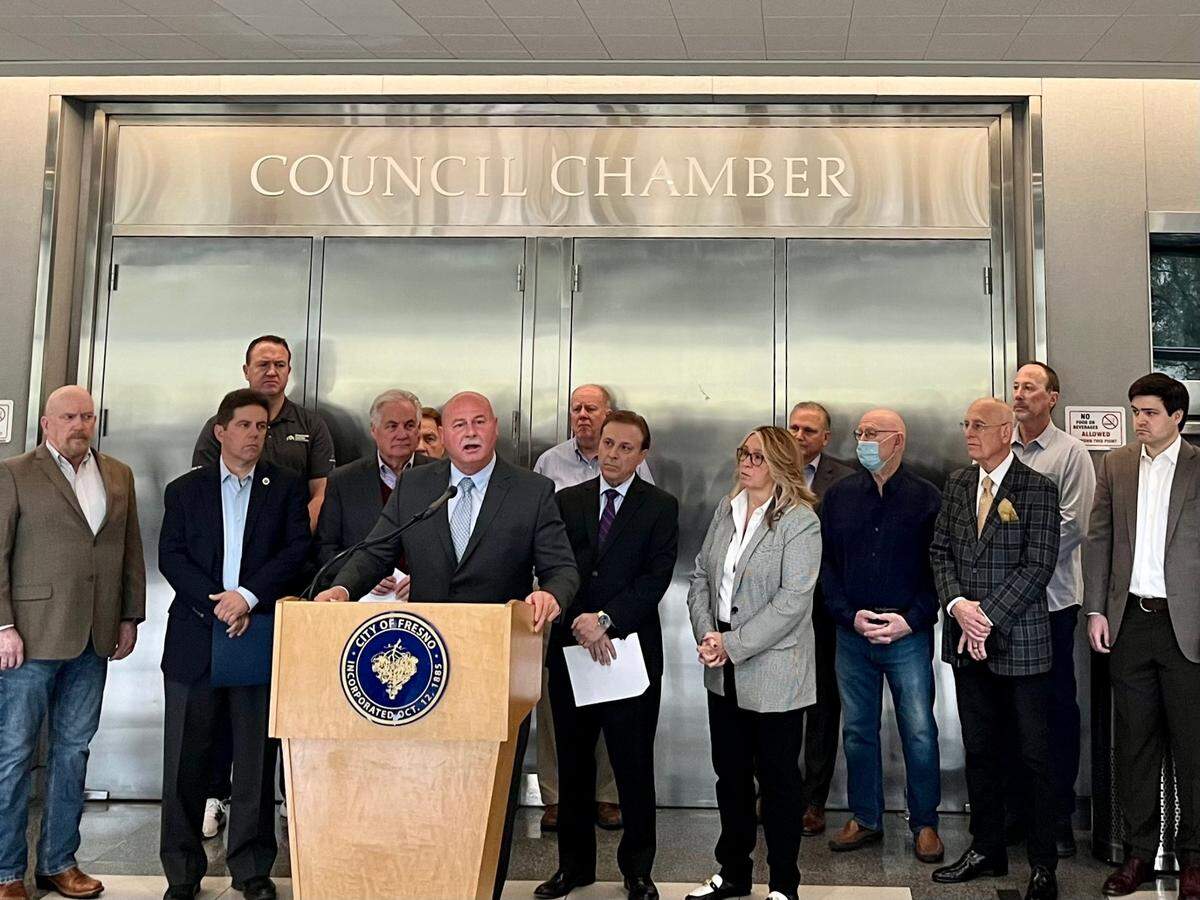
Fresno Mayor Jerry Dyer on Monday rallied local politicians and leaders against Pacific Gas & Electric rate hikes, saying he’d like to know the feasibility of other, cheaper power options for Fresnans.
His rallying cry left some people scratching their heads.
“This was a bit out of left field, and I think the coalition that were all standing together the other day, they don’t all appear to be wanting the same thing,” said Dillon Savory, executive director of Central Labor Council, which also represents the PG&E workers’ union. “They all seem to be mad at PG&E for different reasons. It’s an interesting group of people looking at this.”
The group of leaders standing beside Dyer included mostly Republican politicians: Fresno City Councilmember Garry Bredefeld; Assemblyman Jim Patterson, R-Fresno, and Fresno County Supervisors Steve Brandau and Buddy Mendes.
A handful of Democrats joined the group.
During the news conference, Dyer complained that PG&E rates were too high for the city’s residents. Bredefeld called the company a criminal enterprise that fails to be accountable for its crimes. Patterson and others mentioned how PG&E is hurting the agriculture industry. The CEO of the Building Industry Association of Fresno told reporters stories of buyers unable to move into their newly built homes.
“I really think that the whole display that was put on by the mayor and those councilmembers and county officials, was to get PG&E’s attention,” Savory said. “Could we not have done that more collectively with labor involved? Or with other people suggesting how are we going to get PG&E to service us in the way we feel like they’re servicing other areas?”
Community Choice Energy
Everyone standing in the group on Monday voiced support for the city of Fresno to conduct a feasibility study to determine whether it makes sense for the city to become a power provider. However, it remains unclear how much such a study would cost and how long it would take.
Furthermore, the city already spent $150,000 just three years ago to explore becoming a community choice agency, a system in which municipalities buy electricity on behalf of local residents and set their own rates while traditional utilities continue to own and operate the electrical grid.
That option was spearheaded in 2019 by Councilmember Luis Chavez. The study done on the community choice model at that time didn’t return numbers that would translate to meaningful savings for Fresno residents.
“Fast forward to now, based on the analysis that I saw back then in 2019, the rates that they have now secured are crazy— much higher than they were back then,” Chavez said.
If the city pursues another study and ultimately community choice, Chavez wants to see the savings invested back into the low-income neighborhoods being hit the hardest by high energy costs.
Dyer isn’t opposed to community choice energy. His hope is that the feasibility study will shed light on the best option for Fresno, and, he said, that may be community choice energy.
Fresno, Tulare and Kings counties were close to creating a community choice option in the early 2000s. The San Joaquin Valley Power Authority was trying to become the first public agency in California to supply energy under a new state law allowing community choice aggregation. It ultimately fell through in 2007 after strong opposition from PG&E and the beginning of the Great Recession.
“I don’t remember that,” Dyer told The Bee on Tuesday. “But it is not uncommon for monopolies to try to prevent competition so that they can continue to be the only game in town.
“Having said that, I want to work with PG&E to find a better delivery system of energy to the residents of Fresno that is affordable, sustainable and allows for the timely electrification of projects in our city,” Dyer said.
In the same line of thought, Chavez said if Fresno pursues the community choice model it will need the smaller cities to get on board, such as Clovis, Sanger, Reedley and Selma.
Fresno as a power supplier
Councilmember Miguel Arias stood on the sidelines Monday watching the mostly Republican politicians complain about the Valley’s corporate power supplier and its monopoly.
“It took the city of Fresno one year to fix broken electric vehicle (charging) stations. Fresno County had kids in child protective custody sleeping on desks for years,” Arias tweeted. “Now they want to be in charge of our electricity infrastructure so they can prioritize private market rate projects above affordable housing.”
Arias is firmly against the city becoming a utility district that provides electricity, and he expressed doubts that electrification would occur equitably.
“It is very unsettling to see the anti-government coalition now wanting to run every aspect of society, including the power grid. It is disingenuous in their intent and their purpose, and they lack any bit of competency to actually execute it,” Arias said.
“The method in which they’ve done it, for the purpose of political theater and high-stakes negotiations on what project gets electrified first, will absolutely hurt the most vulnerable, the poorest and people of color the worst,” Arias said. “That’s why you didn’t see them reflected in the press conference. ... They are intentionally being left out of the room, the conversations and ultimately they’ll be left out of the prioritization when their projects are being debated on what gets electrified first.”
Council President Nelson Esparza also isn’t in favor of the city becoming a utility district, but he said the conversation on the dais during Thursday’s City Council meeting will be interesting.
“If it goes in the direction of initiating our own full-scale city utility, that’s something where the economics of the proposal just aren’t going to add up,” Esparza said. “Especially once you consider the level of deferred maintenance we already have on existing city infrastructure.”
That deferred maintenance is one reason both Arias and Savory, the labor council director, said they don’t have faith in the city’s or county’s competency to provide good power service anyway.
Savory pointed to lack of funding for police and firefighters and the city’s move to using both public and privatized trash service. Arias pointed again to the electric vehicle charging stations.
“The city is absolutely dead last in the development of alternative energy, which is a feature of energy,” Arias said, “We’re now going to be at the forefront of electrifying and being responsible for building, operating, buying and selling energy in the open market? It’s a recipe for absolute disaster.”