Fresno County supervisors pick new district map, but opponents say it’s still status quo
Four of the five Fresno County supervisors voted Tuesday on a new district map — an alternate that had no vocal support.
The map came from a six alternates drawn up by county staffers after the Board of Supervisors began to settle on a map that drew controversy, because it was drawn by Republican lawyer and strategist Alex Tavlian.
Detractors argued the supervisors were too close to Tavlian, who has worked for the three Republican supervisors. Most of the vocal detractors wanted a separate map that was dismissed by the supervisors.
Ultimately, the supervisors chose a third map — this time called County Map D — which will go to the board on Dec. 14 for a final vote. Only Supervisor Sal Quintero voted “no.”
Supervisor Brian Pacheco said he could not support Tavlian’s map after the outcry he heard from residents. “There is no perfect map. Every map has its issues,” he said.
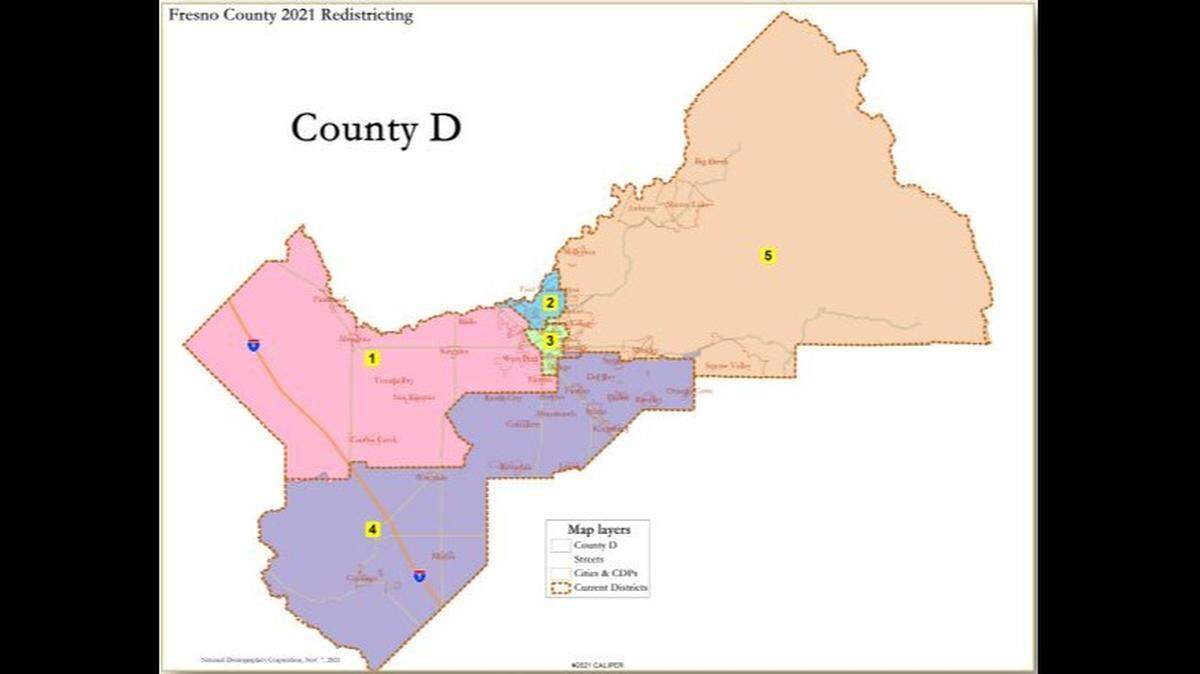
Other supervisors said they liked the map they chose because it keeps intact historic communities.
Supervisor Buddy Mendes bristled at some resident accusations that he was absent from representing small rural communities. “I live in an unincorporated community. A poor one,” he said. “I don’t live out in the country on one of my ranches.”
Many people at the meeting Tuesday continued to advocate for a map drawn by the Equitable Map Coalition, which is made up of the Central California Coalition for Equitable Realignment, Dolores Huerta Foundation and a slew of other community-based groups.
The opponents said the map the supervisors chose was too close to the one the county has been using, and Tavlian’s map.
The dismissed map would give greater representation to rural farmworkers, according to its supporters.
Supervisor Nathan Magsig dismissed that argument, saying farmworkers live across the county. He said he feared the dismissed map made it possible for all of the members of the board to be from an urban area, because the districts all touch Fresno or Clovis.
“I believe that really could limit the benefits that this board could give potentially to some of those disadvantaged communities,” Magsig said.
The overwhelmingly conservative board has been accused of trying to hold onto power, as registered Democrats are now counted almost eight points higher than Republicans, 39.7% to 32%, according to the Secretary of State’s Office. That’s a change from an even split a decade ago.
Fresno County has changed much since 1990 though the district maps have not, according to Angélica Salceda, a staff attorney with the ACLU of Northern California.
The Latino community has grown from about 35% in 1990 to about 54%, according to the last U.S. Census.
“As the Census data confirms, nearly all of the county’s growth over the past decade is attributable to the growth of communities of color,” she said.
An independent commission
Residents voiced concerns that the process to adopt maps in Fresno County was too partisan, leading some to advocate for an independent commission.
Four of California’s 58 counties use independent redistricting commissions: Los Angeles County, San Diego County, Santa Barbara County and San Francisco County — some of the state’s largest counties — according to Common Cause, a nonprofit which advocates for governing changes like independent commissions.
The statewide commission is also independent, according to Luis Huerta Silva, an organizer for Common Cause.
“Maps drawn by an independent commission create a near elimination of bias,” he said.
League of Women Voters of Fresno County President Marianne Kast said the supervisor-chosen advisory commission makes Fresno County’s process questionable.
She also questioned the county’s method of recording public comments and comparing maps before bringing them to the Board of Supervisors.
“(The board’s) actions at every juncture have demonstrated why an independent redistricting committee must be created for Fresno County,” she said.
This story was originally published November 16, 2021 at 6:18 PM.