
This California Republican sponsored the DREAM Act. Democrats say he’s against immigrants
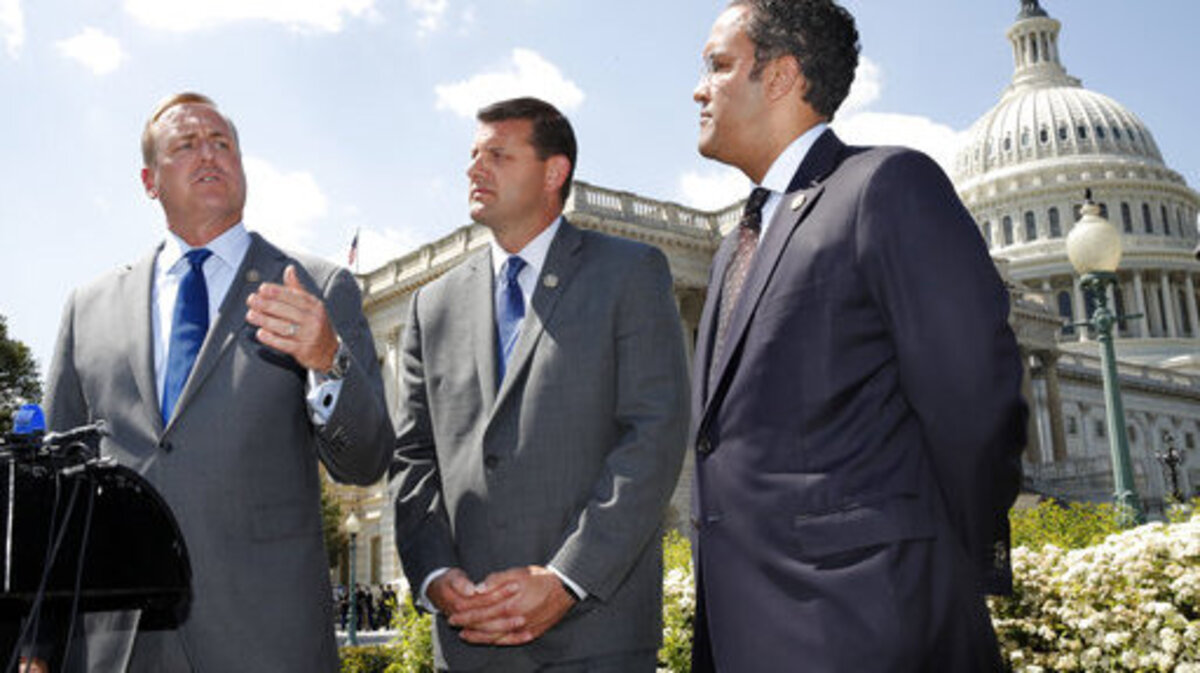
Few Republicans have wanted to wade in to the political minefield of immigration reform.
Those who have done so say Democrats have counter-intuitively made it harder to persuade other Republicans to join them by painting GOP candidates who were open to compromise as hard-liners.
Former Rep. David Valadao, a Republican from Hanford who is trying to return to Congress in November, is one of them.
He was part of a faction of Republicans pushing for immigration reform in 2018, originally against the wishes of GOP leadership. He was also one of a few Republicans in 2017 who cosponsored the Democratic DREAM Act, which would have granted a path to citizenship for immigrants who were brought into the country illegally as children, known as Dreamers.
This year, Valadao’s Democratic opponent in a Latino-majority California congressional district is running ads attacking Valadao’s immigration record.
Rep. TJ Cox, D-Fresno, who unseated Valadao in 2018 by a narrow margin, has charged that Valadao voted against the DREAM Act and permitted President Donald Trump to separate families at the border, claims that are both misleading.
Cox defends the ads, saying Valadao and other Republicans had their chance to get something passed on immigration before Democrats won the House of Representatives in 2018.
He added that Democrats in 2019 passed a bill providing a path to citizenship for about 2.5 million undocumented immigrants, including Dreamers. The Senate did not take up the House bills, leaving them in limbo.
“We got the DREAM Act, which he was trying to get passed,” Cox said. “We passed the farm worker modernization passed, which he was trying to get passed. I get things done for people in the Central Valley.”
The rematch between Cox and Valadao is among the most contentious California House races, with tens of millions of dollars in spending by outside groups.
They’re competing for a district where both parties have incentives to seek a deal on immigration. Agriculture is the major industry in the Southern San Joaquin Valley, where farmers often complain they face labor shortages and where undocumented immigrants live with a threat of deportation.
Cox’s ads slamming Valadao’s record are running on Spanish-language radio stations and a rise in Latino voter turnout in 2018 helped secure the Democrat’s upset victory. The latest Census figures show about 75% percent of the district’s residents identify as Hispanic.
Adding to immigration ire against Republicans, President Donald Trump has also been trying to repeal former President Barack Obama’s program to help Dreamers. The Supreme Court in June rejected Trump’s effort, but the Republican administration has indicated they plan to try to repeal it again.
Cox argued, it was time to vote for Democrats, including Democratic presidential nominee Joe Biden and vice presidential candidate Kamala Harris, if voters wanted to see progress on immigration reform.
“We will see comprehensive immigration reform if we have a Biden-Harris administration, a Democratic Senate and a Democratic House,” Cox said.
Punishing immigration moderates
But some Republicans contend change won’t happen until the parties try to work together.
Former Rep. Jeff Denham, a Republican from Turlock who worked on immigration and was also ousted by a Democrat in 2018, characterized attacks like Cox’s against Valadao as part of an environment that is “sowing distrust.”
“It’s extremely difficult to compromise when you can’t trust those you’re trying to compromise with,” said Denham, who now works as a lobbyist. “And on this issue, a compromise has to address everything from border security and e-verify, to Dreamers and visas. It’s a huge issue that has to go through all these (congressional) committees.”
Valadao said he’s accustomed to attacks on his immigration votes.
When he pushed against House Republican leadership for immigration reform, he said Democrats protested not only at his district offices in California, but also a small group showed up at his house.
He didn’t understand why Republicans pushing for reform were being protested, rather than Republicans who didn’t want to compromise
“I had (Republican) members on the fence, and when I was getting attacked, it didn’t help bring them over,” Valadao said. “I had members come up to me and ask me, ‘Is this how they treat you when you help them out?’ and then they would laugh.”
“They should have been protesting people who were not supporting, but they started with people who were trying to be on their side, or negotiate with their side, and that proved to me it was a political issue,” he added.
Valadao and others, during the push in 2018, first joined with Democrats to try to force a House vote on a path to citizenship for Dreamers. Eventually, they instead teamed with Republican leadership to try to craft a bill that would go through the House. Democrats were not included in those negotiations.
The bill was overwhelmingly voted down on the House floor, rejected by all Democrats over increases to border security and limits to legal immigration and by a significant number of Republicans for various reasons, including what some saw as amnesty for undocumented immigrants.
‘The bare minimum’
Cox’s allies says Republicans have shown they’re not really interested in immigration reform. Republicans have had control of at least one chamber of Congress since 2011, and they held complete control of Congress and the White House throughout 2017 and 2018.
Matt Barreto, co-founder of Latino Decisions, a leading Latino polling and research firm, said most people watching immigration reform have given up on bipartisan efforts. He said Republicans have had “ample time to pass bipartisan immigration reform.”
“We had a bipartisan bill in 2013 that the Republican House completely rejected. We had a bipartisan bill to fix DACA, which the Republican Senate completely rejected,” Barreto said, referring to the Deferred Action for Childhood Arrivals program that protects Dreamers from deportation. “So I think most analysts are now looking at Democratic control as the best chance to actually pass immigration reform.”
Barreto said Valadao’s efforts in were the “bare minimum needed” to cover himself politically on immigration in 2018, the year when Democrats gained 40 House seats.
Both Valadao and Denham insisted Valadao was acting on principle in pushing for reform. And Valadao had similar criticisms for the Democratic party as Barreto did for Republicans, pointing out that Democrats had failed to pass anything on Dreamers when they controlled both branches of government in 2009 and 2010.
“I defend what I did because it was right. I wasn’t focused on politics, I was focused on solving the problem. I proved it,” Valadao said. “I think that’s an important distinction.”
.jpg)