What did Trump sign in Bakersfield? What we know about why he came to the Valley
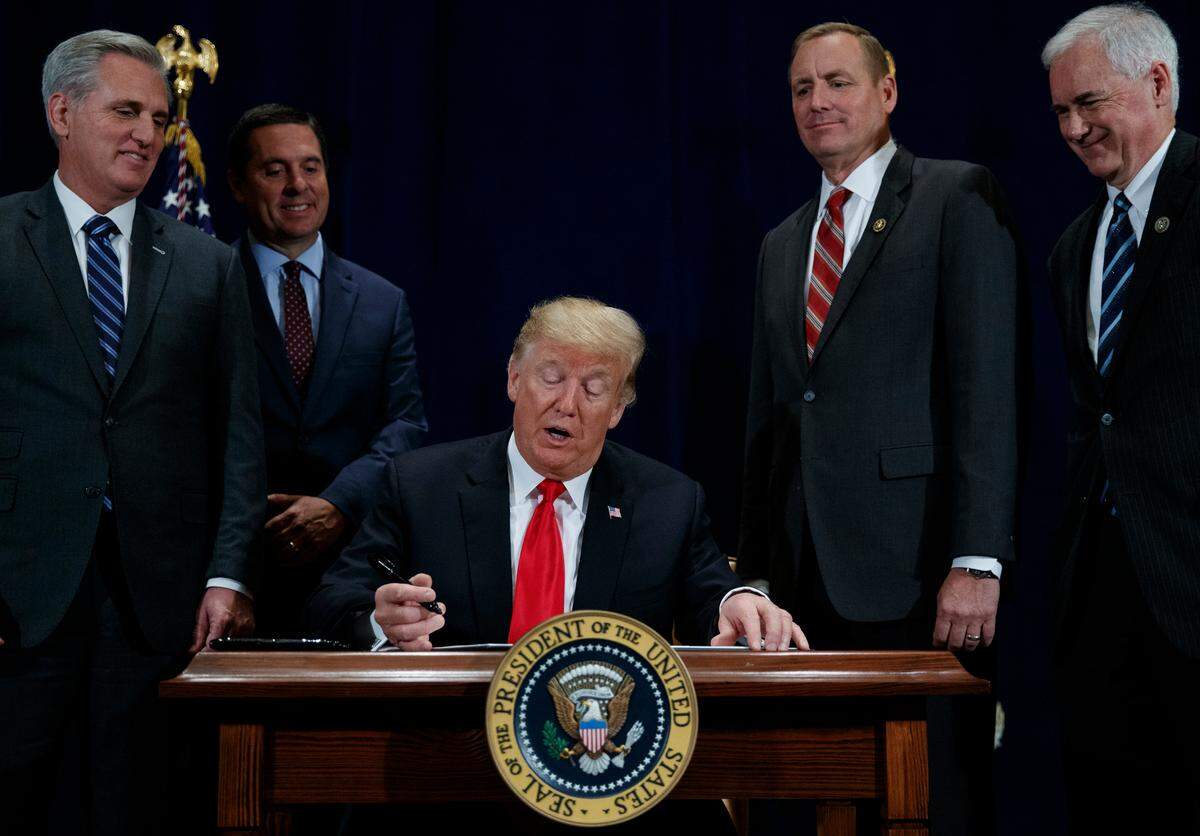
Water and helping farmers was President Donald Trump’s focus during his Bakersfield visit, but the document he signed after an impassioned speech Wednesday afternoon – and the reason he came to the central San Joaquin Valley city – was less clear.
“I’m going to be signing a very important piece of legislation,” Trump told the Bakersfield crowd, “that is going to give you a lot of water, a lot of dam, and a lot of everything.”
What was announced later is the president had shared a new presidential memorandum, different from a piece of legislation – the act of making or enacting laws.
The memorandum was made to go hand-in-hand with the unveiling of a new operations plan by the Department of the Interior and the Bureau of Reclamation. The Interior described that plan in a news release Thursday: It “will maximize water deliveries and optimize power generation for communities and farms in California and implement improved measures to protect endangered species and their habitats in the Central Valley.”
California Gov. Gavin Newsom sees that differently, along with a number of environmental groups. Just before Trump took the stage in Bakersfield, Newsom announced he plans to file a lawsuit to block the president’s initiative “to challenge the federal biological opinions to protect highly imperiled fish species close to extinction.”
“Our goal continues to be to realize enforceable voluntary agreements,” Newsom continued, “that provide the best immediate protection for Delta species, reliable and safe drinking water, and dependable water sources for our farmers for economic prosperity.”
That lawsuit was filed Thursday afternoon by California Attorney General Xavier Becerra, the California Natural Resources Agency, and the California Environmental Protection Agency against the Trump administration.
“Our Administration made clear our concerns about the federal biological opinions,” said Natural Resources Secretary Wade Crowfoot in a statement, “and the need to take legal action if those concerns are not resolved with federal agencies. Today we are taking that legal action.
“At the same time, we remain focused on resolving differences and achieving enforceable voluntary agreements to immediately begin improving conditions for imperiled fish while maintaining reliable water supplies for communities, farms and businesses.”
Water plans from Trump, Department of the Interior
The presidential memorandum Trump shared Wednesday, titled, “Developing and Delivering More Water Supplies in California,” is directed to U.S. secretaries of Interior and Commerce, along with the chair of the Council on Environmental Quality.
Interior Secretary David Bernhardt also spoke on stage in Bakersfield during the president’s speech, directed at Trump supporters who had filled an airport hangar decorated with American flags and farming equipment.
“In the fall of 2018, the president directed the secretaries of Interior and Commerce to address the challenges facing the folks in the Valley and throughout the West relating to water operations. … We have come up with a plan,” Bernhardt said, “changing our operations, to use real-time monitoring, better technology, and provide more efficient utilization of water so it won’t be wasted.”
Trump punctuated that: “You need water. It’s real. It’s really simple. And you have the water. You just need a signature. You’re going to have one today.”
But the power of Trump’s signature on that presidential memorandum isn’t absolute. The document ends with a number of provisions expressing its many legal limitations, including: “This memorandum is not intended to, and does not, create any right or benefit, substantive or procedural, enforceable at law or in equity by any party against the United States, its departments, agencies, or entities, its officers, employees, or agents, or any other person.”
Congressmen respond
House Minority Leader Kevin McCarthy, R-Bakersfield, was thrilled with Trump’s visit to his hometown, as were other Republican politicians who attended Trump’s event.
“The President stressed the critical role our farmers play in the American way of life,” McCarthy wrote in a statement Thursday. “He signed a memorandum that will improve access to water for California’s farmers, allowing California to remain the heart of American agriculture.”
State Sen. Andreas Borgeas, R-Fresno, also put out a statement Thursday.
“The ball is now in Governor Newsom’s court,” Borgeas wrote, “to provide clean, reliable and ample water supplies to Valley farmers and communities. The state must ensure that infrastructure and storage are a top priority. It’s simple: no water, no farms, and no food.”
Several Valley Democratic congressmen shared statements focused on this week’s new biological opinions instead of on Trump signing the memorandum.
Rep. TJ Cox, D-Fresno, and Rep. Josh Harder, D-Turlock, put out a joint statement Thursday afternoon:
“The biological opinions needed to be updated with better, newer science. Without the State of California and the federal government reaching a resolution on their differences, conflicting management of the Central Valley Project and the State Water Project will lead to endless litigation and court battles rather than a set of workable solutions.
Rep. Jim Costa, D-Fresno, put out a statement Wednesday. He started by saying he’s been calling for biological opinions to be updated for years and was “pleased” to see the process come to completion.
“Using adaptive management, science, and observed realities on the ground, rather than arbitrary calendar dates to determine water operations, is the right thing to do,” Costa wrote, “especially in light of California’s changing climate.
“This not only allows for water to be moved more efficiently, which will help our agriculture economy, but also ensures sufficient water for habitat is available when needed for endangered species.”
Costa also shared hope for continued cooperation.
“Water users, the State, and the federal government must remain focused on reaching an agreement on coordinated operations of the State’s water systems,” he continued.
“I’m hopeful this isn’t the end of these negotiations. We have the chance to start a new era of working together on water – one that benefits all sides – and we must not squander the chance.”
This story was originally published February 20, 2020 at 3:19 PM.