
Trump says he rejects Iran Hormuz offer, maintains blockade
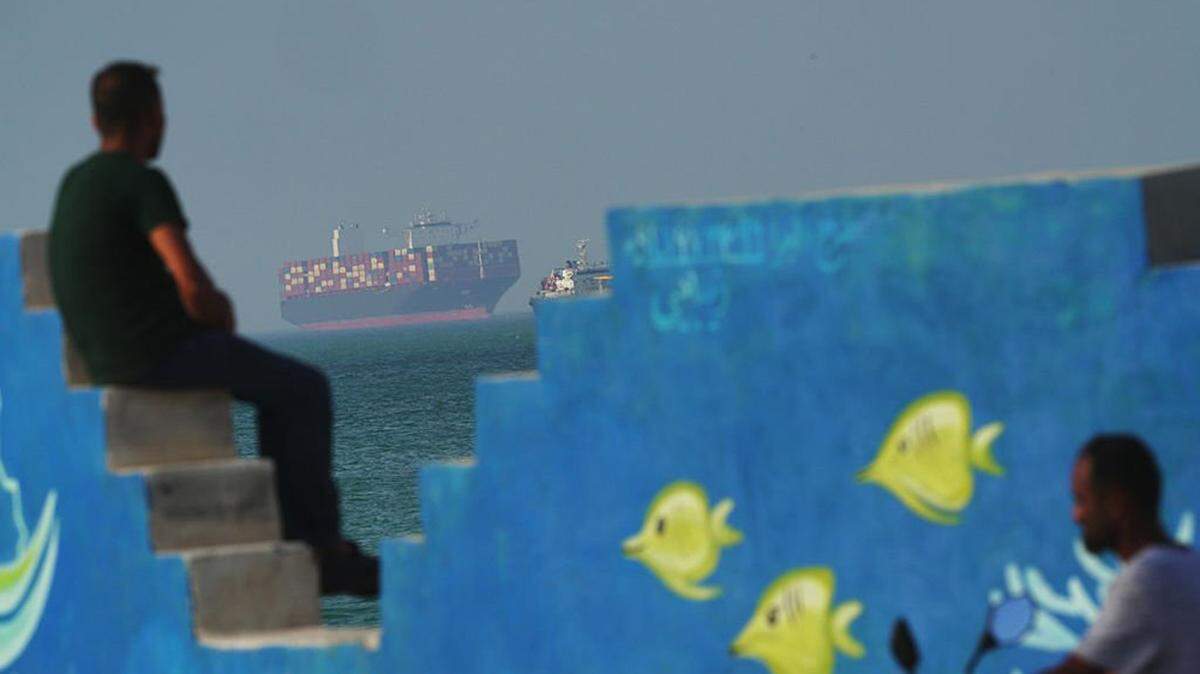
WASHINGTON - President Donald Trump told Axios he will not lift a naval blockade of Iran’s ports until he secures a deal with Tehran to address the country’s nuclear program, extending a standoff over the Strait of Hormuz that has caused a global energy crisis.
“The blockade is somewhat more effective than the bombing. They are choking like a stuffed pig. And it is going to be worse for them. They can’t have a nuclear weapon,” Trump said in a telephone interview Wednesday, according to Axios.
Trump said he had rejected a recent proposal from Iran to reopen the strait but that would have delayed talks on the nuclear issue until later.
The blockade lies at the heart of the impasse between the U.S. and Iran, with the Islamic Republic insisting it won’t restart negotiations or reopen the strait as long as the naval restrictions stay in place. Trump says he won’t halt the operation until Iran agrees to a peace deal to end a war that, while now in a ceasefire, is in its ninth week, causing chaos across the Middle East and energy prices to surge.
While Trump said he’d stick with the blockade, U.S. military commanders have prepared a plan for a short and powerful wave of strikes on Iran to raise pressure on the regime, Axios said, citing people with knowledge of the preparations.
U.S. Central Command has asked to send the Army’s Dark Eagle hypersonic missile to the Middle East for possible use against Iran.
If approved, it would mark the first time the U.S. will have deployed its hypersonic missile, which is running far behind schedule and hasn’t been declared fully operational even as Russia and China have deployed their own versions.
The Request for Forces submission justifies the move by saying Iran has moved its launchers out of range of the Precision Strike Missile, a weapon that can hit targets at more than 300 miles, a person with direct knowledge of the request said.
Dark Eagle, also known as the Long-Range Hypersonic Weapon, or LRHW, has a reported range of more than 1,725 miles, although its exact capabilities are secret. It is designed to glide to its target at more than five times the speed of sound and can maneuver to avoid interception.
The weapon was designed to fight Chinese or Russian advanced air defenses. Each Lockheed Martin Corp. missile costs about $15 million, and there are no more than eight missiles, a person with direct knowledge of the request said.
The Government Accountability Office has said each battery will cost about $2.7 billion.
The U.S. already transferred most of its supplies of the stealthy JASSM-ER cruise missile, also designed for a fight with a near-peer adversary, to the Iran fight. About 1,100 of the missiles have been fired so far in the conflict.
The administration is also looking at enlisting other countries to help restore safe passage through the strait, the Wall Street Journal reported on Wednesday evening, citing a State Department cable.
While U.S. allies have refused to join the military campaign against Iran, the cable enjoins U.S. embassies to persuade allies to join a coalition that would coordinate diplomacy, the enforcement of sanctions and sharing of information, according to the newspaper.
Trump also told Axios that Israel should limit its military actions in Lebanon to “surgical” strikes as the ceasefire there remains fragile.
Brent crude prices climbed with the strait now effectively shut for two months and little sign of it opening soon. The global crude benchmark rose above $119.50 a barrel, a fresh high since the Iran war began. West Texas Intermediate was trading above $107 a barrel.
It’s unclear how much storage and time Iran has left before it would need to close down wells, which may damage them permanently. Analytics firm Kpler estimates it has another 12 to 22 days.
Iranian officials showed no sign of backing down.
Mohsen Rezaee, military adviser to the Supreme Leader, vowed Iran will respond if the U.S. continues its blockade, state television reported. Parliament Speaker Mohammad Bagher Ghalibaf accused Trump of seeking to force Tehran to surrender through economic pressure and internal divisions, the semi-official Tasnim news agency reported.
Trump on Wednesday told reporters that talks are continuing “telephonically” between the two sides after an abortive effort to meet in Pakistan over the weekend.
At the same time, the U.S. is seeking forfeiture of two Iran-linked oil tankers seized by naval forces enforcing a blockade against the Islamic Republic, according to a senior White House official.
Other developments surrounding the Middle East conflict:
▪ Federal Reserve Chair Jerome Powell warned the energy shock brought by the war “hasn’t even peaked yet,” saying at a regular press conference that “the conflict in the Middle East has added to (economic) uncertainty.”
▪ The U.S. has spent an estimated $25 billion on the Iran war, the Pentagon’s budget chief told lawmakers on Wednesday, in the administration’s most complete public estimate of the conflict’s cost so far.
▪ Rafael Mariano Grossi, head of the U.N.’s nuclear watchdog, the International Atomic Energy Agency, said in an interview that Iran’s inventory of enriched uranium is “accessible” should the country wish to retrieve the material. He reiterated that the “consensus of the community” is that the majority of Iran’s uranium stockpile remains buried at Isfahan.
▪ The Iranian rial has weakened significantly in the past two days, according to bonbast.com, a website that tracks the currency’s value on the parallel market, suggesting rising strain on the country’s economy.
▪ Trump said he’d discussed the war in a phone call with Vladimir Putin on Wednesday but rebuffed the Russian president’s offer to help secure Iran’s nuclear material, saying that he told the Russian leader, “I’d much rather have you be involved with ending the war with Ukraine.”
▪ The U.S. Navy’s largest aircraft carrier, the USS Gerald R. Ford, is expected to leave the Middle East soon, media reported on Wednesday.
It is expected to depart for the United States in the coming days, the Washington Post reported, citing several officials. The months-long deployment at sea has taken its toll, the newspaper wrote, and the ship is expected to undergo extensive repairs and maintenance work once back in port.
The move would reduce U.S. military strike capability in the war with Iran.
The U.S. recently bolstered its military presence in the region with the USS George H.W. Bush aircraft carrier. This marked the first time since 2003 that three aircraft carriers were simultaneously deployed in the Middle East, US Central Command (CENTCOM) said last week.
Together, the three vessels comprise more than 200 aircraft and 15,000 sailors and marines, CENTCOM said.
In addition to the two carriers, the USS Abraham Lincoln had also been deployed towards Iran. The USS Gerald R. Ford had previously been operating in the Red Sea, according to the military.
▪ Trump said on Wednesday that his administration was “studying and reviewing the possible reduction of Troops in Germany.”
A “determination” would be made “over the next short period of time,” Trump wrote on his Truth Social platform. The announcement followed Trump’s sharp criticism of Friedrich Merz after the German chancellor publicly criticized the U.S. offensive against Iran.
Merz “doesn’t know what he’s talking about,” Trump wrote of the German leader on Tuesday. It was no wonder “Germany is doing so badly, both economically and in other respects!” Trump added.
He also accused Merz of being comfortable with Iran having nuclear weapons.
Speaking in Berlin on Wednesday, Merz said that his relationship with Trump “remains – at least from my point of view – as good as ever.” “We are still having constructive discussions with one another.”
Trump had already threatened to reduce the number of U.S. troops stationed in Germany during his first term from 2017 to 2021.
According to U.S. military figures from mid-April, around 86,000 U.S. soldiers are currently stationed in Europe, including around 39,000 in Germany. The number changes regularly, partly because of rotations and military exercises.
In March, Merz said Trump had assured him that the U.S. wanted to maintain its troop presence in Germany.
For decades, there have been dozens of major U.S. military bases in Europe that are of enormous importance to U.S. operations around the world, including in the Middle East. Troops, weapons, ships and aircraft are stationed there, drones are controlled from the bases and wounded personnel are treated.
In Germany, these include the U.S. European Command (EUCOM) in Stuttgart and Ramstein Air Base in the western state of Rhineland-Palatinate, which serves as a hub for the U.S. Air Force. The U.S. also maintains important bases in Italy and the United Kingdom.
Congress passed a security mechanism at the end of 2025 under which the total number of forces permanently stationed in the European Command area of responsibility may not fall below 76,000 for more than 45 days. After that, certain reporting requirements would have to be met to pursue a reduction.
▪ Israel and the Iran-backed Hezbollah militia each attacked the other on Wednesday, despite a ceasefire being in place.
Five members of a family in Lebanon were killed in an Israeli airstrike overnight in the south, where a building was hit, Lebanese news agency NNA reported.
Israel also carried out airstrikes in the town of Bint Jbeil, a Hezbollah stronghold, NNA reported, without stating whether there were any casualties.
The Israeli military reported further Hezbollah drone attacks on Wednesday morning, saying it intercepted a drone before it could enter Israeli territory.
An Israeli border town’s warning sirens were triggered. The military stated that it had fired interceptor missiles on several occasions at “a suspicious flying object”, after having identified them near Israeli soldiers in southern Lebanon. It accused the Iran-backed militia of violating the ceasefire agreement.
The mutual attacks came after the Israeli military reported late on Tuesday evening that an employee of an engineering firm working for the Defense Ministry in southern Lebanon had been killed there. He was killed in a Hezbollah drone attack, the military said. Hezbollah claimed responsibility for the attack in Bint Jbeil, stating that its target was an Israeli bulldozer that was demolishing houses.
All houses in villages near the border in southern Lebanon are to be destroyed, according to Israel, which says it seeks to prevent Hezbollah from using the buildings to launch attacks on Israel.
Critics argue that systematically destroying whole villages constitutes a war crime.
According to the Health Ministry, 2,576 people have been killed and nearly 8,000 wounded in Lebanon since the conflict began almost two months ago. The Israeli military has estimated that at least 1,800 fighters from the Iran-backed Hezbollah have been killed.
A ceasefire is officially in place between Hezbollah and Israel, but in practice, both sides have carried out near-daily attacks. Lebanon is not formally a party to the conflict.
▪ Confrontations broke out on Wednesday between ultra-Orthodox Jewish demonstrators and police in Jerusalem as tensions rise over mandatory military service, authorities said.
Protesters threw stones at security forces, while police responded by deploying water cannons to disperse the crowd. The demonstrators had temporarily blocked a major access road during the protest.
In Israel, deeply observant Jewish men were long exempt from compulsory military service. That exemption expired in 2024 and the government has since failed in efforts to extend it through legislation.
In a ruling on Sunday, the country’s highest court ordered the state to take concrete steps within weeks against those refusing military service.
The decision has sparked renewed protests among ultra-Orthodox men. Many in the community view military service as incompatible with their religious way of life, citing concerns including the integration of men and women in the armed forces.
Israeli military officials, however, warn of a significant shortage of combat-ready soldiers.
Bloomberg News writers Veena Ali-Khan, Romy Varghese, Derek Wallbank, John Harney and Laura Davison, along with dpa correspondents, contributed to this report.
Copyright 2026 Tribune Content Agency. All Rights Reserved.