California high-speed rail project: Here’s where Central Valley construction stands
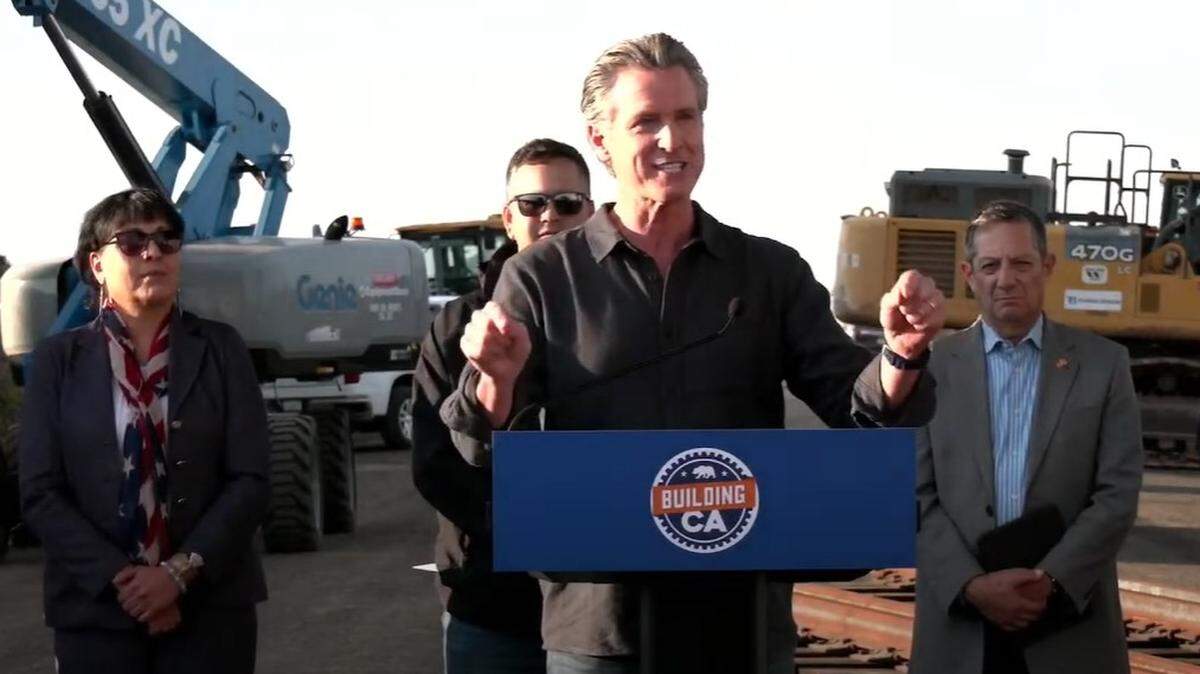
Construction of a new railyard between Wasco and Shafter in Kern County will set the stage for the eventual construction of tracks and other operating systems for California’s planned high-speed rail project.
The site, called a railhead, is near the southernmost end of a 22-mile stretch of the future bullet-train route from the Tulare-Kern county line to Poplar Avenue near Shafter, northwest of Bakersfield.
In the shadow of a newly built overpass along the rail route on Monday afternoon, California High-Speed Rail Authority CEO Ian Choudri and Gov. Gavin Newsom proclaimed the start of work on the railhead as a milestone for the controversial rail project. The site will be the staging area along the existing BNSF Railway tracks in the southern San Joaquin Valley to receive the materials that will be used to lay down the steel rails for high-speed trains.
“This damn thing is substantially permanent,” Newsom said of the overall Valley portion of construction from north of Madera to Shafter, the first stages of what is planned as an initial operating segment for the trains between Merced and Bakersfield. “Finally, we’re at the point where we’re going to start laying down this track in the next couple years.”
Choudri explained that “the railhead is important for us is because it serves as the first step in bringing all our commodities and material to this site and then start laying tracks.”
“This signifies the progress and moves us closer to the reality for the high-speed rail program,” Choudri added.
Newsom, Choudri and others celebrated the start of the railhead work by driving spikes into a ceremonial section of tracks at the site.
The optimism of Choudri, Newsom and others Monday comes as the ambitious rail program, for which construction in the Valley commenced in 2013, confronts a likely weather change when President-elect Donald Trump takes office later this month.
In 2019, during the first Trump administration, the Federal Railroad Administration canceled a previously awarded grant of nearly $1 billion for California’s high-speed rail program, and threatened to claw back about $2.5 billion in other federal economic stimulus grants awarded during the Obama administration.
Over the past several years, California’s project has received several billion dollars in additional money from the 2021 Bipartisan Infrastructure Law to help advance construction in the Valley. The California High-Speed Rail Authority has applications pending with the U.S. Department of Transportation for even more infrastructure money to fully pay for extending the tracks into downtown Bakersfield and downtown Merced.
Republicans in Congress have already proposed legislation to block any future federal allocations to the California project. Additionally, tech billionaire Elon Musk, tapped by President-elect Trump to lead an unofficial Department of Government Efficiency, has long been a critic of the state’s high-speed rail program, describing it as inefficient and wasteful.
In his remarks Monday, Newsom tangentially acknowledged the potential challenges.
“No one’s naive about the headwinds that are coming our way, but we withstood those a few years back,” Newsom said, “and we were able to continue to move forward and I have all the confidence in the world that we will move forward.”
But, he added, “We are in a very different place at this sacred moment, with a lot of humility about the past … and also very prideful that we are finally here announcing this railhead project, moving forward to lay this track and to get this project to a point where success becomes irresistible, success becomes inevitable.”
The moment, however, comes as the schedule for work in the Valley has slipped by years and costs have escalated well beyond what was foreseen when the construction contracts were awarded between 2013 and 2016:
- Construction Package 1, the first contract, spanning from north of Madera to the south edge of Fresno, was awarded in August 2013 based on a winning bid of less than $1 billion and an anticipated completion date of March 2018. Completion is now expected in November 2026, and delays and change orders have inflated the current value of the contract to more than $3.7 billion.
- Construction Package 2-3, stretching from south of Fresno to the Tulare-Kern county line, was awarded in June 2015 based on a winning bid of about $1.2 billion with an anticipated completion date of August 2019. The cost of that segment has grown to nearly $3.6 billion, with construction forecast to be finished in March 2026.
- Construction Package 4, from the Tulare-Kern line to Poplar Avenue near Shafter, was awarded in early 2016 based on a bid of $337.3 million and a forecast completion date of June 2019. The work was substantially finished last summer at a cost that climbed to more than $841 million.
The state rail authority has yet to hire contractors for the installation of tracks, but has retained a company to handle the design of the tracks, signal systems and electrical systems that will provide power to the trains.
And later this year, the agency expects to award a contract for the purchase of trainsets for testing and eventual passenger operations on the Merced-Bakersfield line. The rail authority hopes to have the route operational between 2030 and 2033.
This story was originally published January 6, 2025 at 7:03 PM.