
Fresno teachers union demands better air filters in schools, says FUSD ‘has failed’
The president of the Fresno Teachers Association is demanding that Fresno Unified purchase and install powerful HEPA filter machines that mirror the machines that have cleaned the air in Clovis Unified classrooms for the past six months.
President Manuel Bonilla said the district has failed multiple times to deliver HEPA filter machines that would meet federal and state guidelines for indoor air filtration. He said that the union now wants Fresno Unified to install HEPA filter machines in every classroom that would filter 1,500 cubic feet of air every minute. This would remove 99.9% of hazardous particulates up to 12 times an hour.
“We call on district leadership to correct this error immediately by purchasing and installing HEPA filters that circulate 1,500 cubic feet of air per minute,” he said.
Bonilla’s demand comes in the wake of an investigation published in The Bee that found that Fresno Unified failed for six months to provide HEPA filter machines to its 4,000 classrooms. The investigation also found that when the district tried to remedy this failure, they chose a machine that was not nearly powerful enough to deal with the hazards of wildfire smoke and COVID-19.
In an effort to push back on the Feb. 16 investigation, Superintendent Bob Nelson and his administrative team have undertaken a two-pronged public relations approach. They have tried to explain their past action to not equip classrooms with high-grade HEPA filter machines, while, at the same time, assuring the school board and the public that they are taking new steps to address the health impacts of hazardous air.
In doing so, their public statements have been marked by several inaccuracies.
In public meetings and official statements, FUSD staff have downplayed the health risks posed to children by the district’s six-month delay to provide powerful HEPA filter machines. These are the machines that Clovis Unified and other Valley school districts put into every classroom at the beginning of the school year.
At a Feb 16 board meeting, Karin Temple, FUSD’s Chief Operations Officer, insisted that the district had taken adequate measures to protect children from virus and wildfire smoke. She referred to a small, shoe-box-sized machine the district installed in May 2020 in every classroom.
She said that the device, a UV light with a miniature fan attached, was effective in killing virus particles in a classroom setting. She also claimed the device had a HEPA filter.
“Those units both have a UV light that kills viruses, and they also have a HEPA filter,” she said.
But both assertions by Temple are, in fact, false.
The device does not have a HEPA filter. The only part of the machine that resembles a filter is a 3.5-inch wire mesh screen that keeps dust off the device’s miniature fan.

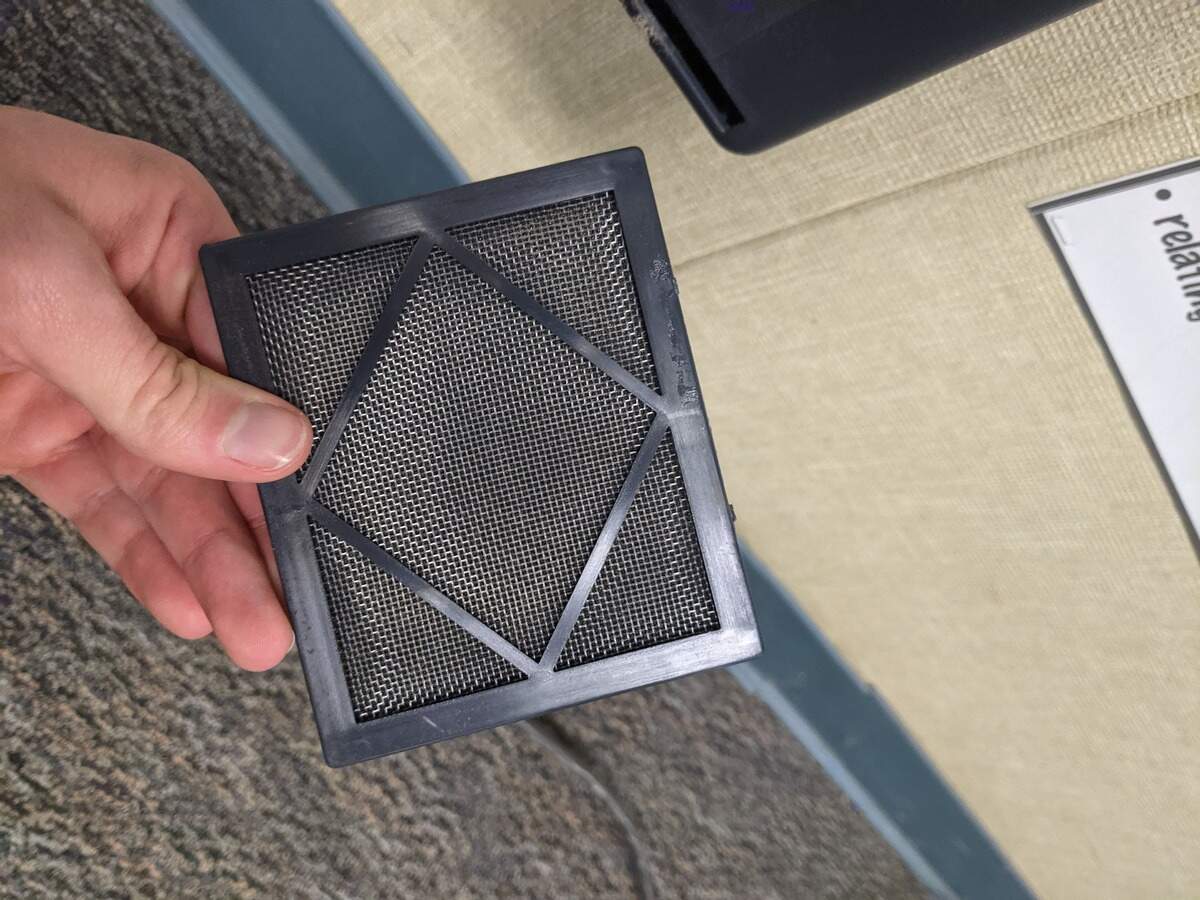
In addition, the device has nowhere near the capacity to neutralize COVID-19 particles at a classroom-scale. Its two-and-a-half inch fan does not move enough air over the UV light to reduce COVID transmission rates. At maximum, the device kills only 2-6% of COVID-19 in classrooms, according to Jeff Siegel, a world-renowned expert in indoor air ventilation and air quality who teaches at the University of Toronto.
During her presentation, Temple also tried to assure the school board and the public that the district’s latest plan — to install Aersus Pure & Clean HEPA filters across the district — would provide adequate filtration for the district’s 65,000 students.
“Our research tells us they’re effective for our 960-square-foot classrooms,” she said.
But this assertion by Temple is also not accurate. The model that Fresno Unified is installing has nowhere near the power to effectively clean classroom air. To prevent the spread of COVID-19 for a 960-square-foot classroom, the CDC, EPA, and California Department of Education recommend a machine that can filter at least 640 cubic feet of air per minute. But the district’s chosen machine, according to its specification sheet, is capable of only filtering 60 cubic feet of air per minute.
In public comments, FUSD leaders have made other inaccurate statements. Underscoring the district’s commitment to the “health and safety” of students during the pandemic, FUSD sent an email to thousands of teachers with the headline “Clarity on Indoor Air Quality Improvements.”
The email was written by FUSD spokesperson Nikki Henry, who, like Temple, tried to assure the community that the district’s UV-light device was an effective way to reduce the risk of COVID-19 transmission.
In the same email, Henry maintained that the district had actually installed some Aersus Pure & Clean HEPA filters in “many larger common spaces such as cafeterias” at the start of the school year.
In an email to the reporter, Henry conceded that Temple misspoke before the board and was “confused.” She also said the district had purchased and delivered 273 Aersus Pure & Clean HEPA filters in March and April 2021. “The district delivered 273 Pure & Clean units to schools in March and April 2021,” she wrote. Henry said there was no delivery list indicating which schools had received the 273 machines.
But even if the district had installed these machines in some common spaces, there would not be nearly enough of them to be effective, an analysis shows. The district would need at least 80 of that particular model in a single 4,000-square-foot cafeteria to come close to meeting federal recommendations for filtered air.
‘We have to demand better, right?’ FUSD trustee says
Fresno Unified Trustee Veva Islas said the district, by failing to install HEPA filters in classrooms at the start of the school year, had not done enough to protect students from COVID-19 and wildfire smoke. At the same time, she said, the Aersus Pure & Clean HEPA filters that the district is now installing are not powerful enough.
“We have to demand better, right?” Islas said. “We need a better device. We need to upgrade and have staff work expeditiously on where they can find another device.
A story published by The Bee on Feb. 16 detailed how Fresno Unified had neglected to put HEPA filters in every classroom in the midst of a once-in-a-century health crisis and the worst stretch of wildfires in California history. This omission took place even as the district received $703 million in COVID relief funds – the second-most in the state, behind only LA Unified.
At the start of the school year, districts across the Valley used a portion of their much-smaller federal relief monies to buy high-grade HEPA filters for all their classrooms. Clovis Unified Facilities Superintendent Denver Stairs said the machines his district installed — which filter classroom air more than four times an hour — immediately reduced the threats of COVID-19, wildfire smoke, strep throat, and even the flu.
It is impossible to track how much COVID-19 transmission at FUSD can be attributed to the district’s failure to utilize HEPA filters in their classroom over the past six months. But chronic absentee rates at Fresno Unified have hit record highs during the pandemic. In official documents, the district has reported that 45% of its students have been chronically absent since the start of the school year.
Entire grade levels at some Fresno Unified schools have been shut down at times this school year due to COVID-19. In contrast, a principal at a Clovis Unified elementary school reported that even during the worst waves of the pandemic, less than two percent of students missed school time due to illness.
The meeting on Feb. 16 was the first opportunity for the public to hear the district’s explanation for its failure to equip its classrooms with high-grade HEPA filters during the worst of wildfires and the pandemic.
Islas, who had warned the board in September that teachers were having to exhaust their personal resources to buy air filter systems for their classroom, called Temple to the lectern.
Temple is the FUSD executive in charge of the district’s ventilation and filtration program. Islas asked her if the state or federal government was clear about the level of filtration that should be in classrooms. Such levels are measured by so-called MERV ratings. A MERV-13 filter, for instance, captures more pollutants than a MERV-11.
Temple said that the CDC and the state Department of Public Health were not specific in their recommendations about what level of filtration schools should aim for to prevent COVID-19 transmission. “They’re not specific as to a MERV-level,” she told the board.
Temple’s assertion, however, was inaccurate. The CDC, in its official document titled “Ventilation in Schools and Childcare Programs,” explicitly recommends that HEPA filters — which are rated at MERV-17 — be used by schools “wherever possible.”
Islas then asked Temple for an estimated completion date for the district’s ambitious, long-term project that will upgrade the heating, ventilation and cooling systems to MERV-13 filters at scores of schools.
Temple said FUSD was still in the process of completing a district-wide assessment of its HVAC units, but the district was aiming for the end of 2024.
“We have a contractor that’s getting to the point of finishing [the report] up that we hope to bring to the board in the coming months,” she said.
Trustee Terry Slatic then asked Temple why the new HEPA machines that Fresno Unified was rolling out in the next few weeks were only 4-5% as powerful as Clovis Unified’s.
“They made their selection, and we made ours,” Temple said.
Her comment was met with snickers from the crowd.
Nelson said he was concerned that the HEPA machines used at Clovis Unified would be too loud. “There’s something to be considered in terms of whether or not those kids can clearly hear their teachers.”
Clovis Unified officials have said the filters in their classrooms are no louder than a household refrigerator.
“What can we do to save kids today, not five years from now?” Slatic asked.
Temple said “If the request from the board is to seek out units that are larger...we’ll certainly undertake that research.”
This story was originally published March 9, 2022 at 12:52 PM.