
Fresno-area college instructors call for better pay, benefits. ‘I can’t work for free’
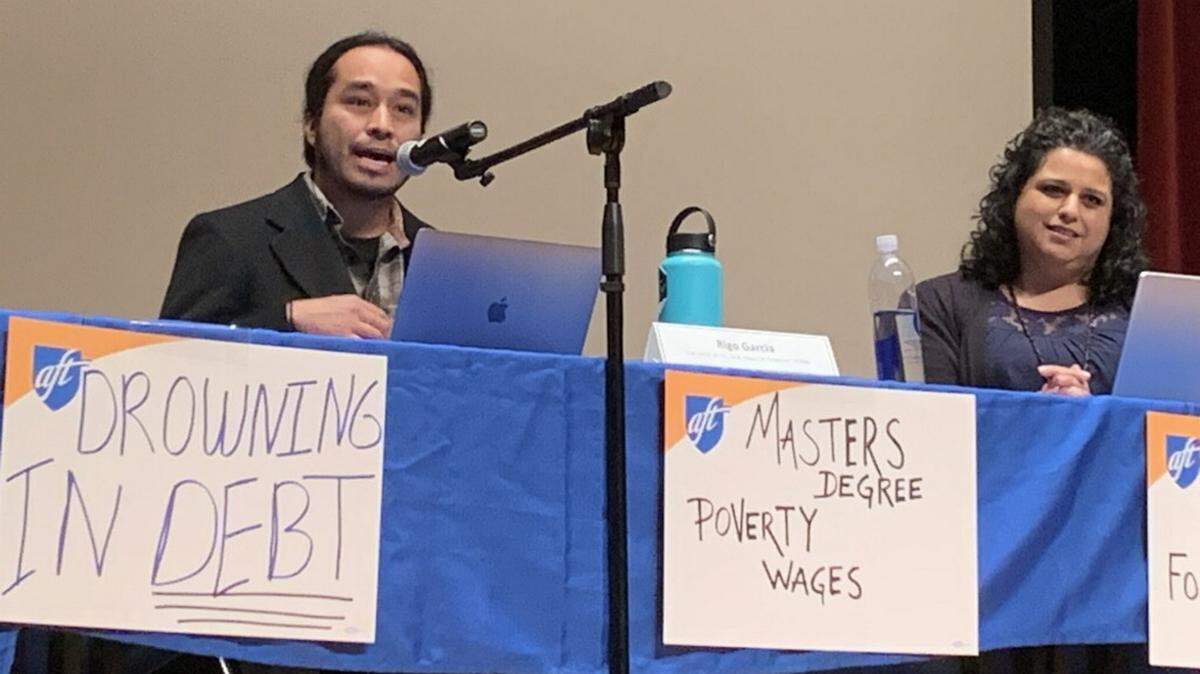
State Center Community College faculty are calling for equity and fairness in the way adjuncts are compensated for their time, which they say is a problem, particularly at community colleges in California.
Adjunct faculty spoke out during a panel discussion at Fresno City College on Thursday night organized by the State Center Federation of Teachers, the union that represents faculty.
Bernadette Moordigian has taught for eight years in the psychology department. She said she loves her job and doesn’t want to leave, “but I can’t work for free.”
She called on the district to pay her for the years she’s done prep work for classes without being paid for those hours. She also asked for faculty to be paid for having to move their courses online during the pandemic in 2020.
“Paying each one of the thousand adjuncts in this district would have a positive ripple effect,” she said.
Adjuncts are part-time instructors who are paid hourly. Many teach at multiple colleges to make ends meet. Most are only paid for time spent in the classroom and not for lesson planning, grading time, or office hours.
State Center adjuncts who work part-time don’t receive benefits such as health care.
Adjuncts say it’s difficult to do their best work when running from campus to campus to teach enough classes to pay their bills.
“This district has the money to pay adjuncts,” Moordigian said, citing the federal emergency money colleges received to help out during the pandemic.
She said she’d like to see a base rate pay that includes prep time.
The instructors who spoke said they love working at Fresno City College, where they went to school, but can’t sustain a living working there.
Rigo Garcia, an adjunct instructor in the Chicano Latino studies department, takes on odd jobs, such as mixing cement, to live.
He said he feels like adjuncts are “cheap, disposable labor” to colleges.
“I have no benefits, no job security,” he said. “It’s pretty much poverty pay. I literally have been on food stamps while working as an adjunct, which is very interesting sometimes to share that with students.”
Paul Gilmore, a tenured history instructor, gave a keynote speech about the history of adjuncts at California colleges.
He said colleges are hiring far fewer tenure-track positions than in the past, and the starkest difference is at community colleges.
There are 1,795 faculty positions at State Center, and 1,100 of those are part-time and temporary positions, he said.
“When we say ‘part-time’ by the way, just remember, when you’re teaching three classes a term, especially if you’re a young professor prepping those classes, that’s a hell of a lot more than 40 hours a week,” Gilmore said. “I teach full-time, and after 20 years, I suppose I work 60 hours a week.”
Gilmore said when he was in college in the late 80s, “people were concerned about the coming crisis in higher ed,” when many professors started retiring. He said after that, those full-time positions didn’t get replaced.
“Over the years … we shifted more and more of the teaching onto the shoulders of adjuncts.”
Gilmore said colleges also began to behave like corporations, “cutting labor costs, turning what we do here, education, research, into commodities for sale.”
Pulling up a search of current community college history instructor jobs up on the screen, Gilmore noted there was only one full-time position posted.
“I wouldn’t be surprised if four or five of my part-time colleagues at this school are applying for that job right now,” he said.
The Education Lab is a local journalism initiative that highlights education issues critical to the advancement of the San Joaquin Valley. It is funded by donors. Read more from The Bee’s Education Lab on our website.