
How Fresno State Foundation leaders lost power. Why president pulled plug on their tenures
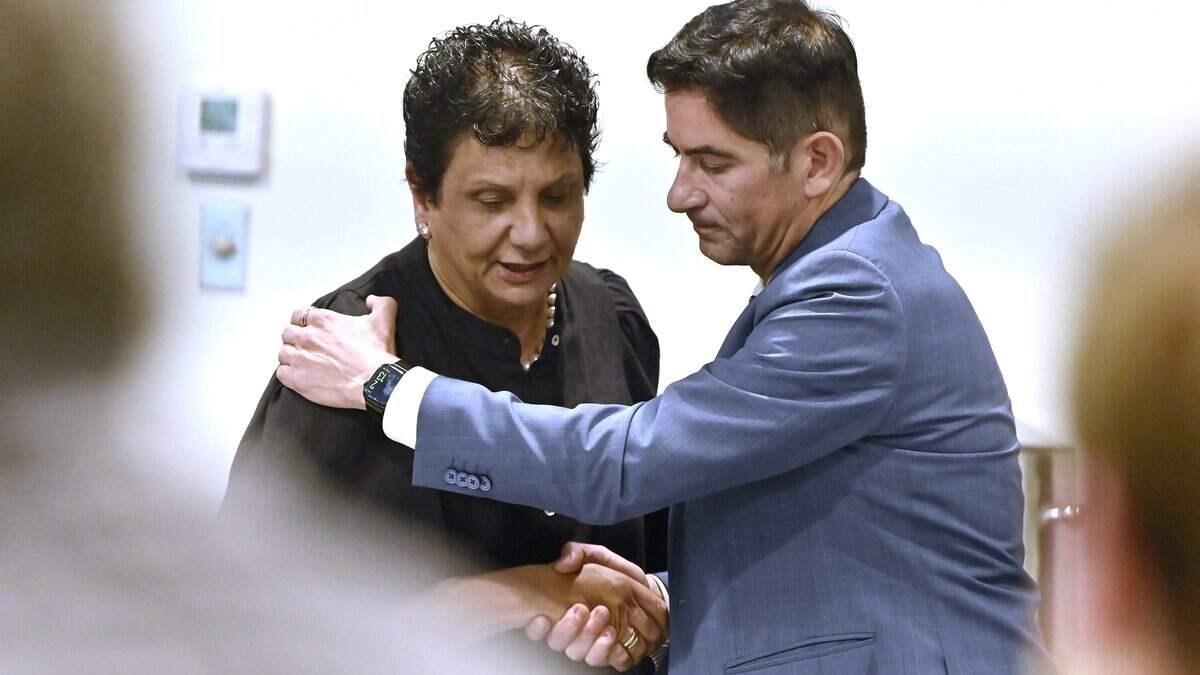
Fresno State president Saúl Jiménez-Sandoval said in a letter to leaders of the university’s independent philanthropic foundation last month that he was against reelecting the chairperson and four others with long tenures on the board, citing a need to modernize governance standards and assure the California State University system that it was taking its call for reforms seriously.
Working against the wishes of board power brokers, Jiménez-Sandoval then began to reshape the board when chairperson Vinci Ricchiuti, who served for 32 years including the past 10 as chair, was rotated off the board last week at the end of the 2025-26 academic year.
Also terming out were Claude Laval III, Richard Spencer, Kyle Stephenson and Nat DiBuduo. Laval had served on the board for 29 years, the other three between 15 and 22 years.
Click here to see the full letter
“This determination is not a reflection of diminished appreciation for their service. To the contrary, these governors have contributed meaningfully to Fresno State and the Foundation over many years, and their commitment is recognized with gratitude and respect,” Jiménez-Sandoval wrote in the letter.
“Rather, the preliminary determination is grounded in the governance circumstances currently before the University and the Foundation.”
The decision, and the machinations behind it, are detailed in the letter Jiménez-Sandoval wrote to the governance committee in June, which was obtained by The Fresno Bee through a public records request.
The Fresno State president was given the authority to determine whether it is in the best interest of the foundation to recommend reelection of governors in 2022, when it rewrote its bylaws to eliminate term limits for board members. That move may have been a significant tactical error and an all-timer of a case study in unintended consequences for a board that is packed with members who have volunteered their time for decades to serve the foundation, and have shown little inclination toward moving on.
The Fresno State president’s case also was bolstered by highly-critical findings of an advisory review of key processes at the foundation that was conducted by the CSU chancellor’s office and released in January. The foundation was found to have glaring weaknesses in its governance and operations that impacted its financial control environment.
In his letter, Jiménez-Sandoval did not delve deeply into findings from that review, but some of the findings of the 32-page report make it difficult to square up with the return of long-time board members.
The Fresno State Foundation manages an endowment of around $250 million, third largest in the CSU system, as well as $65 million in post-award research grants.
Yet, several of its core financial processes including fund balance reconciliations and endowment income distributions relied on manual practices that were outdated and no longer met the needs of an organization of its size, according to the CSU report from the advisory review. Overall, the report flagged 46 areas in governance, operation and financial practices that were in need of remediation.
Critical risks were identified in banking practices and the segregation of duties, with the same individual allowed to both prepare and approve multi-million dollar wire transfers and large electronic payments. When combined with infrequent bank reconciliations, which in some cases were performed by that same individual, significant opportunities were created for unauthorized or undetected activity, according to the report.
The limited board and board leadership turnover, coupled with minimal university representation and outdated governing documents, reduced transparency and resulted in a misalignment with the university’s strategic priorities, the CSU report states.
The Fresno State president met with Ricchiuti, the chair, on May 7 to discuss board governors whose terms were expiring at the end of June and the areas for reform identified by the CSU report, according to the president’s letter to the governance committee.
A meeting to further consult with the governance committee was scheduled for May 19, but it was canceled because only one committee member was available to attend. Jiménez-Sandoval instead shared his thoughts on the direction the board would take with the committee later that day by email, and offered the opportunity to meet with committee members individually.
He said in the letter that while continuity, institutional memory, and experienced leadership benefit the foundation, board renewal is important to its health and effectiveness. Turnover creates opportunities for expanded networks, fresh perspectives and alignment with the university’s strategic priorities, it said.
The foundation partnership agreement and board roles and responsibilities also reinforce the importance of alignment between foundation governance and the university’s strategic direction.
“Governors are expected to help ensure that the work of the foundation is aligned with the university’s strategic plan, accept fiduciary responsibilities, support the campus president, senior administrators, and foundation staff, and conduct the board’s business in an exemplary fashion,” Jiménez-Sandoval wrote to the committee.
“These expectations are especially important during a period in which the university is implementing governance recommendations, responding to Chancellor’s Office attention, and clarifying the Foundation’s future structure and practices.”
Ricchiuti, governance committee chair George Soares and others on the board voiced objections.
“We need action to note this, that the president, Saúl Jiménez-Sandoval, made a sole decision to not reappoint those members whose terms end June 30,” Ricchiuti said, at a meeting of the governance committee one day before the full board met for the final time in 2025-26.
“Board chair does not concur, but respectfully knows that is his prerogative … There should be a motion, or something to that effect.”
Despite objections, Ricchiuti and the others from the foundation board at the end of terms and had served nine or more years were out.
Jiménez-Sandoval told the governance committee in the letter that his determination to move Ricchiuti and the other board members along is not to suggest they had failed to serve with dedication. The university, he wrote, is deeply grateful for their years of service, leadership and philanthropy. He said he remained committed to handling the board transition with respect, gratitude and care.
“However,” he wrote to the governance committee, “the bylaw standard is not limited to whether a Governor has served honorably in the past. It asks whether, upon expiration of the current term and after considering all relevant matters, it is in the best interest of the Corporation to recommend reelection.
“Given the advisory review, the Chancellor’s Office focus, the need to demonstrate implementation of term limit expectations, and the importance of board renewal and succession, I have determined that recommending reelection of these Governors would not be in the best interest of the Corporation at this time.”
This story was originally published July 6, 2026 at 12:38 PM.