
Fresno State Foundation requests extension on reforms, as longtime board members leave

The Fresno State Foundation on Tuesday asked for an extension to deadlines that its own board of governors set to make governance changes stemming from a highly-critical review by the California State University chancellor’s office.
It also said goodbye to five long-time members of the embattled foundation board including longtime chairperson Vinci Ricchiuti at a highly-charged and at times emotional final full meeting of the 2025-26 academic year.
Christopher Morse was nominated from the floor and elected as its next chair. He has served on the foundation board for nine years and is on its audit committee.
The Foundation, which manages $315 million in donations and grants on behalf of the university, gave itself a June 30 deadline to complete several tasks to reform its operations:
- Revise board composition to include appropriate university representation.
- Establish and enforce term limits for its board of governors.
- Establish term limits for its officers (chair, vice chair, treasurer) and rotation.
- Document a policy for board chair and committee chair rotation in alignment with the requirements outlined in the governance committee charter.
- Revise bylaws to reflect current leadership roles, including the assignment of the executive director to the university’s vice president for advancement.
Ricchiuti reminded the board that it had set the deadlines. “The deadline did not come from the chancellor’s office, it came from us,” she said.
But it opted to ask for more time — it had submitted its implementation plan to the CSU in March.
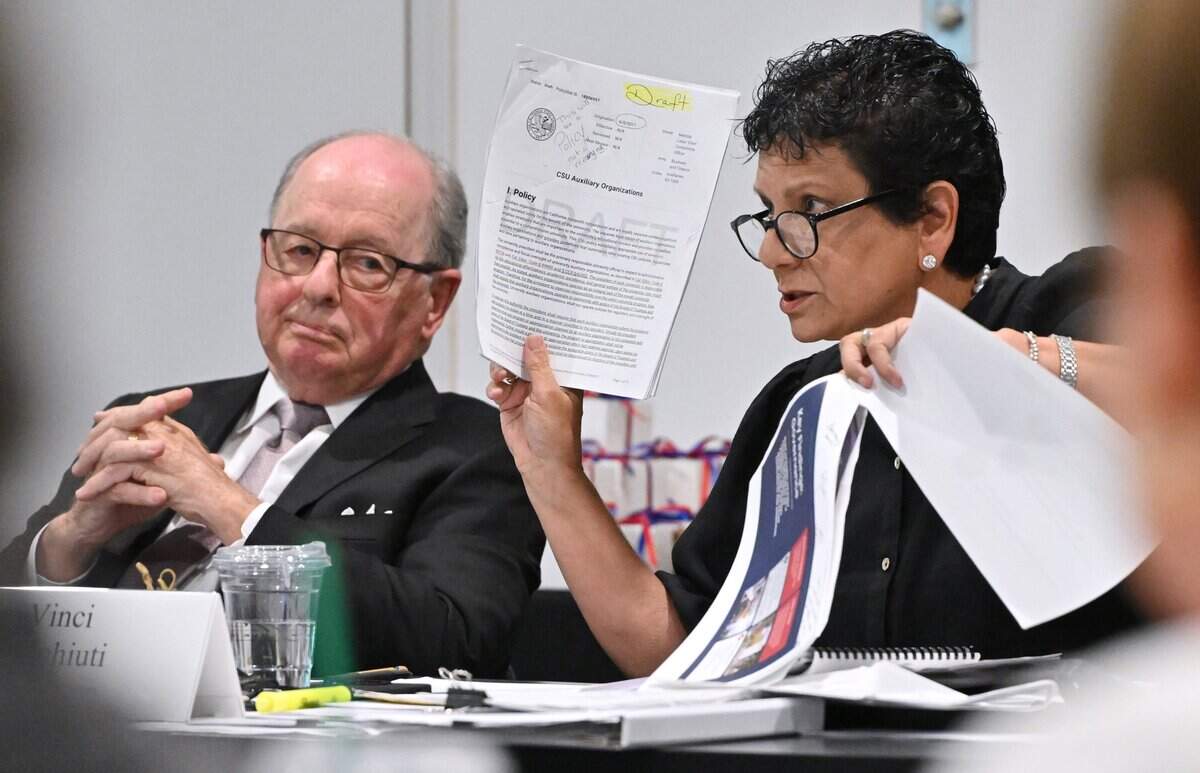
The chancellor’s office in its review by CSU Audit and Advisory Services found a long list of governance issues within the board that, according to its report, compromised oversight, reduced opportunities to introduce fresh perspectives and support the foundation’s continued growth.
The criticisms from the review included a lack of appropriate financial controls, no faculty or student board representation, and a lack of board turnover, among 46 areas cited for reform.
Those weaknesses in its governance and financial control environment, the CSU found, heightened the foundation’s exposure to financial misstatement, fraud and operational inefficiencies. It also left it vulnerable to financial and reputational risk, hindered its ability to safeguard assets and impacted its ability to support the university’s missions.
Digging in on term limits and student and faculty participation
Term limits and a lack of appropriate university representation became hot topics for the board and its governance committee, as the June 30 deadline approached.
Though the Fresno State Foundation handles philanthropic and post-award grant activity, it does not include faculty, staff or student representation on its board.
In 2022, the board eliminated member term limits in 2022 that called for two consecutive four-year terms with an option to serve again after a one-year absence. Prior to the change, the limits were only loosely enforced. As part of that change to its bylaws, the board gave the university president the power to block members from returning at the end of their terms.
Its bylaws now state: “Upon the expiration of a governor’s term, the president of California State University Fresno in consultation with the board chair and governance committee, will determine whether it’s in the best interest of the corporation to recommend reelection of such governor to the board.”
Fresno State University President Saúl Jiménez-Sandoval exercised that authority on Monday and blocked five board members from returning to the board: Ricchiuti, who served on the board for 32 years, the last 10 as its chair, and four long-time board members, who termed out and will not return in 2026-27: Claude Laval III, Richard Spencer, Kyle Stephenson and Nat DiBuduo. Each served on the board for at least 15 years.
Governance committee chair George Soares railed in committee meetings and the full board meeting on Tuesday against term limits and criticism that the foundation is in violation of California regulations with a board composition that does not include adequate staff/administration, faculty and student representation.
The board’s governance committee contends the foundation, established in 1931, is exempt.
A section of Title 5 of the California Code of Regulations, which governs CSU non-profit auxiliary boards, states that approved non-student auxiliary organizations that were operating on April 1, 1969, could continue using the governing board composition they had at that time.
The CSU in its report stated the foundation updated its articles of incorporation in 2012, which typically prompts reassessment of compliance with applicable laws and CSU policies. It referenced one foundation in the 22-campus system that was established in 1958, and could also be exempt, but instead maintains university representation in five board positions in addition to its university president.
“The governance committee was I think clear that they see value in expanding the board when it comes to faculty and students,” Soares said on Tuesday.
The foundation has made progress in other areas of its implementation plan. It has addressed and completed four CSU findings in endowment management, eight in financial practices and non-endowed cash, five in organizational structure and one in indirect cost recovery and operational areas and policy infrastructure.