Clovis infill rezone plan to build 1,300 housing units stirs traffic, safety concerns
Dozens of Clovis homeowners voiced opposition Thursday to a proposal that would build 1,300 housing units on 20 parcels of infill development to comply with the state’s affordable housing mandate.
The proposal to redesignate 20 underutilized parcels for high- or very-high-density residential land within established neighborhoods is one of the outcomes of a 2024 settlement agreement. It stems from a lawsuit filed by Desiree Martinez, a local advocate for the unhoused, who accused Clovis of not complying with a state mandate to provide adequate affordable housing opportunities.
The selected 20 parcels are scattered across the city and have the capacity to accommodate 1,303 dwelling units, which is sufficient to meet the court-ordered requirement of 1,284 units.
Approximately 3,000 households reside within 800 feet of the selected 20 parcels, according to city officials.
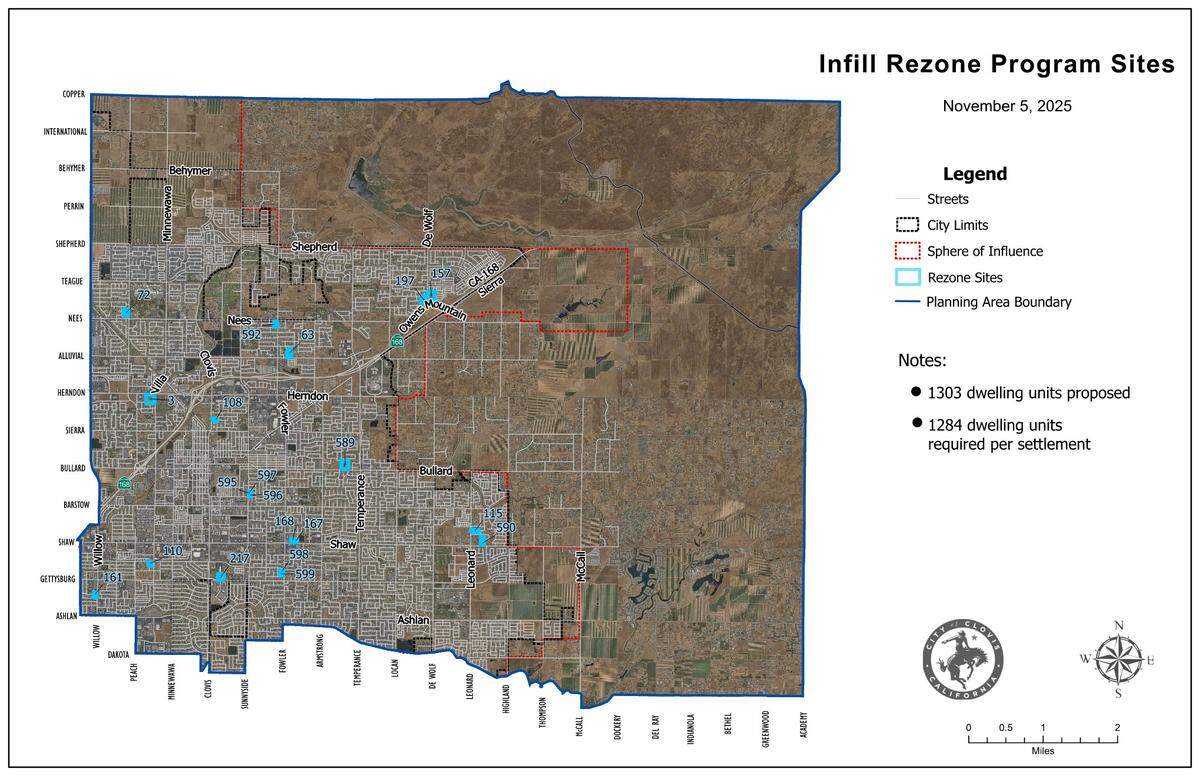
Nearly 50 homeowners from the southeast area of Clovis voiced concerns about the program at an informational meeting Thursday evening. Many said they worried that the influx of residents would place additional pressure on already overburdened infrastructure, transportation, and school systems, and disrupt the city’s way of life.
“I think the City of Clovis is an amazing city, and it has a way of life. I think we really need to take into consideration how we build up these areas of Clovis,” said Christina Palmer, a 30-plus-year resident.
Palmer said the Department of Motor Vehicles office at the Shaw and Leonard intersection where two parcels have been targeted for rezoning is already rife with safety hazards. The two parcels on the northeast corner of the intersection will be rezoned as high-density, meaning 20-30 residential units per acre.
“We were told the DMV was going to be a great neighbor. They are an okay neighbor, but we do have traffic-learning drivers coming into our homes, and we have kids playing, and they’re all over the place,” Palmer said. “The impact is real. It used to take two minutes to get on Shaw, now it’s 10 minutes.”
Property owners asked city officials for crime rates, traffic accidents, pedestrian safety, and property value reports.
“Now you go to Walmart, everything’s on lockdown because crime increases in that area. It’s been a pretty good way to live in there, but we see the change. There’s so much Section 8 housing in that area, and people are migrating further out, but we’re just losing the Clovis way of life,” said a Clovis resident who declined to be identified.
Clovis officials said the city is only changing the zoning to meet the court order’s requirement. There’s no construction proposed at this time.
“There’s no actual development that’s proposed with the program, so the level of analysis on each site, or each of the 20 sites, isn’t being done at this time because we don’t have project proposals,” McKencie Perez, deputy city planner, said at Thursday’s meeting. “When that comes in for development, then at that time, we would look at what the requirements are needed for the specific site.”
Officials said the parcels are all within city limits and hadn’t been part of the city’s housing inventory. The parcels were selected based on several criteria, including proximity to services.
Officials said they have not yet evaluated the impact of rezoning on the surrounding neighborhoods because there is no actual development plan at the moment. However, Clovis conducted engagement surveys after its initial selection of 24 parcels.
The city notified all the property owners of the 24 parcels, said Perez. Owners of ten sites asked to be removed from the selection, but property owners from six other parcels asked to be included in the program, she said.
The modification was reviewed and approved by Martinez, per the settlement agreement. The informational session is part of the process and the rezone proposal will go before the city’s planning commission and the City Council for final approval, Perez said.
Once the rezoning is complete, developers pursuing multi-family housing development in the high-density or very-high-density areas will be required to undergo a series of review procedures, but there’s no requirement to provide further notice or seek consent from nearby homeowners, according to city officials.
Martinez said she’s excited to see the city moving forward with the rezoning.
“Infill is probably going to have some traffic issues because you’re building into existing areas. We’ve been working really hard together to get this project done,” said Stephanie Hamilton Borchers, director of litigation and advocacy from the Central California Legal Services, who represents Martinez. “There’s a lot of criteria that go into deciding if it’s a correct site. So there’s a process that it went through. I don’t have any reason to believe that it wasn’t done for the purposes of doing the infill.”
Borchers said the the lawsuit aimed to prod Clovis to comply with the state mandate to make affordable housing attractive and feasible for developers to develop.
“Right now, across the state of California, it’s difficult to build. Right now, we can’t say when something will actually be built, but we can put the structure in place to make it attractive to developers to come in and build,” Borchers said.