
Is Fresno economically, racially inclusive? City is making progress, report says
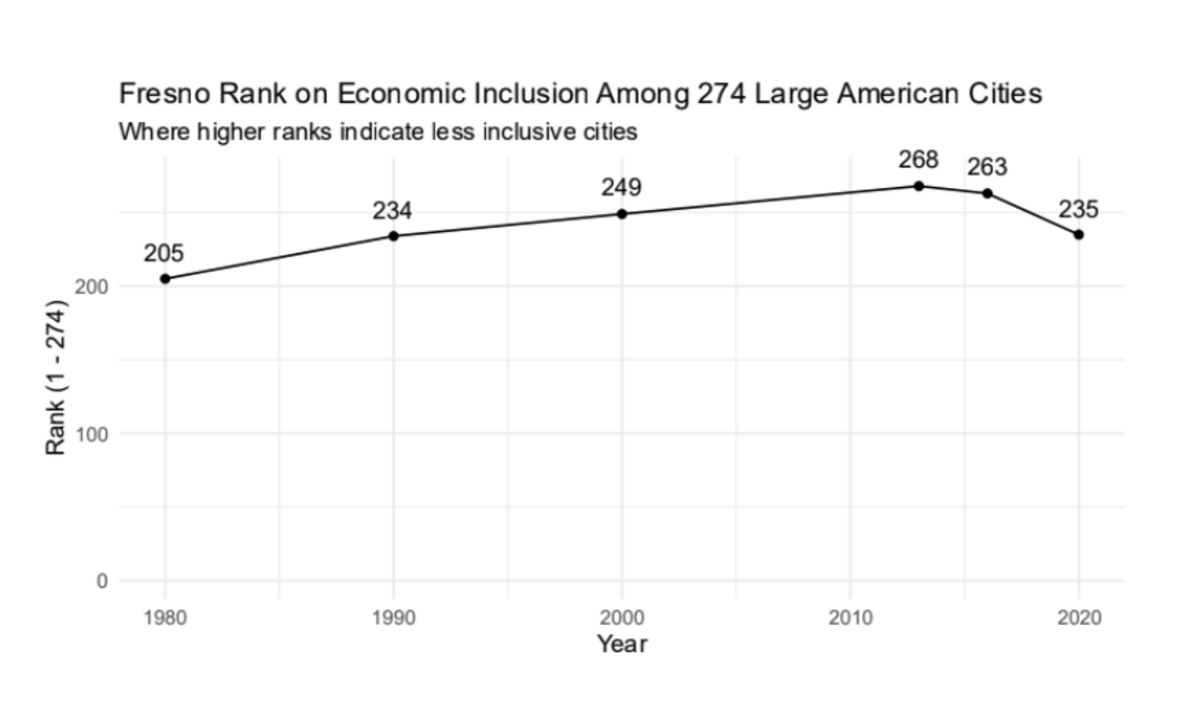
Fresno has historically ranked near the bottom nationally for economic and racial inclusion, but new data suggests the city is reversing its trend of decades of exclusion.
The report by the Central Valley Community Foundation shows that while household income and employment rates have risen from 2013 to 2023, poverty has declined and high school completion rates are up, particularly among Black and Hispanic students.
Those gains were enough to vault the city 33 spots in the Washington-based Urban Institute’s economic inclusion index rankings — from No. 268 to No. 235 — of 274 large U.S. cities.
Still, racial gaps remain across the board, and Fresno remains behind most U.S. metropolitan areas.
“These results show progress — but they’re just the beginning,” Fresno Mayor Jerry Dyer said in a statement. “There’s still more to do to ensure that residents in every neighborhood have access to a future full of possibility.”
Economic inclusion assesses whether people with lower incomes can take part in and benefit from the local economy. For its report, the Central Valley Community Foundation analyzed neighborhood segregation by income, housing affordability, the number of people working full-time who live in poverty and high school dropout rates.
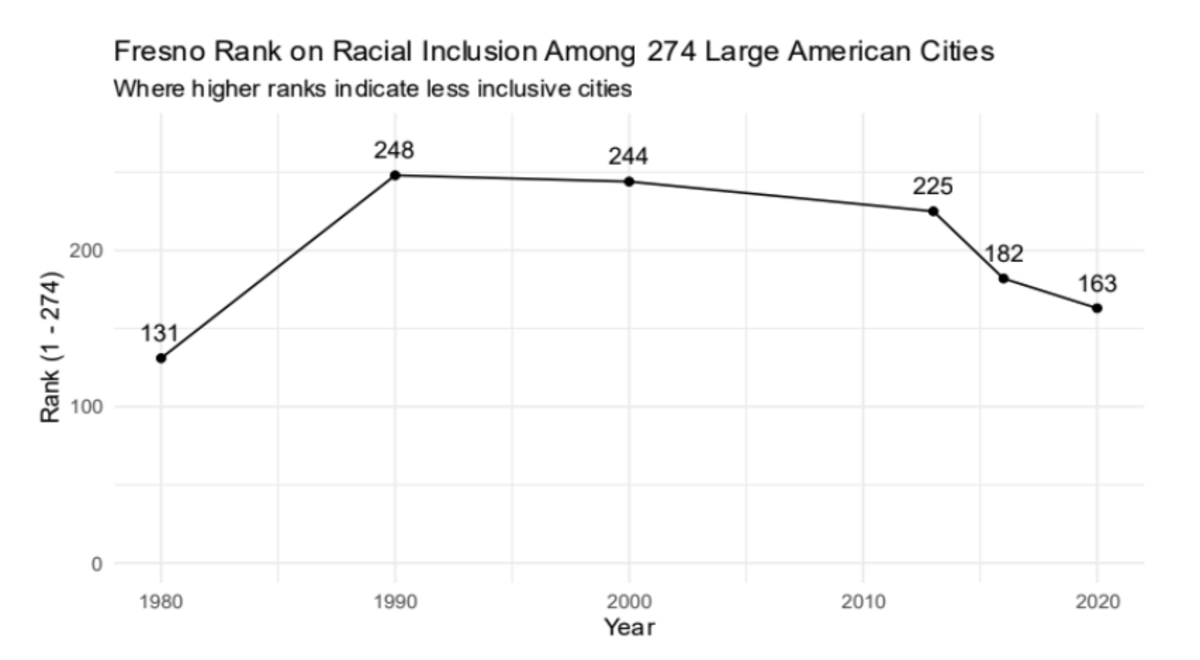
Racial inclusion evaluates how well people of color share in the benefits of economic growth compared to white residents. Racial homeownership, poverty and education gaps are included in the index, along with neighborhood segregation by race, according to CVCF.
From 2013 to 2023, Fresno rose 62 spots in racial inclusion, moving from 225 to 163, the data shows.
The CVCF is a philanthropic, non-profit serving Merced, Mariposa, Madera, Fresno, Tulare and Kings counties. The organization works to connect donors with local initiatives to foster economic growth in the region, one of those being Fresno DRIVE (Developing the Region’s Inclusive and Vibrant Economy).
DRIVE is a coalition that is advocating for a 10-year $4.2 billion investment through 14 initiatives to develop an inclusive and sustainable economy for residents of the greater Fresno region.
The initiatives are divided into three categories. The first being “people,” focusing on things like education, access to childcare and training the next generation of workforce. The second, “prosperity,” focuses on the regional economy. Lastly, the “place” initiatives work to improve downtown Fresno and access to affordable housing.
The new data comes five years into the 10-year plan. While no single program can claim responsibility for Fresno’s improved rankings, CVCF says community-led models like DRIVE have contributed to a broader movement to advance economic and racial inclusion.
Since its launch, the coalition has engaged 10,000 residents and secured more than $630 million in public and philanthropic investment to implement the plan, CVCF says.
“What we learn from DRIVE is this idea that when one person succeeds, we all succeed; and calling ourselves back to a community ethos that we all share something in common: We all live here,” said Ashley Swearengin, president and CEO of CVCF.
Fresno still lags behind most U.S. metros
Despite the growth, Fresno lags behind most U.S. metros, the data shows.
The city ranks in the bottom 15% for economic inclusion and the bottom 40% for racial inclusion nationally, but its rate of improvement is among the fastest in the county, the CVCF says.
According to the CVCF report:
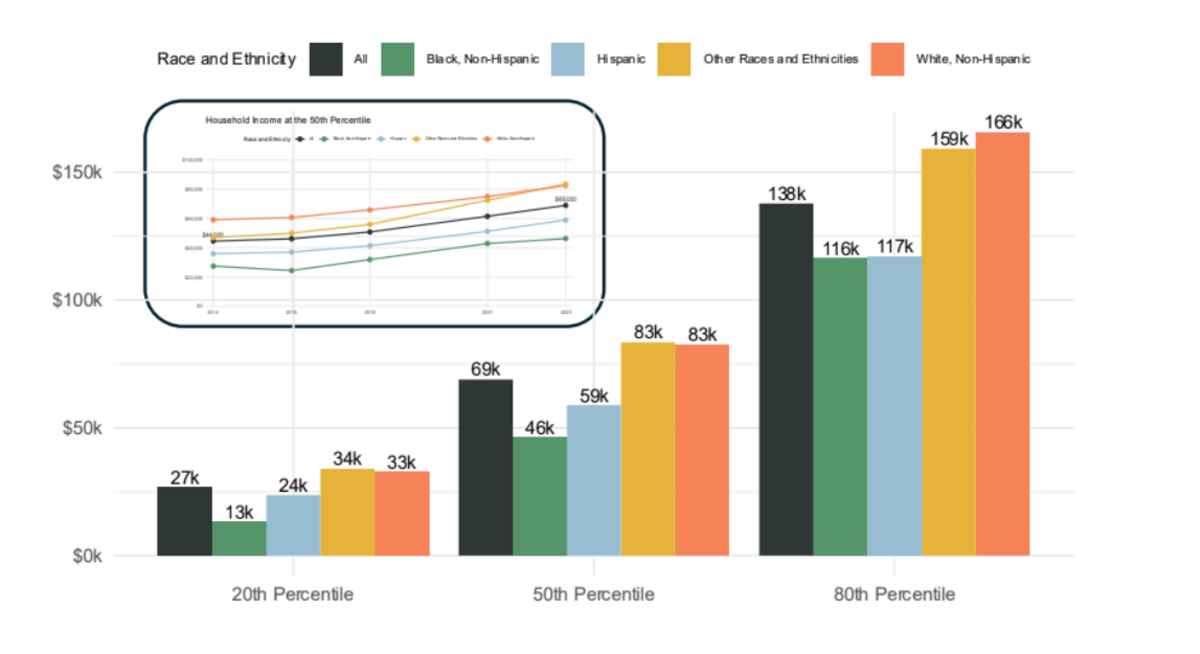
- Household incomes in the Fresno area rose 55% since 2014, from $44,000 to $69,000, but white households still earn far more than Black and Hispanic households.
- Employment increased from 68% to 74%, nearing the statewide average of 79%. Yet disparities remain: 78% of white adults are employed, compared to 73% of Hispanic and 66% of Black adults.
- Concentrated poverty declined by 68%, but Black residents living in poverty are more than twice as likely as white residents to live in high-poverty neighborhoods.
- Debt in collections dropped from 37% to 24%, but neighborhoods of color still face higher rates — 26% compared to 13% in predominantly white areas.
- High school completion climbed to 91.8% among 19 and 20-year-olds. Gains were strongest for Black students, 78% to 87%, and Hispanic students, 80% to 90%. Both still trail white students, who had a 96% completion rate.
How can Fresno continue to improve its ranking?
There are a few areas of focus Fresno can work on to improve economic and racial inclusion.
This includes promoting mixed-income neighborhoods, investing in more housing of all kinds, growing job opportunities with living wages and strengthening education pathways, along with expanding housing and education equity programs, according to CVCF.
In the second half of DRIVE’s 10-year plan, the coalition will focus on attracting additional investment to advance its initiatives and getting more residents involved, its leaders say.
“Seeing the transformative change that Fresno DRIVE and its local partners have made in the past five years, increasing equity in education, housing, and job opportunities for people in the greater Fresno region, has given me incredible hope for what the future of Fresno holds,” said Artie Padilla, director of DRIVE initiative.

This story was originally published October 7, 2025 at 9:00 AM.