
Fresno City Council gives initial OK to street vendor regulations on a split 4-3 vote
An array of proposed new rules to regulate street-food vendors citywide won initial approval Thursday from the Fresno City Council, but the split 4-3 vote strongly indicates that there will be more changes following impassioned pleas from vendors and advocates.
Councilmembers Luis Chavez, Nelson Esparza and Tyler Maxwell voted no on the introduction of the proposed “Street Vendor Ordinance.” The law, sponsored by Councilmember Miguel Arias and Council President Annalisa Perea, will return for a second vote by the City Council on Dec. 5, but could be pushed off beyond that depending on the extent of changes that are hammered out between council members.
A vote on the ordinance planned for earlier this month was pushed back after members of the Fresno Association of Mobile Vendors voiced numerous concerns, including that they felt the restrictions would hurt their business and the expense of the fines charged for violations.
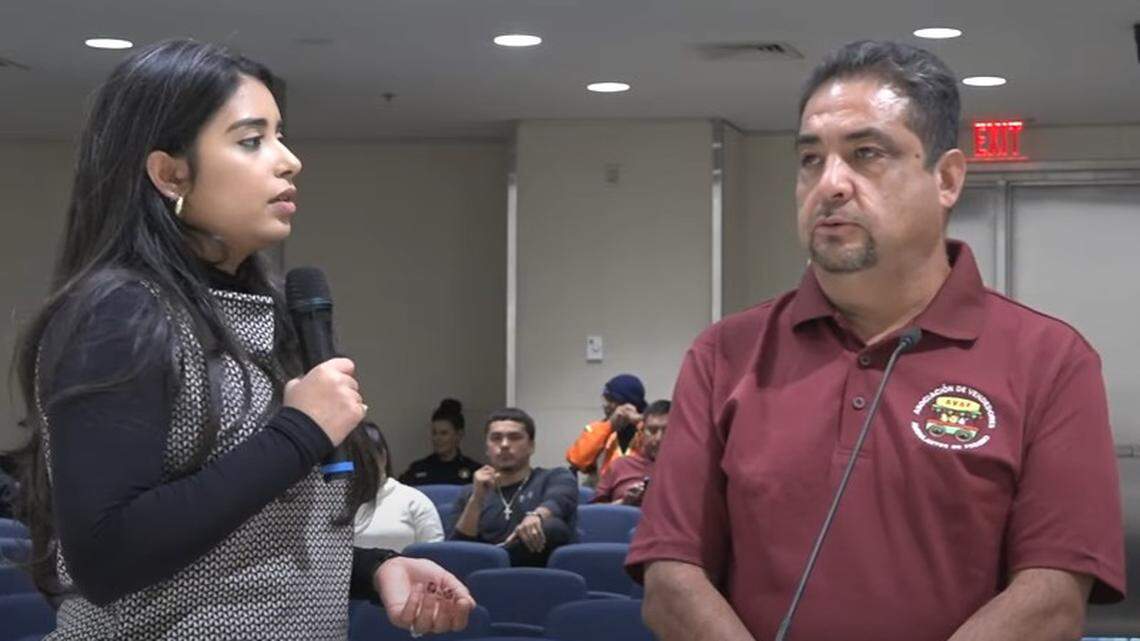
About a dozen people — members of the vendor organization and advocates — returned to City Hall this week to reinforce their message.
Key provisions of the regulations in the version introduced Thursday include:
- Requiring street vendors to have both a city business license and an operating permit from the Fresno County Department of Public Health, unless they have only a small display space of less than 25 square feet and are only selling prepackaged food or whole uncooked produce.
- Requiring written permission from the property owner if they are selling on private property.
- Maintaining a clean, trash-free 10-foot radius around a street vending cart, and cleaning up any grease, food or fluids that may fall on a sidewalk or public property.
- Not operating within 200 feet of a freeway on- or off-ramp unless on private property with the owner’s permission; or within 10 feet of another sidewalk vendor unless they have a written agreement to collaborate; or within 100 feet of a residence. An exception to the residential limit would not apply to vendors who sell pre-made food items such as fruit cups, elotes or Mexican street corn, bread, tamales or other food that does not need to be cooked at the cart.
- Forbidding operation within three feet of a building or under an awning attached to a building for vendors who are cooking food.
- Operating in a manner that does not impede the use of sidewalks or limit access to adjacent properties including homes or businesses, or impede emergency access by police, fire or medical personnel., or within 18 inches from the edge of a curb.
- Not placing canopies, chairs or tables for customers, except to provide shade only for the vendor.
- Limiting the operating hours of vendors within the Tower District, bounded by McKinley, Belmont, Blackstone and Palm avenues: no vending between 12:30 a.m. and 8 a.m. Thursdays through Sundays, and no sales after midnight.
- No vendors within 200 feet of a certified farmers market if the vendor is not associated with the farmers market.
- No vendors within 200 feet of an event for which the city has issued a temporary special permit if the vendor is not associated with the permitted event.
The latest version also includes a proposed reduction in fines from what was originally proposed two weeks earlier: a written warning for a first violation; $25 for a first offense within a year instead of $100; $50 for a second offense instead of $200; and $100 for a third offense within a year of a first citation instead of $500.
The fines would not kick in for six months, except where a pilot program has already been in place in the Tower District.
Despite the changes in amounts of the fines, vendors aren’t convinced that the law won’t bring them hardship.
“It will affect us negatively. We have not received enough time to educate ourselves on the policy,” said Miguel Ruiz, vice president of the Association of Mobile Vendors, through a Spanish-language interpreter. “We are asking for a time of six months to better prepare ourselves.”
“I have been a mobile vendor for more than 25 years and I have gone through many things,” Ruiz told the City Council. “I have been beaten up, I’ve had firearms pulled on me, they have dumped out my corn, my elotes. If you only knew how sad it feels when they toss your product, this product you spent time and money preparing for it to just be thrown away.”
Arias and Perea both noted that while problems have been primarily in the Tower District of central Fresno with vendors who cook live on the sidewalks and spill grease on the sidewalks or dump their oil into the wells of street trees, they believe a citywide law is necessary for consistency across Fresno.
“We cannot have people cooking on public sidewalks in residential neighborhoods or blocking the public right of way,” Arias said. “This policy is not in any way intended to stop you from doing business.”
“It is a handful of people who continue to violate basic rules,” he added. “In order for us to enforce rules in any part of the city, we need to have basic rules across the city so these individuals simply don’t move a block next door and create and replicate the same problem somewhere else.”
Chavez, who was one of the original sponsors of the law, raised concerns of his own Thursday, urging consideration of attempting to tailor the ordinance for certain areas of the city rather than one overarching set of rules.
“We know that the people here are not the problem,” he said of the assemblage of vendors at City Hall. “We know they are folks who come in from outside the city, set up and do things their way – maybe because they don’t know or maybe because they don’t care.”
City Manager Georgeanne White and Police Chief Mindy Casto said another concern within the Tower District are vendors who set up in the late night and early morning hours after bars have closed, attracting crowds that sometimes involve rival gangs and require pulling police officers in from other parts of the city.
Chavez asked Arias and Perea if they’d be willing to postpone the law’s introduction one more time to Dec. 5 to hammer out details addressing site-specific enforcement of the law.
“I’m not agreeable to a policy that’s only for one neighborhood, that’s different for the rest of the city, because we’re only going to push the problem out to the South Tower, push it to the Lowell Neighborhood, pushes it to Blackstone (Avenue) or (Cesar) Chavez Boulevard,” Arias replied.
“I’m not sure we can just continue to chase this problem (from one neighborhood to another) without having more of a blanket policy citywide,” Perea added, noting that the ordinance already includes a number of “carve-outs specifically for the good actors.”
Esparza said he was not ready to vote in favor of any sort of financial penalty for violations after hearing from the vendors Thursday.
“The fines have been lowered, and a fine or penalty of $25 may not seem like much at first glance,” Esparza said. “But when you put that into the context of someone who’s only making or netting $100 per day, it’s a really a huge bite out of the very humble living that these vendors are making.”
Maxwell joined Esparza and Chavez on Thursday to vote against the introduction of the law. Maxwell cited his own concerns with the fines, and added that the City Council frequently creates rules that apply only to certain parts of Fresno.
Chavez and Arias said they would work together to seek a compromise and possible changes before the Dec. 5 meeting. If those changes are deemed substantial, it would require resetting the process and introducing yet another version of the ordinance on Dec. 5, with a second reading on Dec. 12. If it clears hurdles on those two dates, whatever form the new law takes would become effective 30 days later.
This story was originally published November 22, 2024 at 9:29 AM.
