Fresno has hundreds of stoplight cameras. Will city catch you if you run a red light?
Surveillance cameras are a fact of modern life in Fresno, be it the street cameras that proliferate across the city, private business surveillance or home doorbell cameras.
But what are drivers looking at while stopped at a light?
Many of the city’s intersections are equipped with hundreds of cameras — or what appear to be cameras — with different types of equipment or sensors mounted on them. In most cases, they serve an ordinary purpose, such as detecting when to give motorists a green light.
What’s clear is Fresno does not hand out traffic tickets for running a red light through cameras, though it’s not for lack of trying.
The city used red-light cameras to enforce traffic laws, but dismantled the effort in 2005. The company the city contracted with for those red-light cameras never retrieved the equipment, and at least one of the poles is still up near Herndon and Blackstone avenues, according to city staffers.
Critics said those cameras took poor-quality photos that often obscured the driver or license plate number. The city didn’t get as much revenue from tickets as the manufacturer had said was likely, according to Bee archives.
The city has around 600 intersections controlled by traffic signals. About 270, or 45%, are connected to the city’s network of cameras used for traffic operations, according to Scott Mozier, Fresno’s director of public works.
He said that the cameras on city intersection poles do not affect the city’s general fund.
“Everything has been accomplished through grant funding,” Mozier said.
Here’s what each of the cameras you see at Fresno stoplight intersections are used for — and whether police can access them.
What is that camera hanging from the stoplight?
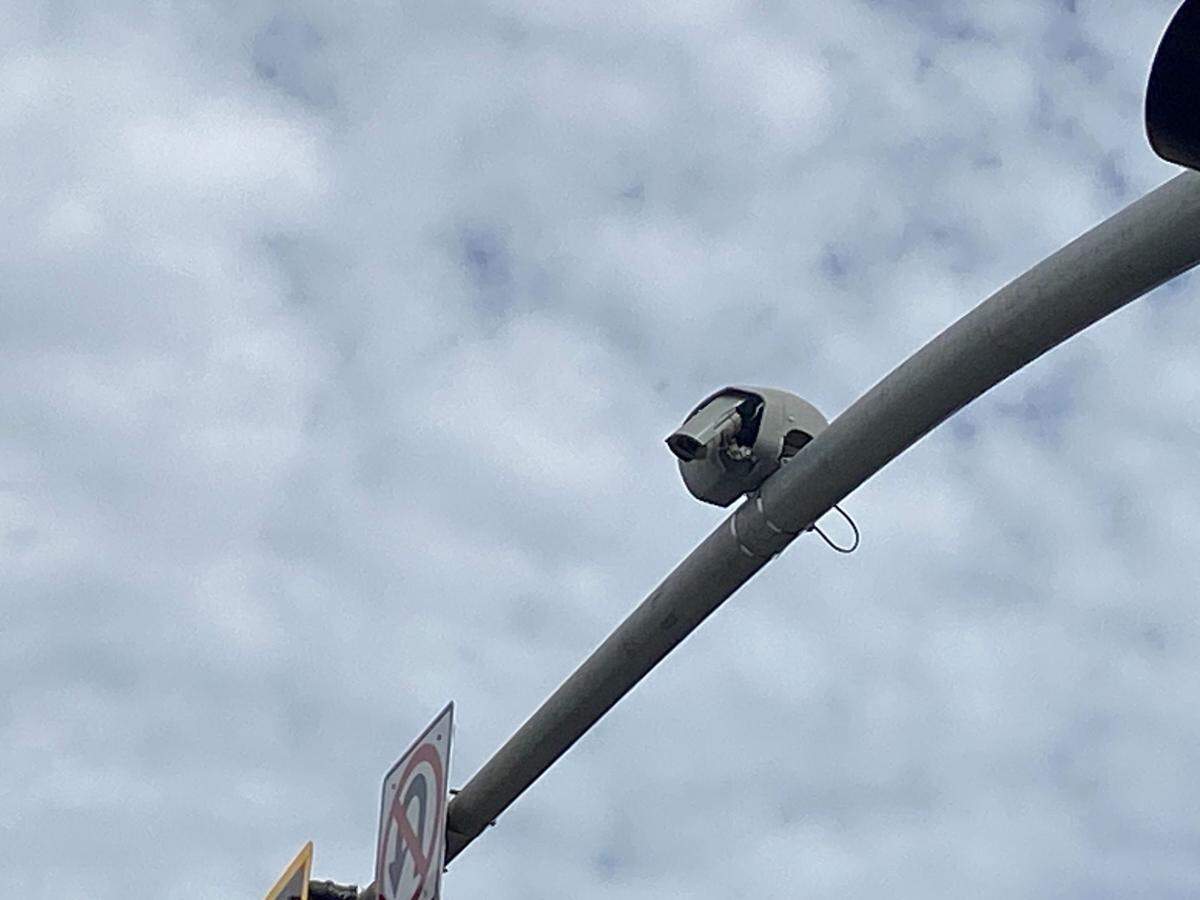
The white or gray bell-shaped devices often closer to a street corner — as opposed to out on a traffic light’s arm near the stoplight — are cameras live-streaming the traffic to public works employees, Mozier said.
The cameras are not under constant surveillance by city employees, he said, but rather allow those who work in traffic operations to view potential problems without having to go out and stand on each street corner.
“Instead of having to drive the entire corridor or stand on a street corner and then move to another — that would be an old school approach — with the cameras, pretty quickly we can monitor how things are functioning,” Mozier said.
Those cameras can be moved around remotely so employees can get a better look. The Public Works Department’s cameras are not able to record footage, and police are not allowed to use them in the Real Time Crime Center under the rules of the grants that funded the new equipment, he said.
Can flashing car headlights really change a red light?
The most common device near the red, yellow and green traffic lights is a receiver that detects a signal emitted from an emergency vehicle like a fire engine, Mozier said.
The receiver features a black cylinder with two smaller arms protruding from it and detects signals sent from first-response vehicles to give emergency personnel priority for a green light.
Mozier said the device works off of a code within the equipment. This means flashing a car’s high beams has no affect for drivers who might be trying to beat the system while sitting at a red light.
“Your car cannot do that,” he said. “That’s a proprietary product. Coded, secure, protected.”
Is that a surveillance camera?
Though some of the devices may appear to be classic surveillance cameras, their looks may be deceiving. Mozier said the gray or white devices are there to detect cars who may be waiting for a light to change.
Many stoplights have sensors in the ground just before the crosswalk, but some intersections have sensors that may look like a camera. Another model looks similar though it has a larger shell around it.
Mozier said those devices are looking for movement — much like a doorbell camera — to sense whether a car is approaching an intersection.
Some devices aren’t cameras or sensors
Most major thoroughfares, like Herndon or Blackstone avenues, are connected to the city’s camera network using underground cables.
Some areas not on those major roads but nearby are connected through wireless equipment, which tend to look like gray or white plastic connected to several wires near a stoplight.
Mozier said the wireless equipment is cheaper than the work to add underground cables, and help extend the network.
Do police use the traffic cameras?
Mozier said residents will sometimes ask for footage from traffic cameras following an accident. He noted the cameras are not recording, and are not capable of recording.
The grants that paid for the traffic improvements require that they not be used in policing.
When unveiling the Real Time Crime Center in 2015, then-Chief Jerry Dyer touted the cameras’ ability to cover large portions of the city around the clock.
Lt. Bill Dooley, a police spokesperson, said Fresno police have access to about 100 cameras from the police department’s system, cameras from the FAX bus system and Fresno Unified School District surveillance.
The center is always operating but not always staffed.
“They are not manned 24/7, but they are always accessible if needed for a critical incident (or) investigation,” Dooley said in an email.
The school district provides access to their cameras upon request from police, according to Diana Ramirez Diaz, director of communications for Fresno Unified.
She said school resource officers also can access surveillance cameras at middle and high schools. The district has about 4,000 cameras across all of its sites, she said.