Clogged drains, refrigeration temporarily shut Fresno-area restaurants in May
Four Fresno County food businesses – two in Fresno, two in Sanger – were temporarily closed or restricted by health inspectors in May because of food-safety violations.
Plumbing issues, including clogged and overflowing drains, were among the problems found during inspections by the Fresno County Department of Public Health. One of the businesses remained partially closed as of June 4 pending a re-inspection and corrections to violations.
In Fresno, the affected businesses were the Little Peking Restaurant at Cedar and Nees avenues in northeast Fresno and Tacos Tijuana on East Ventura Avenue in southeast Fresno.
The Sanger businesses were the Ranch Market at Academy and North avenues and the Chipotle Mexican Grill at Jensen and Bethel avenues.
A May 8 inspection at Little Peking Restaurant revealed a clogged floor drain at the kitchen food-preparation sink that was causing wastewater to overflow, prompting a closure.
A plumber called to the restaurant that day said the problem was because of a full grease trap tank and could not be fixed until the grease trap was pumped out.
The inspection also found a pair of cockroaches in the kitchen, one in a dry-storage area and another near the kitchen freezer; improper thawing of meat in a sink rather than in a refrigerator or under running water; improperly washing raw produce prior to being cut and prepared; grime on refrigerator handles; a wok improperly stored on the floor under the kitchen stove; and deteriorated flooring in the kitchen.
The restaurant was authorized to reopen on May 14 after a re-inspection found that all of the violations had been corrected.
At Tacos Tijuana, a May 20 inspection discovered a lack of hot water at the kitchen ware-washing sink. Restaurant staff said the water heater would turn off intermittently.
The inspector also found that some foods were being held at temperatures that were either too warm or too cool for food-safety purposes. Those foods – 20 pounds of chicken soup, five pounds of beans, two pounds of chopped tomatoes and three pounds of rice – were discarded.
The restaurant reopened later the same day after a new water heater was installed.
A May 9 inspection at Sanger’s Ranch Market – formerly Gong’s Market – determined that water at kitchen sinks was not reaching the minimum temperature required by food-safety regulations. A handwashing sink in the kitchen was inoperable because of a leak, and a leaking ware-washing sink was causing floor drains to overflow.
Floor and wall joints in the meat department and restrooms were deteriorating and need to be replaced with new coverings, and floors in the meat walk-in refrigerator and in a prep room needed to be cleaned.
The store was partially closed with restrictions to not use areas inside the walk-in refrigerators where wastewater from the floor drains were surfacing and the backed-up drains are repaired. The health department reported that the partial closure remained in place as of June 4.
Also on May 9, the Chipotle Mexican Grill in Sanger was closed after an inspection found that a walk-in refrigerator was not maintaining a proper cold temperature. The restaurant was allowed to reopen the next day.
What inspectors look for
A lack of hot water is one of the most common violations inspectors from the Department of Public Health find when they make their routine visits. Hot water at a temperature of at least 120 degrees is considered important by inspectors for safely washing pots, pans, dishes and glasses, and 100 degrees for employees to wash their hands.
Insect or vermin infestations are another type of violation that can result in immediate closure of restaurants or food businesses when they are observed by health inspectors.
Among other serious concerns for food safety are refrigerators that don’t keep food cold enough or steam tables that don’t keep food hot enough to inhibit bacterial growth, or clogged sinks or drains that cause contaminated water to back up into kitchens.
In most instances, if an inspector finds a problem, it’s something that can be fixed on the spot – issues such as having enough bleach or sanitizer in the water used to wipe down food-preparation areas, putting lids back onto containers in walk-in refrigerators, replenishing soap, paper towels and toilet paper in the restrooms, or reminding employees to wash their hands and wear gloves and hairnets.
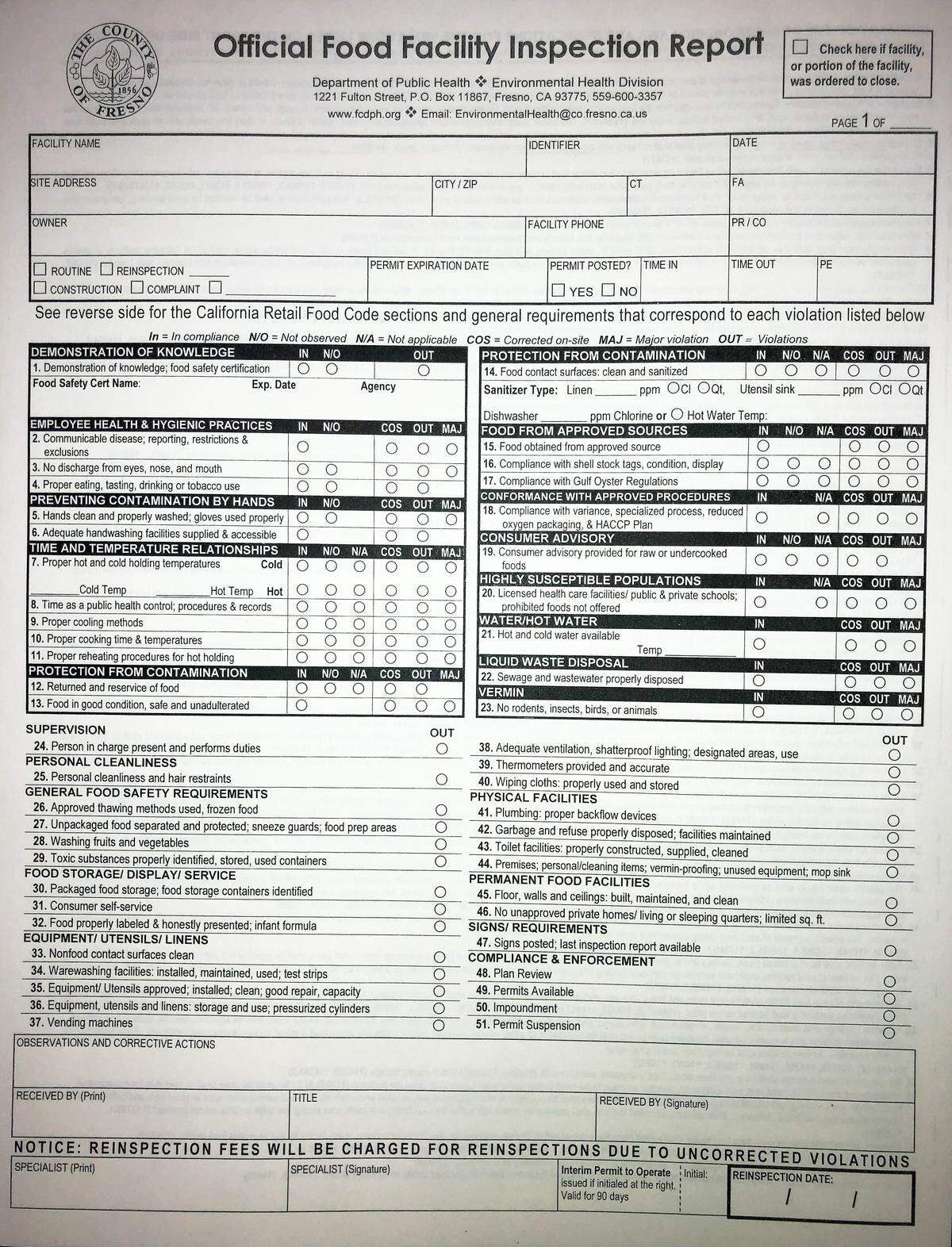
When inspectors visit a restaurant or other food service business, there is a lengthy and detailed list of more than 50 things that draw their scrutiny. They include:
- Whether the manager and all employees have the required food safety or food-handling certificates.
- Hygiene of individual employees.
- Ways to keep cold food at or below 41 degrees and hot food above 135 degrees.
- Use of proper sterilization for counters, tables, utensils and cookware.
- Overall cleanliness.
- Proper drainage of sinks and floor drains.
- Restrooms stocked with supplies.
- Whether the business has the proper license or permit.
The Fresno County Department of Public Health has about two dozen environmental health specialists who monitor more than 5,300 restaurants, snack bars, grocery stores, commissaries, delicatessens and food vendors across the county, making unannounced visits several times a year.
Restaurants also are inspected in response to complaints or other concerns from the public, including when people see what they believe are health or sanitation issues at restaurants.
This story was originally published June 5, 2024 at 12:33 PM.