California wins big federal grant for high-speed rail. How much, and where will it be spent?
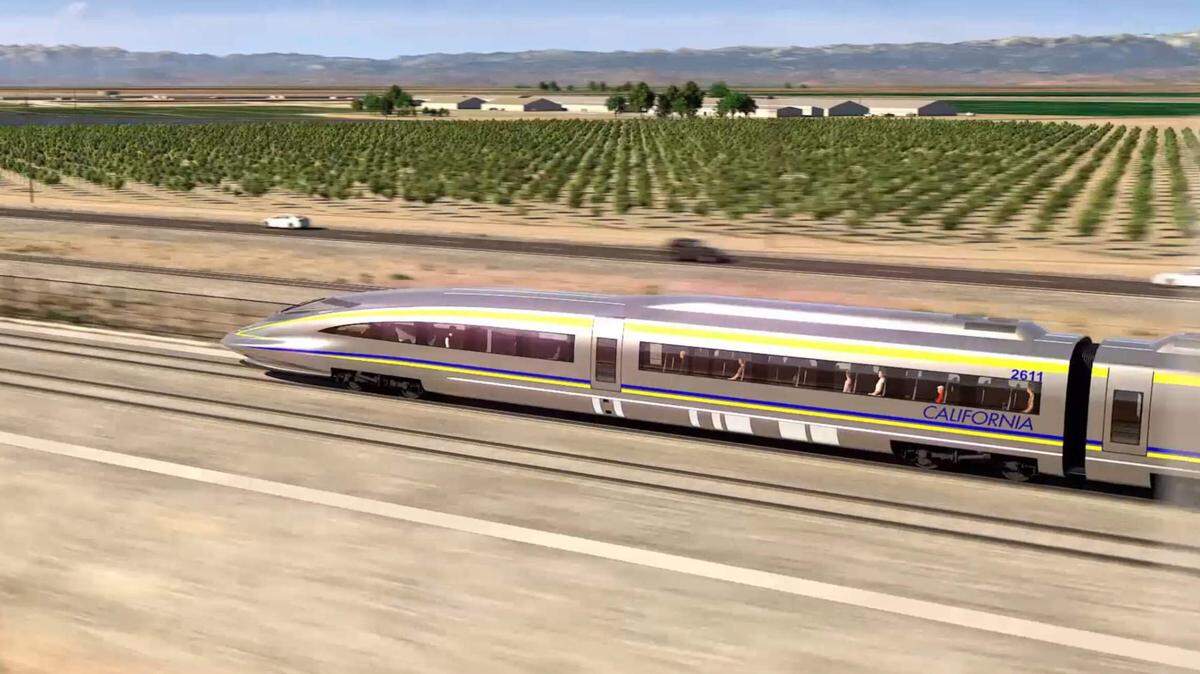
A federal grant of almost $202 million for California’s high-speed rail project, awarded Monday by the U.S. Department of Transportation, will help pay for the design and construction of six major structures to eliminate railroad crossings in the southern San Joaquin Valley.
The Consolidated Rail Infrastructure and Safety Improvements, or CRISI, award is the largest single grant from the pot of more than $1.4 billion announced Monday. The California High-Speed Rail Authority has its collective fingers crossed for getting much more than that to complete the work underway and to develop an initial operating line from Merced to Bakersfield. Those trains would travel through the Valley via Fresno at about 220 mph.
The CRISI grant will cover about 80% of the anticipated cost to design, purchase property and construction of six new structures intended to eliminate at-grade road crossings at existing BNSF Railway freight tracks and future high-speed rail tracks running through the city of Shafter, northwest of Bakersfield.
Each of the six grade separations included in the grant sit south of the southern extent of the existing construction contracts for 119 miles of high-speed rail work from north of Madera to Poplar Avenue at the northwestern edge of Shafter. The rail authority’s CEO, Brian Kelly, said he sees that as an indication of a federal commitment to provide more money to complete the extension south to a future rail station in Bakersfield.
The high-speed rail crossings in Shafter are among six California projects that received a total of almost $291 million.
Most of the grants announced Monday support railroad safety and supply chains, but others – like the one for the Shafter crossings as well as projects in the Sacramento-Roseville area – are aimed at expanding passenger rail capacity.
Several other grant applications from the high-speed rail agency are still pending with the U.S. Department of Transportation, most notably a request for $2.8 billion. That application calls for funding to:
- Buy six electric-powered trainsets for testing and eventual passenger service on the line between Merced and Bakersfield.
- Construction a second set of tracks instead of only one track on the 119-mile stretch from Madera to Shafter.
- Build a new high-speed rail station in downtown Fresno at Mariposa Street between H and G streets.
- Complete pre-construction work including design, right of way acquisition and utility relocation for extensions of the Valley line northward to downtown Merced and southward to Bakersfield.
The three current construction contracts in the Valley are budgeted at just over $20 billion – an increase of about $2 billion over the 2021 estimated price tag of just under $18 billion.
The increases, according to rail authority leaders, are due to factors such as design changes that add new structures or tweak the routes; the effects of inflation and rising supply costs; and higher than anticipated costs for utility relocations up and down the 119-mile route
This story was originally published September 25, 2023 at 3:29 PM.