
Mom was Arte Américas co-founding director, now her daughter takes over Latino cultural arts center
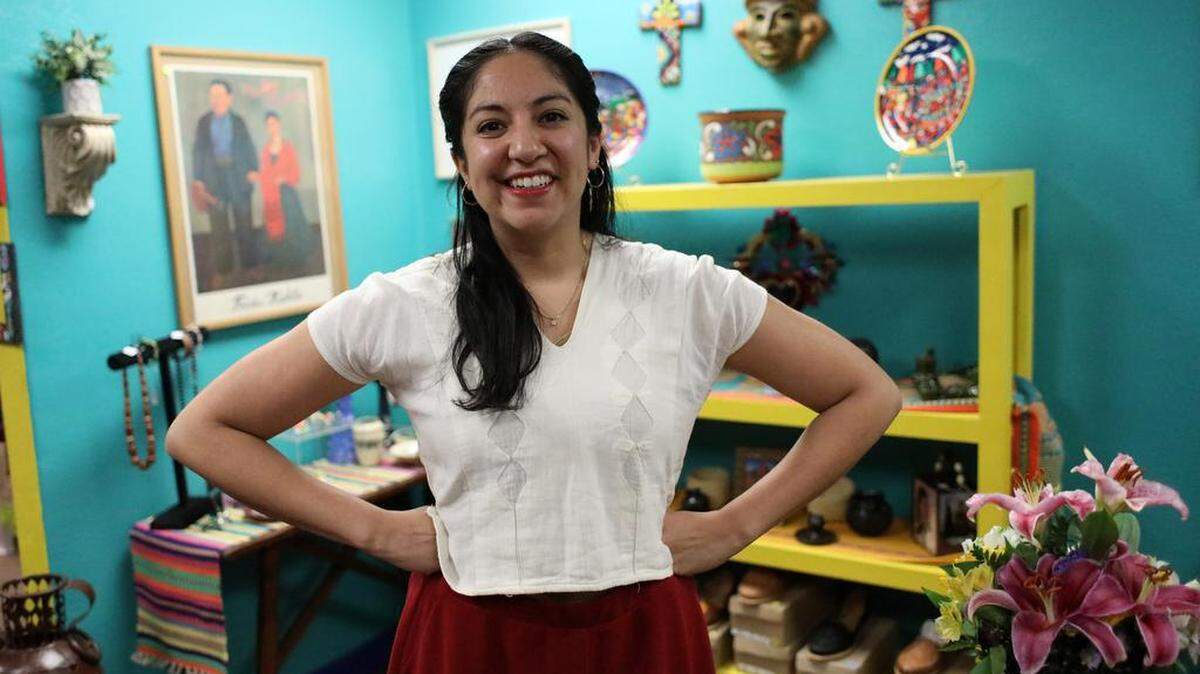
The little girl who took Día de los Muertos workshops on making sugar skulls, watched her mother help launch a cultural arts center, and performed at a few of the center’s events as a Mexican folkloric dancer is now in charge of shaping the future of Arte Américas.
Arianna Paz Chávez was chosen as the new executive director for Arte Américas, the largest Latino cultural arts center between San Francisco and Los Ángeles. She began on March 27 in the same job her mother, Lilia Gonzales Chávez, held.
Gonzales Chávez, currently chair of the Fresno Arts Council, was Arte’s founding executive director.
“The board is confident that Arianna is the right person to take care of our beloved Latino cultural arts center and lead us into our next stage of growth,” said Vivian Velasco Paz, Arte board chair.
“ Indeed, Arianna was shaped by our mission to celebrate, nurture, and preserve Latino arts and cultures during her mother, Lilia Chávez’ tenure.”
Velasco Paz said Chávez arrives at a crucial time for the 36-year-old center, which moved into its current location in 1995 after operating from a store front office at the Warnors Theatre.
Arte Américas, which is still waiting for a $7 million state grant obtained last year by Assemblymember Joaquín Arámbula, needs refurbishing for the 144-year-old building after suffering some damages during the pandemic.
Chávez said she is up to the challenge.
“Arte Américas is a really unique organization in that we are one of the largest arts organizations in the Central Valley, and we have this incredible gallery spaces and this incredible capacity to put together exhibits,” said Chávez, who earned a bachelor’s in art history and arts management from the University of San Francisco and a masters in art history from Syracuse University.
The Latino cultural center, on Van Ness and Calaveras, “is unique” because it is community-driven, said Chávez.
“I’m attracted to this job and to arts specifically because it had such a big role in shaping who I am and informing my own interest in art,” she said. “I hope that we can help to inspire other people to have arts be a part of their lives.
“I am excited to honor and amplify that work and am grateful for the opportunity to contribute to the community that raised me.”
www.fresnobee.com/vida-en-el-valle: Complete story with Q&A
The following is from a recent conversation with Chávez.
What are your earliest memories of Arte Américas?
“There are photos of me at Arte when it was still in the storefront. My earliest memory in this building was participating in art-making workshops where we would make these masks, and we used plaster strips right on our faces. I was probably 4 years old, but that experience of the cold plaster hardening on my face really, really, really stayed with me.”
What exhibits through the years do you recall?
“I remember the nacimiento exhibitions. That’s probably the earliest one I remember. I remember seeing works of art from Cheech Marín’s collection. I remember a really fantastic exhibition that was in collaboration with the Smithsonian that was all about Latino music. And, of course, the Caminos exhibition, which is still part of Arte Américas’ collection.”
Talk about your time in Italy in 2022.
“After spending the first 10 years of my career focused on arts education, I was curious to see if it made sense to go back to research. I chose that master’s program (at Syracuse) because I wanted to see if maybe I wanted to get a PhD in art history down the line. I really enjoyed being in Italy. It was really exciting to see particular objects that are reflective of those first interactions between indigenous people and Europeans.
“I was doing the opposite of what a lot of my classmates were doing by looking in that way. I decided I have too much energy to be happy in a library. And, I wanted to come home and contribute to this place that raised me.”
What about a space for Latino artists?
“Arte Américas was really founded to be a space for Latino arts at a moment when Latino artists were not being shown. They weren’t receiving as much attention from other institutions. It was deliberately named Arte Américas so that it could be directly responsive to the Latino communities that are here in the Central Valley.
“There are a lot of different needs within the Latino community, and art is really uniquely positioned to offer creative solutions and creative approaches to those needs.”
Talk about your folkloric dancing experience.
“I have 20 years of experience dancing and learning about ballet folklórico. I also have some experience teaching as well. It’s a huge part of my life and a huge part of who I am. Not just myself, but for a lot of people, ballet folklórico is kind of the way you learn about México and all of the different regions in México. You learn about the diversity and beauty of your own culture by learning different dances and putting on the costumes and getting into character.
“I thought I would stop dancing when I left Fresno. When I was in San Francisco, I met a couple of other people who had also grown up dancing. So we created a group at the University of San Francisco called Baile Folklórico de San Pancho.
“When I moved to New York, the first thing I had to do was find a ballet folklórico group. So I did my research and I learned about a group called Calpulli. At the time, it was one of the only ballet folklórico companies and I was attracted to it because of the education component of their mission. They offer a lot of free classes.”
What influence has your mother had on you?
“My mom was one of the three co-founders and was the first executive director at Arte Américas. And I mean, there have been a lot of executive directors apart from my mom. She hasn’t really given me any one piece of advice, but she’s been really supportive and good about asking me questions to make sure that this is really what I want to do. My family’s been really great about being supportive, but not putting any pressure on me or leading me in any direction.”
Any specific goals for Arte Américas?
“Arte has had a lot of successes in 36 years, but we haven’t really met our full potential. I want us to be more consistent in the educational programs that we offer. And by that, I’m really looking forward to deepening partnerships with the school districts.
“And I want Arte to be in the financial position to be able to plan well in advance. The nature for a long time has been focused on what is immediately ahead. And I want us to be able to really look ahead and plan and get to a place where we have some stability so that we can really maximize our potential as a resource.”
This story was originally published April 7, 2023 at 11:04 AM.