New, more comfortable Amtrak train cars coming to the Valley. What else can riders expect?
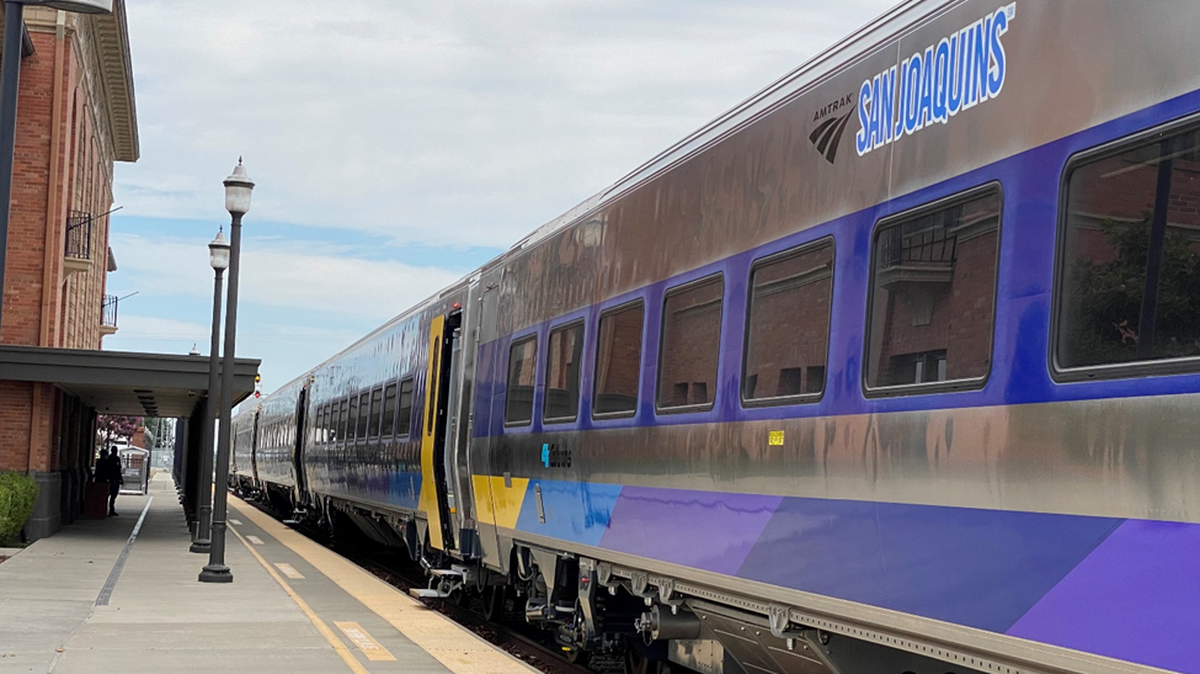
The first of seven new passenger rail train sets for service through the San Joaquin Valley has been accepted – finally – by the state Department of Transportation for eventual deployment.
Caltrans confirmed it has taken delivery of the first Seimens Venture train set – a connected set of seven passenger coaches – from manufacturer Siemens Mobility. The single-level cars provide wider aisles and more comfortable seating than the older rail cars that are part of the existing fleet serving the Amtrak San Joaquins line between Bakersfield and Oakland/Sacramento.
The total of 49 Venture passenger coaches being built in Sacramento by Siemens were purchased by Caltrans as part of a multi-state partnership to buy more than 100 rail cars to modernize passenger train fleets. Caltrans’ share of the deal was $136 million. But the deal has had its share of hurdles since the purchase program was announced in 2012.
The first manufacturer chosen to build the trains, Nippon Sharyo, was replaced by Siemens in 2017 after its cars failed federal impact safety tests. One of the latest issues confronted by Siemens in delivering the trains was lead showing up in the water from plumbing systems on some of the train cars.
Most of the cars will be 70-seat economy coaches.
It’s uncertain when the new cars will go into service on the Valley route, which includes Fresno and Merced. “Caltrans and (San Joaquin Joint Powers Authority) are working through the final agreements and vehicle modifications necessary to put the Venture cars into service in the coming months,” Caltrans officials said in an email to The Fresno Bee.
The San Joaquin Joint Powers Authority is an agency comprised of representatives from each of the counties along Amtrak’s Valley corridor. It handles day-to-day oversight and operations of the Amtrak San Joaquins service.
When they do begin carrying passengers, the Venture cars will replace refurbished 1960s-era, single-level Comet cars that are used on some of the 12 daily trains – six northbound, six southbound – on the San Joaquin route. Most of the trains on the route use newer two-level California Cars purchased in the 1990s.
The San Joaquin route is the sixth-busiest Amtrak service in the U.S., with 1.1 million passengers and serving 18 stations between Bakersfield, Stockton, Sacramento and Oakland.
Information from Caltrans indicates that the new rail cars feature improved WiFi service, as well as power outlets and USB ports at every seat. The cars also have larger windows, more leg room, larger tray tables, more luggage storage options, and larger restrooms with touchless technology that comply with Americans with Disabilities Act accessibility requirements.
One feature that will be missing from the new trainsets, at least initially, will be cafe car service with an attendant. Earlier this year, the San Joaquin Joint Powers Authority voted to move forward with the installation of vending machines in two cars of each trainset.
Until the vending cars enter service on the Venture trains in 2023, the SJJPA will offer a snack box service to passengers, Caltrans said.
Providing beverages and food from vending machines rather than an attended cafe car is a means of reducing costs on the San Joaquin trains. Cafe cars would remain in service on the remaining trains in the fleet after the Venture cars are deployed.
Some observers, including Doug Kerr, northern California vice president for the Rail Passenger Association of California, characterized the vending proposal as a downgraded food service with no hot meals or beer, wine or liquor that are available on the other trains. He added that vending machines instead of an attended cafe car would be a disincentive to public transportation.
Authority officials said the vending machines could be augmented with an attended service counter if passenger volume increases and demand warrants.
The single-level Venture cars have a higher floor than the bi-level California cars, creating the need for installation of special ramps at train stations for wheelchair users and others with limited mobility to board the trains without using hand-cranked wheelchair lifts.
“High-level boarding which requires all passengers to climb a steep set of stairs, narrow doors, and use of a manually cranked wheelchair lift at all stations often cause boarding delays, increasing dwell times and reducing on-time performance,” the San Joaquin rail authority stated in its 2022 business plan.
Caltrans will use locomotives from its existing state-owned fleet to power the trains. The initial configuration of the train sets, the agency reported, will include six of the 70-seat coach cars with a locomotive at one end and a non-powered locomotive at the other. Plans eventually call for the non-powered locomotives to be replaced by new cab cars, perhaps by early 2024. The cab cars include seating for 62 passengers as well as a cab from which engineers can control the powered locomotive at the opposite end of the train.
When all of the promised cars are delivered, each seven-car trainset will include four economy coaches, two vending cars and a cab car.
This story was originally published September 30, 2022 at 5:30 AM.