
California schools would be encouraged to buy American-made food under bill on Newsom’s desk
This story is part of the Central Valley News Collaborative — a bilingual, community journalism project funded by the Central Valley Community Foundation and with technology and training support from Microsoft Corp. The collaboration includes The Fresno Bee, Valley Public Radio, Vida en el Valle, Radio Bilingüe and the Institute for Media & Public Trust at Fresno State.
A bill on Gov. Gavin Newsom’s desk could require California public institutions — including schools — to purchase food produced in the United States, as long as it doesn’t cost 25% more than imported products.
Senate Bill 490, the Buy American Food Act, aims to support domestic food production by creating competition among American businesses and providing locally grown meals to students, according to the bill’s author, state Sen. Anna Caballero.
Caballero said the measure prioritizes domestic products over cheaper, imported ones. The legislation is needed, she said, because California has among the strictest requirements for food safety and climate standards, and the state’s wage and benefits regulations drive up labor costs.
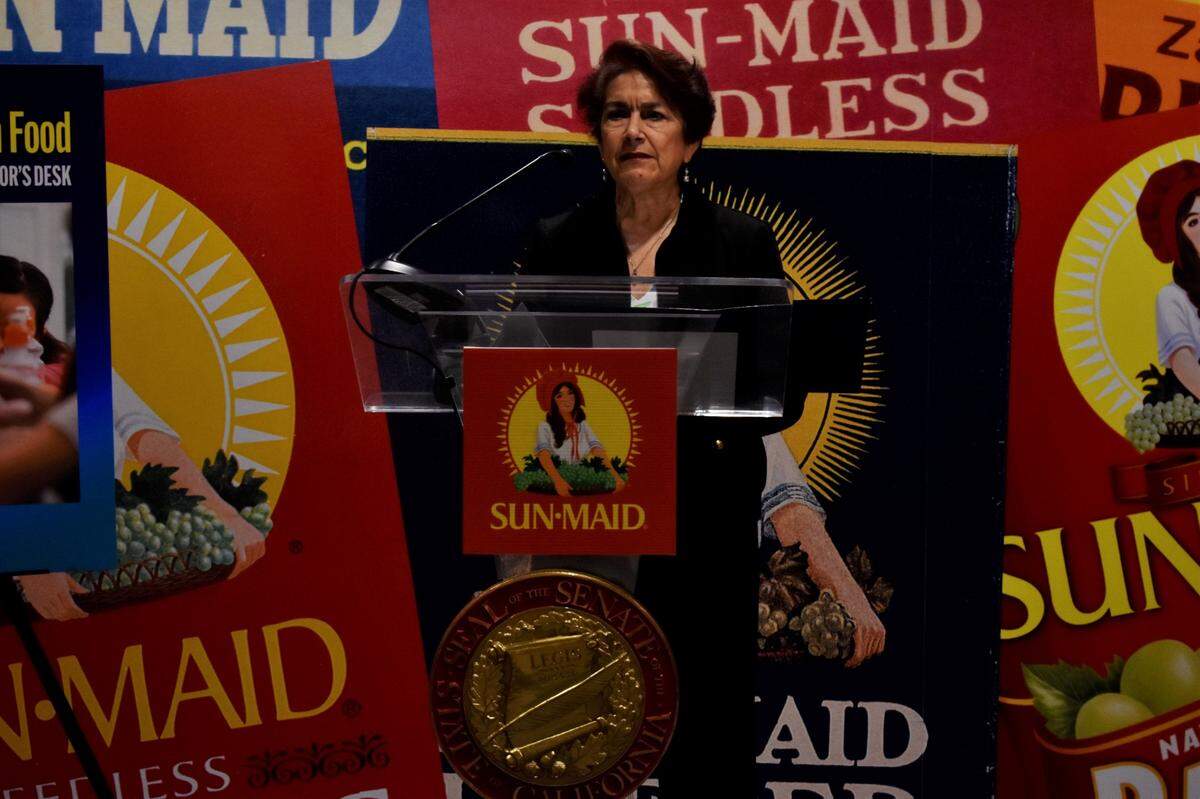
“I think that if you buy American, you’re going to be buying from California almost exclusively in all (produce) categories,” Caballero, a Democrat who represents the Salinas Valley and parts of the San Joaquin Valley, said during a press conference Wednesday morning at the headquarters of Sun-Maid Growers of California.
If signed, the bill’s provisions would be enforced through an “honor system,” according to Elisa Rivera, Caballero’s spokesperson.
This is Caballero’s second attempt to get a bill of this kind signed into California law. Her previous bill aimed to implement a similar protocol. It stalled in the legislature in June.
The previous and current measures have strong support from California agricultural organizations. Both bills are opposed by educational organizations, which say the Buy American Food Act would drive up their food prices.
“There are better ways to subsidize our agricultural industry besides self-imposed price hikes on California schools,” said Troy Flint, spokesperson for the California School Boards Association. “This bill is effectively a transfer of funds from public education to the farming industry.”
Some California agriculture groups support the bill
Some agriculture industry organizations support the bill, saying it could help stabilize and grow California’s agricultural industry after the challenges it faced during the COVID-19 pandemic.
“I really think that policies like the one introduced by Senator Anna Caballero are much needed today to protect the workers that were deemed essential,” said Hernan Hernandez, executive director of the California Farmworker Foundation.
By pushing state institutions to buy domestic food products rather than imported ones, the bill would support California growers who are struggling to compete with agricultural operations in other countries, said Rich Hudgins, president and CEO of the California Canning Peach Association.
“One of the biggest threats facing California’s peach growers today is the increasing volume of foreign-sourced canned peaches entering the U.S., primarily from China and from Greece,” Hudgins said.
“What is devastating to farmers is that some of these foreign peaches have been purchased using taxpayer dollars and are being served to our students in school feeding programs in California,” he added.

School association says bill would increase food costs
But the California School Boards Association, which represents elected officials who govern public school districts and county offices of education, says the legislation would strain school districts’ meals budgets and endanger the state’s efforts to provide universal school meals to school children.
The association said the Buy American Food Act would increase the purchasing cost for school meals by up to 25%. It said the Buy American Food Act would cost districts an additional $474 million or $85 per student, according to calculations by the California County Superintendents Educational Services Association.
Caballero acknowledged the Buy American Food Act will indeed cost school districts more. She said the state allocated $611.8 million to help school districts cover that extra cost.
“This higher rate of reimbursement will enable the local educational agencies to continue offering better quality and diverse meals for our students and ensure the Universal Meals program continues uninterrupted,” Caballero said.
However, Flint with the CSBA said the association fought for the $611.8 million to cover the already increasing prices schools are facing to comply with the Universal Meals program, not Caballero’s bill.
“Because California is now serving meals to all students, school districts are hiring more staff for the nutrition program and converting part-time staff to full-time and incurring significant additional costs in terms of salaries and benefits,” Flint said.
“That’s what the $611.8 million is designated to pay for, so it is disingenuous to suggest that this money was intended to pay for a law that arbitrarily suggests schools pay higher prices for goods,” he added.
Newsom has until the end of the month to sign or veto the legislation.
This story was originally published September 18, 2022 at 5:30 AM.