
Fresno State launches sexual harassment task force. Everything is on table, president says
Fresno State has taken a next step in addressing sexual harassment and Title IX violations on its campus, creating a task force that initially at least may target culture rather than a problem that was exposed by news reports and led to the resignation of former university president and California State University chancellor Joseph I. Castro.
The task force, working with external consultants retained by the CSU board of trustees, will dive into a process of reporting and investigating discrimination, sexual and gender-based harassment and other claims at Fresno State that for years had been tainted by a fear of retaliation for victims and campus personnel reporting abuses.
“We are going to establish a process that is informative, but at the same time is accountable,” university president Saúl Jiménez-Sandoval said. “That is our highest goal in all of this.”
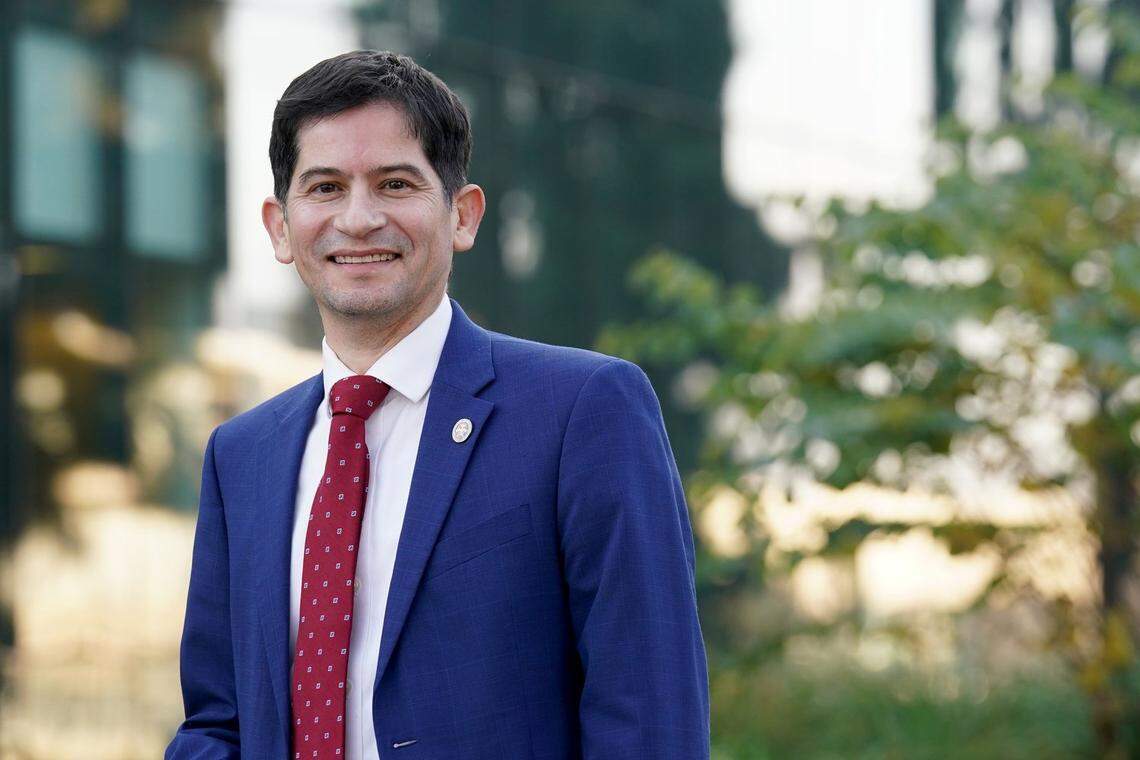
Jiménez-Sandoval said that “everything is on the table right now,” when it comes to existing resources and personnel including perhaps shifting responsibilities in and above the university’s Human Resources, Title IX and Discrimination, Harassment and Retaliation departments.
“We can’t re-conceptualize the system without putting all of the basic elements on the table,” he said.
The task force will be led by chair Bernadette Muscat, the university’s dean of undergraduate studies, a former professor in the Department of Criminology with a victimology emphasis.
The task force includes Jaime Arvizu, the director of the college of science and mathematics advising center; Davion Baker, from the Office of Black Student Success; Ashley Emerzian, a community representative; Kathryn Forbes, from the department of Women’s Gender and Sexuality Studies; Hailey Hererra, an Associated Students representative; D’Aungillique Jackson; Associated Students president; Dheeshana Jayasundara, from the Department of Social Work Education; Kate Kafonek, from the Department of Criminology; Mindy Kates, a survivor advocate; Samarpreet Kaur, an Associated Students representative; Sue McCarthy, from the CSU Title IX office; Georgianna Negron-Long, a mental health educator with the Student Health and Counseling Center; Jim Schmidtke, interim associate vice president for faculty affairs; Malia Sherman, director of Counseling and Psychological Services; Rachel Stanton, a graduate student representative; and Brian Tsukimura, from the department of biology.
Also, deputy Title IX coordinator Erin Boele, associate vice president for human resources Marylou Mendoza-Miller and Title IX and Clery compliance director Jamie Pontius-Hogan, who were in those positions for at least part of the tenure of former vice president of student affairs Frank Lamas, who was the subject of a number of sexual harassment allegations prior to a 2019 Title IX investigation after an employee detailed alleged abuses that went on for more than two years.
Lamas, according to the investigative report, gave the complainant condoms, touched her inappropriately including once adjusting her bra strap after it had slipped down her shoulder, and once grabbed her forearm and massaged her bicep with his other hand while commenting, “Look at those muscles. She’s so toned …”
CSU also reviewing its Title IX practices
Despite the allegations, which started shortly after Lamas was hired in 2014, Castro never formally disciplined Lamas and continued to provide positive evaluations and annual pay raises. When Lamas departed the university, he left with a $260,000 settlement and promise of a letter of recommendation from the university president.
Castro also recommended Lamas for the presidency at Cal State San Marcos.
As Fresno State moves forward with its task force, the California State University system also has engaged the law firm Cozen O’Connor to review its Title IX practices, training and support systems across its 23 campuses.
“I want the task force to fully explore this and fully see what the possibilities are so that they, along with Cozen O’Connor, recommend what the next steps will be,” Jiménez-Sandoval said.
For Fresno State, culture is a critical piece, Muscat said.
“Individuals need to feel comfortable,” she said. “They need to feel safe and they need to know that they can speak up. These issues are ones that are very under-reported, not just here, but elsewhere; not just on campuses, but in a variety of settings and organizations be it in the valley, in the state, nationwide, globally. These are things that people don’t talk about and don’t feel comfortable speaking up about and they don’t feel that they’ll be heard.
“But to have that culture of knowing I can speak up and I can talk about this and I will be heard, that there is a process in place, that’s extremely empowering to the individuals who have to speak up or to those who have to speak up on their behalf.”
There were obviously processes in place at Fresno State, as well as a long list of universities that allegedly or have been found to mishandle abuse claims including high-profile cases at Michigan State and Louisiana State.
In the CSU, a former athletics trainer at San Jose State accused of sexual misconduct with female student-athletes over a 15-year career was charged last month with civil rights violations. The university had reviewed those allegations in 2010 but cleared the trainer of wrongdoing, according to a report by USA Today, and he was never disciplined and remained in his position for the next 10 years.
“I think the CSU realizes this is an opportunity for creating a forward-thinking system that addresses a lot of the issues that have gone unanswered and I think the CSU also understands that the legal basic parameters that we have with these laws, they’re not fulfilling the needs of our very complex environments,” Jiménez-Sandoval said.
“I think the CSU sees this as the opportunity to empower Fresno State to build a system that will be a model for the other 22 campuses.”