Several Fresno County communities will soon see upgraded internet. Here’s who gets help
Rural communities in Fresno County are seeing an increase of state, federal, and private dollars to close the ‘digital divide’ as families say they fell behind during the pandemic.
The region’s digital divide — or the gap between those who have internet connection, digital devices, and digital literacy skills and those who don’t — was at least partially addressed earlier this week when the rural West Fresno community of Biola celebrated the arrival of free internet access thanks to a $1 million “digital equity” investment from Comcast.
Located just 20 minutes from central Fresno, Biola is a rural community of over 1,427 people, a majority of which are Latino and over 69% of which are non-citizens, according to the U.S. Census data. Many are employed in the local agriculture, construction, and manufacturing industries, and 38.5% of the residents experience poverty.
When the pandemic forced students to connect remotely from home, local school officials worked to ensure Biola’s students could continue their studies.
Central Unified School District, which includes the community of Biola, used CARES Act funding to install a radio antenna tower at Biola-Pershing Elementary School to provide permanent, free, in-home internet connectivity. In 2020, the Board of Trustees approved the purchase of AT&T hotspot devices free of cost to Biola-Pershing Elementary students, said Gilbert Magallon, public information officer for the district.
Still, families said their children struggled because of internet connectivity during the pandemic.
“The truth is it was horrible because the internet went out all the time,” said Guillermina Platon, speaking in Spanish. Platon is a 40-year-old farmworker and mother of three Biola-Pershing Elementary students.
Other times, the school computers didn’t start, and the family had to go to the school to change equipment, said Platon.
Platon said that her kids fell behind in school. “It was really difficult.”
However, the family was able to breathe a sigh of relief on Tuesday as Platon’s three children— Emilio, a sixth grader, Guadalupe, a fourth grader, and kindergartener Itzel—were among the 250 Biola students that received free laptops thanks to a donation from Comcast.
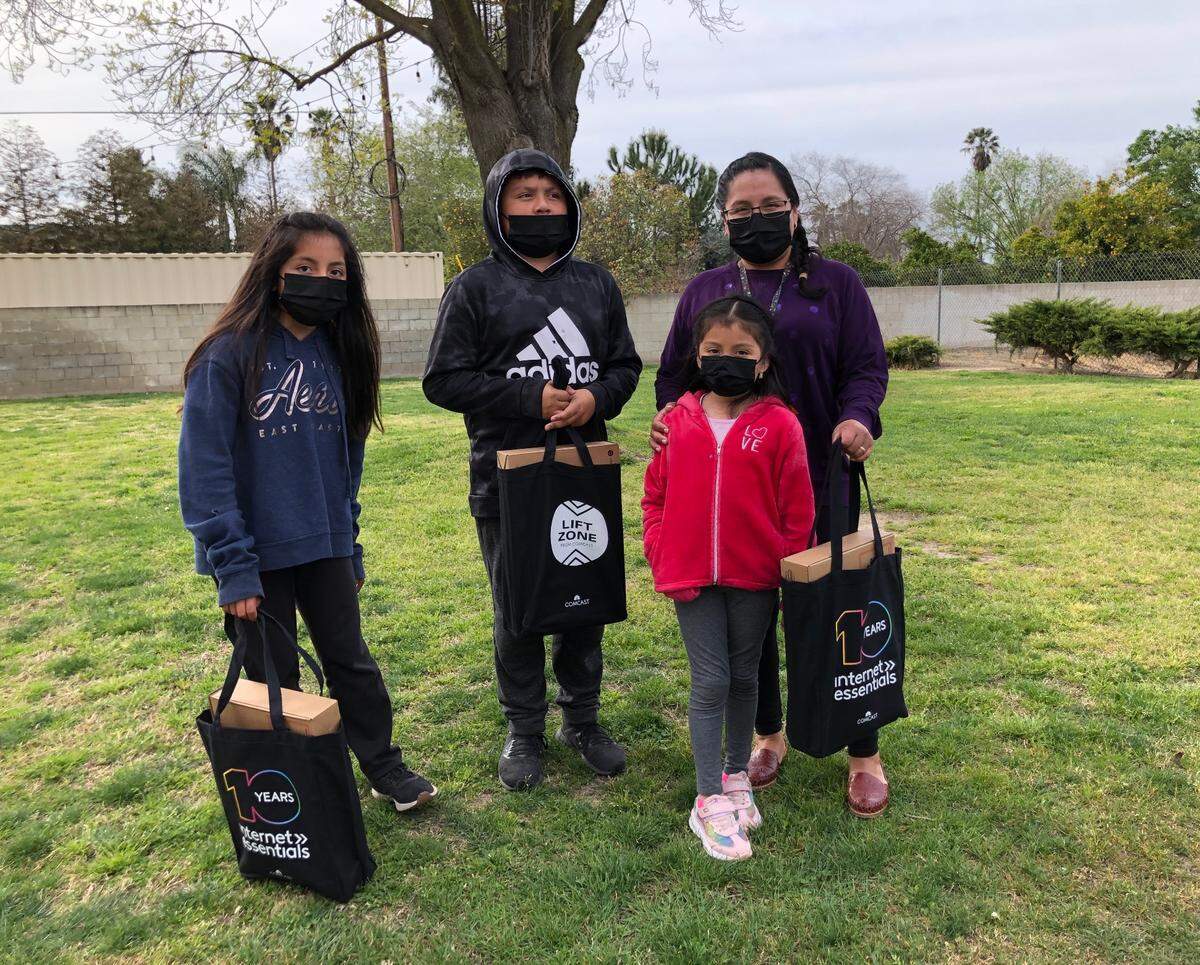
The $1 million investment, which was announced on Tuesday at the Biola Community Services District, will be used to open three “Lift Zones” in the Central Valley region, including Biola, as part of a plan to build 1,000 free internet zones at safe locations nationwide for low-income communities.
Qualifying families and individuals that sign-up for Comcast’s Internet Essentials Program and the the federal ACP program will be able to receive free broadband access.
The company is also donating over $100,000 to local community organizations, including Fresno State Parent University and Reading & Beyond, to provide digital literacy training to Biola students, families, seniors, and community members.
Local representatives celebrated the donation. “This will help us to move a giant step forward,” said Assemblymember Dr. Joaquin Arambula, a Democrat from Fresno, who spoke during Tuesday’s announcement.
The initiative comes at a time when California education leaders are trying to close the digital divide in the region and recover from the educational impact of the pandemic.
School leaders acknowledged the difficult two years that students and families faced with distance learning.
“The Central Valley was one of the hardest-hit areas during the pandemic, “said Biola-Pershing Elementary school Principal Chelan Shepard. “It will take years, if not decades, for our community to make a comeback from the economic, social, and emotional effects caused by the COVID-19 pandemic.”
West Fresno sees a piece of state’s $6 billion digital equity funding
While 2019 estimates have reported that 25% of Fresno County homes are without internet, county officials think that the percentage of those without internet may actually be higher.
An October 2021 report by the Public Policy Institute of California said that 41% of low-income households in California still do not have full digital access to both the internet and a device for educational purposes. The problem is great among communities of color: 37% of Latino households and 29% of Black households lack full digital access as well as devices for educational purposes.
Official data doesn’t capture the whole digital divide, said Eduardo Gonzalez, program director for San Joaquin Valley Regional Broadband Consortium, another initiative working to close the digital divide. “It’s hard to tell (the full gap) unless you map community by community,” he said.
The Consortium helped work with Comcast to secure the investment for Biola and was also recently consulted by the state on another west Fresno broadband investment.
In November, west Fresno was announced as one of 18 projects to receive initial funding for “middle mile” broadband initiatives from the state as part of the state’s $6 billion dollar investment to expand broadband internet access in the state’s underserved communities, which Gov. Gavin Newsom announced last July.
Of the multi-year investment, $3.25 billion will be used to build, operate and maintain a state-owned open access “middle mile” network, a high-capacity network that can carry large amounts of data at higher speeds over longer distances between local networks, according to a news release.
When the project is complete in about two years time, the network will service the communities of South Dos Palos, Kerman, Mendota, Firebaugh, Tranquility, and San Joaquin.
The state is also dedicating $2 billion towards “last mile” projects that connect households and businesses with local networks, and $750 million of the investment will go towards a loan loss reserve fund so that local governments and nonprofits can access secure financing for broadband infrastructure.
Access to the internet opens up a world of services, such as education, employment opportunities, and telehealth, to help lift families out of poverty, said Gonzalez, of the broadband consortium. But broadband infrastructure and access to the internet aren’t enough.
Digital literacy skills have to be part of the work to close the digital divide, he said. “What’s the benefit of having a Ferrari if you don’t know how to drive?”
Fresno County leaders say broadband isn’t a luxury
Fresno County leaders say they are vying for this type of state grant funding to expand broadband access in rural parts of the county, and is building collaborations to address the digital divide.
The county is part of the Fresno Coalition for Digital Inclusion as well as the Fresno County Equitable Broadband Committee, two initiatives that seek to close the digital divide. Both groups include the Fresno County Superintendent of Schools, local school districts, California State University Fresno, the State Center Community College District, Cradle to Career, Fresno Housing Authority, Valley Children’s Hospital, and others.
According to Sonja Dosti, public information officer for Fresno County, these coalitions are working together, sharing information, and jointly applying for grants to support “digital inclusion” throughout Fresno County while also advocating on behalf of county residents to both state and federal agencies.
Melissa Montalvo is a reporter with The Fresno Bee and a Report for America corps member. This article is part of The California Divide, a collaboration among newsrooms examining income inequity and economic survival in California.
This story was originally published March 17, 2022 at 5:00 AM.