Meet California’s ‘Blaxican’ elected leaders: ‘We exist, we’re out there, we’re present’
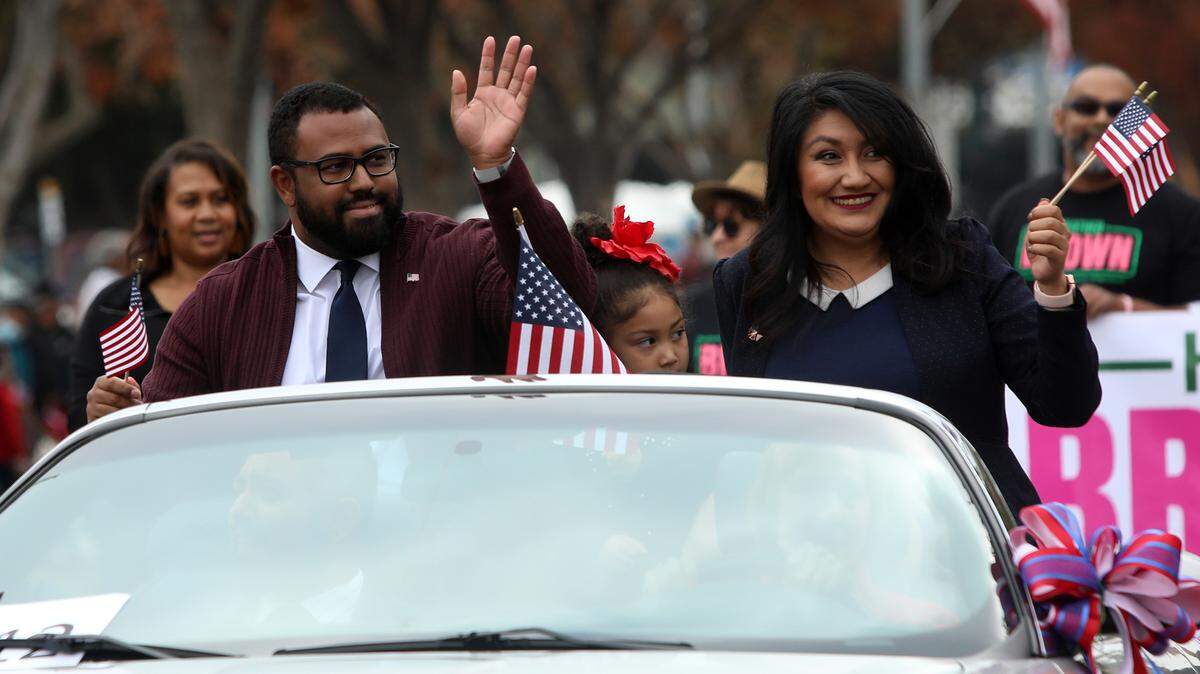
During last month’s Martin Luther King Jr. Day march in downtown Fresno, City Council President Nelson Esparza took to the stage to address a crowd of about 300 people.
“Were it not for the leadership of Dr. King,” Esparza said on that crisp, sunny morning in front of City Hall, “I certainly wouldn’t be up here speaking here today.”
Esparza, who identifies as half Mexican-American and half African-American, said that the opportunity was special for him. The 31-year-old Esparza said he thinks he is the first Fresno City Council president to identify as someone of both Black and Mexican heritage.
Al Villa was the first Latino elected to the Fresno City Council in 1971; Joe Williams was the first African-American elected to the Fresno City Council in 1977.
“I identify as two ethnicities that have traditionally been part of marginalized communities,” said Esparza, who was elected to the Fresno City Council in 2018 after a two-year term on the Fresno County Board of Education.
He is part of a growing number of city leaders throughout California who identify as “Blaxican” or Afro-Latino including: Assemblymember Mia Bonta, a self-described “proud Black Latina” who represents California’s 18th district; Marcus Bush, the Blaxican vice mayor of National City in San Diego County; Blaxican Lamar Thorpe, mayor of the East Bay city of Antioch; and Tony Thurmond, the California Department of Education’s first Afro-Latino superintendent of public instruction.
The trend among elected leaders mirrors national and local demographic changes that experts say reflect both the growing diversity of the nation and the way the census question was asked.
In 2020, communities throughout the Central Valley saw a huge jump in the number of people that identified themselves as comprising two or more races in combination. In Fresno County, 4.5% of Fresno County residents identified as multi-racial in 2010, compared to 16.2% in 2020.
“Leadership in the community should reflect who the community is,” said Esparza. “That was a big part (of) why I wanted to run in the first place,” he said.
How bi-cultural identities shape elected leaders’ worldviews
Esparza was born to an immigrant mother from Villanueva, Zacatecas, Mexico, and an African-American biological father. He grew up in a working-class Latino household in East Madera, eating menudo, pozole, and tortas, as well as other American foods. His grandfather worked in the fields as a farmworker and his mom worked in commercial insurance.
Although he was raised only knowing his Mexican family, Esparza said he’s typically perceived as a Black man.
“I certainly know what it’s like to be Black in this country,” said Esparza. “If you didn’t know me, you probably would just assume I’m fully Black.”
Esparza said that his appreciation for his Mexican side manifests in many ways. His first language was Spanish, and he still uses it in the course of his work, such as listening to public comments made in Spanish. In January, the Roosevelt High School mariachi troupe came out to City Hall to perform at Esparza’s council president reception.
But because Esparza grew up with his Mexican mother and stepfather, and not around his biological African-American father, he had to explore his Black identity “largely on my own.”
At 16 years old, Esparza said he experienced a “great shock” when he encountered overt racism for the first time. While walking in his East Madera neighborhood, the high schooler was stopped by the police, who said he matched the description of a suspect nearby.
Esparza said he was “happy” to comply with the police in their search. But as he started to empty his pockets, Esparza said he felt “fear and confusion” when the police officers pointed their guns at him.
In that moment, Esparza said, he learned that he should never “reach (for his pockets) during an encounter with the police.”
Many Black families in the country are “sadly forced to teach (this lesson to) their children at a young age,” said Esparza, but it was something he had to navigate solo.
Blaxican leaders in California said they have also grappled with their mixed-race identities.
Bush, the vice mayor of National City in San Diego County, was born to an African-American father and a Mexican-American mother. He said he identifies equally with his Black and Mexican sides but was “treated by society as an African-American.”
“We have a misconception of what it means to ‘look Mexican,’” said Bush.
A 2016 Pew Research Center survey found that nearly one-quarter of U.S. Hispanics identify as Afro-Latino.
Thorpe, mayor of the East Bay city of Antioch, was born in prison to an African-American mother and adopted by a Mexican family. He grew up speaking Spanish and attending bilingual school in El Sereno, a predominantly Mexican neighborhood in Los Angeles.
“It’s deliberate to say ‘Blaxican,’” said Thorpe, who identifies with the term. “But Mexicans are Black just as they are Spanish, just as they are Indigenous,” said Thorpe.
California’s Blaxican leaders represent communities
A first-generation college student, Esparza said he developed an interest in public service and public policy during his economics studies at UC Riverside.
Another event around that same time inspired Esparza to pursue public office: the 2008 presidential election.
“The first name I ever marked on a ballot was Barack Obama,” said Esparza. Obama’s victory proved that there was “an appetite” for more representation by people of color. “It really opened my eyes to the fact it was possible,” Esparza said.
Representation, however, is not always a simple task.
Critics point out that Esparza was initially hesitant to support what he described as the “divisive rhetoric” of the Black Lives Matter movement in 2018 when he was running for city council.
In response, Esparza said that the language and rhetoric around race in the U.S. “has evolved” between 2018 to 2020, especially in light of the killing of George Floyd.
“There was never a moment I didn’t support it,” Esparza said of the movement.
In 2020, Esparza co-sponsored a declaration that made June 18, or Juneteenth, “Black Lives Matter Day” in Fresno.
Bush said he is seen as a champion for the Black community on the majority-Latino National City council because he is one of only two Black men elected to public office in San Diego County.
He said he supports the African-American community through his policy decisions, such as fair wages for city employees, local hire programs that increase access to jobs, and in addressing homelessness, which disproportionately impacts the African-American community.
And in a “symbolic but still important” move, last year, Bush spearheaded an effort to raise the Juneteenth flag at National City city hall.
Still, said Bush, “it’s not about choosing one side or the other. It’s about, ‘who do the people need a voice for,’ ‘who is unrepresented?’”
One message rings loud and clear from the group of Blaxican city leaders.
“We exist, we’re out there, we’re present,” Bush said.
This story was originally published February 23, 2022 at 5:00 AM.