
No more masks for vaccinated California farmworkers? ‘Too soon,’ some advocates say
This story is part of the Central Valley News Collaborative — a bilingual, community journalism project funded by the Central Valley Community Foundation and with technology and training support from Microsoft Corp. The collaboration includes The Fresno Bee, Valley Public Radio, Vida en el Valle, Radio Bilingüe and the Institute for Media & Public Trust at Fresno State.
Labor rights organizations are raising concerns about a California agency’s proposal to ease some COVID-19 workplace safety regulations for most industries. They say the relaxed rules could jeopardize the health and safety of the state’s agricultural workers, a community already disproportionately affected by the deadly disease.
As California reopens the economy and eases the majority of its COVID-19 restrictions, the California Division of Occupational Safety and Health, or Cal/OSHA, is looking to loosen workplace guidelines put in place during the pandemic.
While the agency has proposed requiring healthcare employees to follow existing COVID-19 workplace rules, which include mask-wearing at the workplace, enforced social distancing and cleaning and disinfection protocols, other industries — including agricultural and food processing workers — would no longer be required to do so for all of its workers.
The state’s Occupational Safety and Health Standards Board will vote on implementing the revised rules Thursday.
But labor organizations and workers’ rights advocates are concerned the new rules could leave unvaccinated farmworkers unprotected and put them at higher risk of contracting the virus again — leaving them and their communities more vulnerable to outbreaks. They are calling on the board to keep existing COVID-19 workplace emergency standards for food and agricultural workers in place in its revised measures, just like it has proposed for healthcare workers.
“While statewide COVID-19 metrics continue to improve, the pandemic is far from over,” Mitch Steiger, a legislative advocate with the California Labor Federation, said in a letter to the board chairperson. “If approved as written... this update will worsen the pandemic and sicken and kill workers, with the death toll extending beyond the workplace and reaching families and friends as well.”
Cal/OSHA has said the highly effective COVID-19 vaccines reduced the need for some of the pandemic-related workplace protections. The purpose of the new guidance, it has said, is to align with recommendations from the U.S. Centers for Disease Control and Prevention and provide information about higher-risk settings where masks and other protocols are still required or recommended.
In a statement to The Bee, a spokesperson for the agency also noted the proposals include requirements for protective measures in cases of workplace outbreaks.
Mask guidelines would change under new rules
Current workplace rules mandate all employers to comply with emergency workplace standards, which include masking, distancing and physical barrier requirements. Steiger said the existing rules have “saved countless lives in industries such as food service, animal slaughter, retail, and many others.” He added: “The time is far too soon to do away with these efforts completely.”
Earlier this month, the Occupational Safety and Health Standards Board approved proposed updates that would’ve required vaccinated workers to wear masks indoors around unvaccinated employees — a move that sparked criticism from businesses who said the rules were difficult to implement and would have contradicted state and federal COVID-19 guidance.
The board scrapped that proposal last week and instead drafted the new rules with looser restrictions that it’s considering Thursday.
Under the revised guidelines, vaccinated workers would be allowed to go completely mask-free. They would still require unvaccinated workers to wear masks indoors unless they’re alone in a room or eating and drinking. Employers would be required to provide N95 masks for unvaccinated workers who want them when they are working indoors.

Workers, regardless of vaccination status, would also not need to practice social distancing.
The new rules would be enforced through an “honor system,” where workers would “self-attest” their vaccinated status, according to a draft of the proposal.
Are farmworkers at risk under new standards?
María De Luna, a policy coordinator with Alianza Nacional de Campesinas, an advocacy organization representing more than 700,000 farmworkers across the U.S., said the proposed changes to the safety guidelines would “jeapordize farm and food system workers,” the majority of whom are also Latino and undocumented immigrants.
It’s these workers, she added, who continue to be most at risk of infection and death and are still facing barriers to getting vaccinated.
Though Latinos make up 39.4% of the state’s eligible vaccine population, they account for just 27.5% of the state’s administered vaccine doses, recent state data shows.
“Many workers are still struggling to access care, to be able to get the vaccine and there are still many many concerns and anxieties around the vaccine,” De Luna said in an interview Wednesday. “Scraping away some of these workplace protections are going to put in greater jeopardy farm and food system workers who have had to shoulder a significant amount of the burden of this pandemic.”
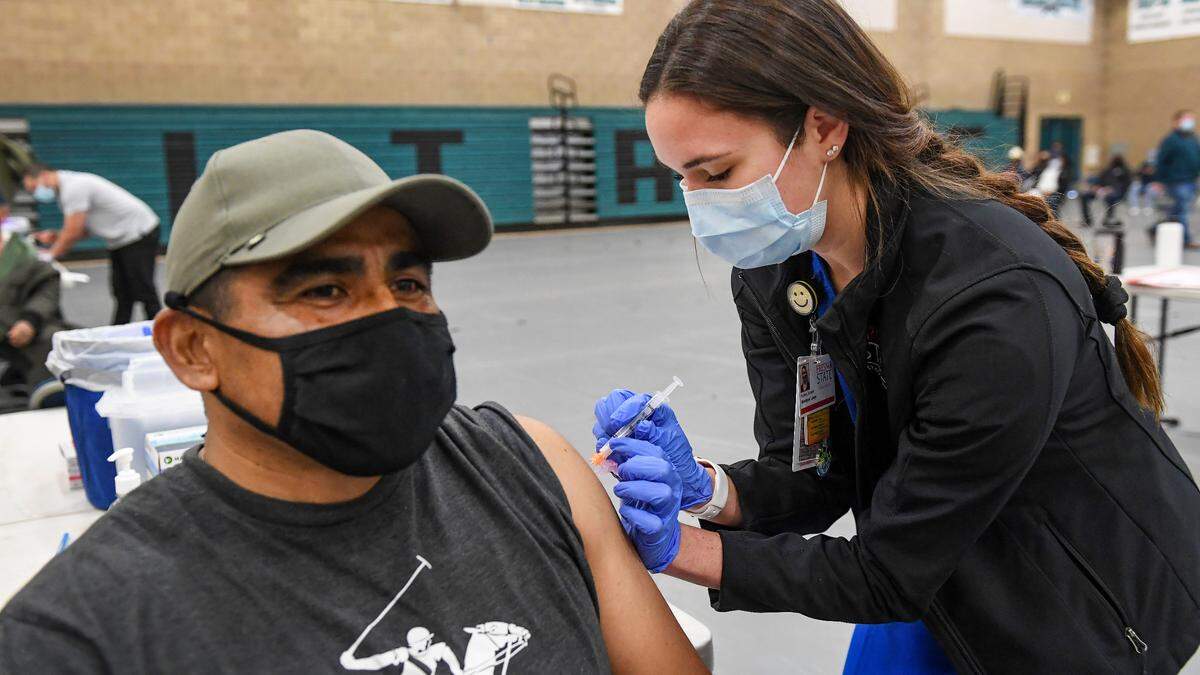
Some farmworkers agree the rule changes could be problematic, since many in the community have not yet been vaccinated.
Juan Duarte, 51, a mayordomo, or crew boss, supervises a team of about 20 farmworkers on a farm in Fresno County. He said many of the younger workers still refuse to get vaccinated, citing fears over the safety and efficacy of the vaccines.
He’s tried to convince his workers that the COVID-19 vaccine is safe, but some — including his two sons — have told him they don’t want to take the risk, he said. That’s why he believes the existing rules should stay in place.
“We don’t always know who among us is vaccinated,” he said in Spanish. “So yes, (the rules) matter. We have to keep being cautious.”
Duarte said relying on an honor system to enforce the new mask mandates alone won’t protect workers or prevent the possibility of a future outbreak, adding that he will keep taking precautions “for everyone’s benefit.”
“We should keep exercising caution for a while longer until we feel a little more secure that this (crisis) has diminished,” he said.
According to a report released earlier this year by the University of California, Merced, Community and Labor Center, there was a 38% increase in deaths among California workers in high-risk industries. This includes agricultural and food-chain workers, who comprised four of the ten California industries with the highest increase in deaths.
If the new state guidelines are approved Thursday, Gov. Gavin Newsom said he would sign an executive order putting them immediately into effect. Without the executive order, the earliest the rule could be implemented would have been June 28.