Cardboard boxes to fight wildfires? Fresno company banks on it for California, U.S. market
Over the past few years, as wildfires have ravaged parts of California and the western U.S., a Fresno company has been sitting on the sidelines with a system of cardboard boxes that its CEO believes could add much-needed capacity to the state and federal arsenal of aerial firefighting options.
Caylym Technologies International LLC and its CEO, Rick Goddard, have invested years in developing the Guardian System – an oversized cardboard cube capable of holding 264 gallons of water or fire retardant and dropped onto a wildfire from the rear ramp of many different models of cargo aircraft.
Countries around the world have adopted the system for firefighting: Italy, Romania, Slovakia, Germany, Greece, Israel, Thailand, Australia, Peru and Uruguay. The Guardian system accounts for about $2 million of the company’s $5 million in overall annual sales. But the boxes have not been used in California, where five of the six largest wildfires in state history struck last year, nor anywhere else in the U.S. or North America.
The U.S. Forest Service says it has concerns over the safety and effectiveness of Caylym’s system and similar proposals, and indicated that it is satisfied with its current array of resources for fighting fires from the air.
That’s been a frustration to Goddard and his company. “I think the most important reason is it’s not consistent with what they have been using in the past,” Goddard told The Bee in a recent interview. “We’re changing a paradigm here, “to be able to bring all these cargo aircraft available to fight the fight and to respond to the need for surge capacity.”
The U.S. Forest Service, part of the U.S. Department of Agriculture, contracts with private companies each year for tanker aircraft and firefighting helicopters for aerial firefighting. But massive blazes like the Camp Fire that devastated the northern California town of Paradise in 2018, and last fall’s Creek Fire in eastern Fresno and Madera counties – becoming the single largest wildfire in California since modern recordkeeping started in 1932 – have overwhelmed the limited aerial firefighting resources that the federal agency can bring to bear because they are spread among multiple fires across the western U.S.
“All of the capabilities of tankers, whatever system we have is being used as effectively as possible,” Goddard said of the Forest Service’s aerial assets. “They’re responding as quickly as they can; they just don’t have enough in years like we’ve had when you’ve got 4 million acres burning. … Our system allows surge capability.”
Tal Eslick, a former congressional staffer now working as a consultant with Caylym, said the Guardian system “opens up many airplanes to fight fires.”
“It’s not saying tankers don’t work. The problem has grown; our capability needs to grow,” Eslick added.
How it works
The Guardian system is a collapsible cardboard cube with an inner liner and a lid, all mounted atop a pallet that fits on the rollers in the floor of many airlift-capable cargo aircraft. The system is shipped flat and arrives at a flight line ready to assemble.
When needed, the flat assembly is popped into its cube shape and the inner liner filled with water or fire-retardant chemicals. The assembly and filling process takes between three and five minutes, said Kyle Goddard, who handles operations support for Caylym and is Rick Goddard’s son. Once filled, it’s ready to be loaded into the aircraft like any other type of cargo.
A four-engine C-130 Hercules cargo plane can carry 16 individual Guardian boxes – about 4,200 gallons of water, fire retardant or foam – in a single load. When the aircraft reaches its position flying over the drop point designated by fire incident commanders, the rear door of the aircraft opens and the boxes released to drop from the ramp.
Once released, aerodynamics pop the cardboard lid from the box. The tethered lid acts as sort of a parachute, pulling open the inner liner and letting the box tip to empty its contents onto the fire below.
“The units roll out by gravity just off the back of the airplane,” Kyle Goddard said. “This entirely biodegradable cardboard box comes out (and) opens in the air. Think about tipping a bucket over, now the water is in free fall very much like rain.”
“It creates very long, gentle patterns for retardant,” he added. “After it falls on the ground, it can be collected and recycled later.”
A full load of 16 Guardian boxes dropped from a C-130 can cover a pattern up to a quarter-mile long with water or fire retardant, Rick Goddard said.
This isn’t just any cardboard box. It’s made of many layers of corrugated material, adding up to about 1 1/2 inches in thickness. Instead of having glued seams at the corners, the sides are wound without seams. “It’s made to hold large quantities of liquid with very low material weight,” Kyle Goddard said.
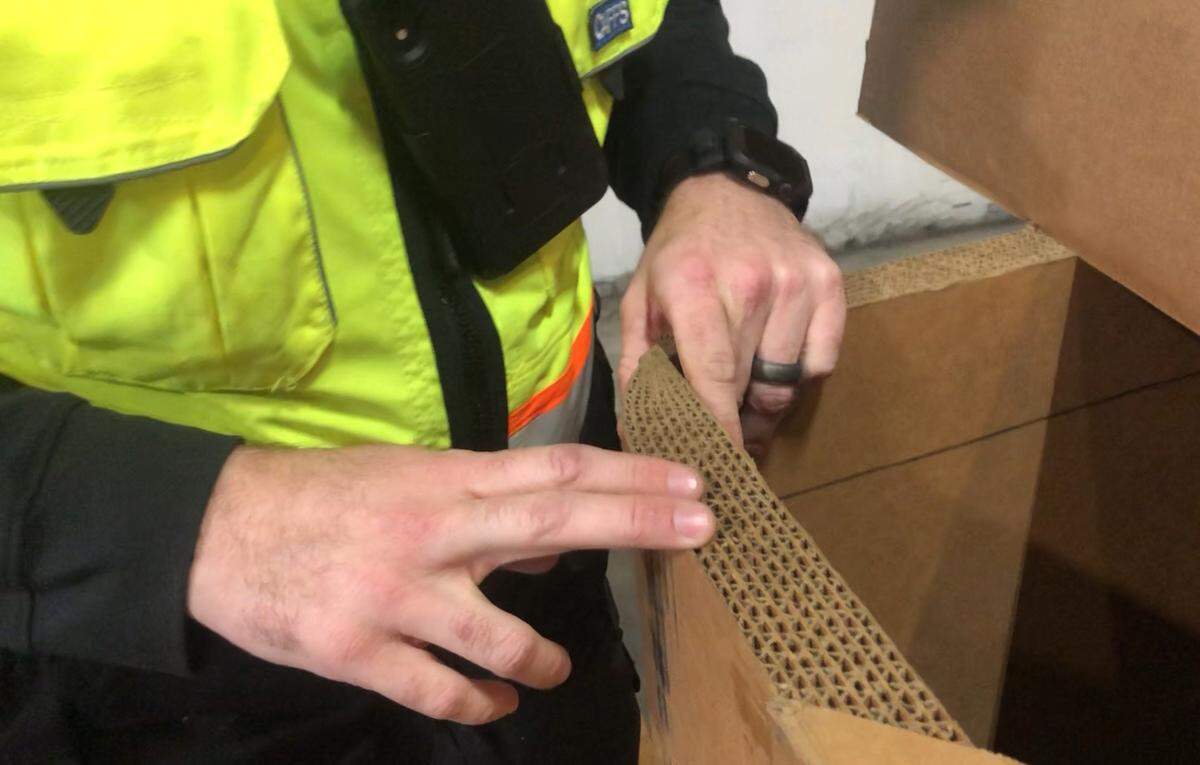
Rick Goddard said the layered cardboard material was originally designed to transport liquid bulk food products such as tomato paste or essential oils in rail cars across the country. Each box, fully assembled with its pallet and lid, has an empty weight of about 105 pounds.
Rick Goddard said the company, which since 2015 has been in a warehouse less than a mile from the Forest Service’s Fresno Air Attack Base at Fresno Yosemite International Airport, is on a pace to sell about 1,000 Guardian boxes this year, at a price of about $600 each; the per-unit price gets lower depending on the scale of the sale.
The company employs 23 workers full-time, and has three part-time workers as well. For now, the bread and butter of Caylym’s business is assembling and selling more conventional corrugated cardboard boxes for produce companies, food manufacturers and other customers. But the line and its employees can quickly pivot to producing the heavier Guardian boxes on short notice if its firefighting customers need them, Rick Goddard said.
What’s the holdup?
While it’s being used by other countries, the U.S. Forest Service has yet to give a green light to using Caylym’s system, .
Rick Goddard said the Air National Guard and the U.S. Air Force both tested the Guardian system on their cargo planes in 2018 and determined that “the system behaves exactly as their standard cargo” that can be dropped from the rear deck of the aircraft. He said there has been positive feedback from Cal Fire, the state agency that deals with wildfires on state lands.
But Cal Fire’s influence is limited because “when it comes to the air assets, most of the assets that would be drawn upon to use our system would be federally based,” Goddard said. “We need to look to (the U.S. Forest Service) to be on the leading edge.”
Rick Goddard added that the Forest Service has indicated a need for additional testing of the system.
Eslick said Caylym has gotten positive interest from members of the California’s congressional delegation, including Rep. Jim Costa, D-Freson, and two of his former bosses, Rep. David Valadao, R-Hanford, and Rep. Devin Nunes, R-Tulare. Despite that, “the Forest Service wouldn’t be accused of being particularly creative or fast-moving” in its decision making, Eslick said.
Eslick added that the company has hopes that a new administration in Washington and new leadership in the Department of Agriculture and Forest Service, may offer new opportunities for headway. “We have to do something,” he said. “We’re talking about property, and more importantly, lives being lost. This is not a time to not entertain options for any reason.”
The U.S. Forest Service’s National Interagency Fire Center reported in an email to The Bee it has contracts for up to 35 air tankers available nationwide for the 2021 firefighting season, as well as eight military C-130 cargo aircraft equipped with firefighting gear, and additional air tankers in collaborative agreements with Canada and the state of Alaska.
Additionally, it expects to be able to have more than 200 helicopters through various resources.
But the agency appears reluctant to sign on with Caylym’s system.
“Public and firefighter safety has not been adequately addressed, in particular mitigating the risk of a pallet impacting personnel on the ground, particularly one that has failed to open weighing 2,500 pounds,” according to a statement from the Forest Service’s headquarters in Washington.
“Although it is stated that the Guardian System is over 95% biodegradable, it would not be environmentally responsible to leave it on its own to decompose over time,” the agency added. “There is generally some level of post-fire rehabilitation that occurs; however, locating and gathering container debris would add additional time and cost to the effort.”
The Forest Service also noted that it has established optimal drop altitudes for different aircraft, speed and coverage related to effectiveness and safety. “Our current fleet of contract airtankers and (other aircraft) meet these requirements,” the agency stated, noting concerns with consistency, or inconsistency, of the coverage of water or retardant drops using the Caylym system.
Another concern involves introducing a new system and process for ground crews to learn. “Our current system of retardant loading the delivery has a very efficient and operationally effective infrastructure,” the agency said. A new system “would add to cost, complexity, logistics and possibly disrupt the synchronous operational tempo that is critical to protecting lives, property and natural resources.”
The Forest Service said it is “open to evaluating new and innovative technologies in wildland fire management,” and added that “in recent years, we have been approached by a number of companies with similar proposals” to Caylym’s.
“We have completed an assessment of our retardant delivery requirements in conjunction with current industry science, technology and best practices,” the agency added. “At this time, our current capabilities align very well with our requirements and modernization strategy.”
“Thus, we are not seeking any additional capabilities such as this (Caylym) system.”
Rick Goddard said his goal is not to replace air tankers, but to bring more capacity to the firefight. There are many more cargo aircraft with the ability and versatility to carry and drop the Guardian system than there are aerial tanker planes. And because they can make their drops from a higher and safer altitude relative to the terrain, cargo planes can operate day or night.
In the U.S. alone, there are about 220 big C-130 cargo planes that can hold two rows of eight Guardian boxes, Rick Goddard said. Other countries’ air forces are using smaller cargo planes to drop the Guardian system.
The Air National Guard Station Channel Islands in Southern California has two C-130 equipped with the Modular Airborne Fire Fighting System in which tanks can be loaded and water or retardant sprayed from the airplane as it flies over a fire line. Other C-130s that are part of the base’s airlift wing, however, were of no use to the firefighting going on across California last summer and fall, Rick Goddard said.
Goddard said he believes support from elected officials could help nudge the Forest Service into action. “I think we’re gaining ground,” he told The Bee. “Some years ago it did feel like a stone wall. Now it’s more like a very steep climb.”
“This isn’t that the other stuff is bad. It just wasn’t enough,” he added. “We just can’t afford to have enough (single-purpose tanker) airplanes when we need them.”
This story was originally published April 5, 2021 at 11:27 AM.