
Inside Fresno County Jail during coronavirus pandemic: ‘It’s sad and it’s scary’
With more than one in every three inmates at the Fresno County Jail infected with the coronavirus and a number of officers testing positive for COVID-19 also, their family members are demanding for more action to ensure the safety of those at the downtown facility.
Those at the jail, according to relatives who’ve spoken to inmates and officers, have described the facility as lacking effective protocol to limit the spread of the novel coronavirus.
Family members of inmates also claim those with COVID-19 don’t always receive proper medical treatment, which would put everyone at the jail in danger.
“I’ve heard other stories of what it’s like inside the jail it’s sad and it’s scary,” said Desiree Genera, whose husband is a correctional officer at the Fresno County Jail. She also has a sister at the facility who is an inmate.
“But a lot of officers,” Genera continued, “don’t want to speak up because they’re afraid of whistle blowing then (suffering) retaliation.”
As of Friday, Fresno County Sheriff Margaret Mims announced 764 people at the jail had tested positive for COVID-19 with at least 40 of them being correctional officers.
That’s among approximately 2,100 inmates housed at the Fresno County Jail and 500 officers who work there.
There has been one hospitalization but no coronavirus-related deaths. In addition, the jail has received 642 negative test results, and 353 other results are pending.
“As long as you have a jail facility, you’re constantly having to deal with illnesses, sicknesses,” Mims said. “What happens in our community, it’s going to happen in our jail setting.
“We were able to hold off COVID cases for a long, long time. And then, when we got the positives, they came on big.”
Fresno County Sheriff’s spokesman Tony Botti added that any claims that the jail isn’t taking steps to ensure the safety of its correctional staff and inmates “is all false.”
An officer infected
Genera’s husband, correctional officer Miguel Cisneros, declined The Bee’s interview request.
But according to his wife, he was instructed to work his shift despite reporting to his supervisor that he’d experienced COVID-19 symptoms during his days off.
Four days later, Cisneros received test results confirming COVID-19, Genera said.
She has since spearheaded protests demanding better conditions and more effective protocol.
“When he told his (supervisor) he’d been sick, she said: ‘You’ve been wearing a mask, right? You’ll be fine. You don’t have COVID,’” said Genera, recounting what Cisneros told to her. “So he worked. But we all know masks are not 100% protective. Now, who knows however many people he might’ve infected — officers and inmates.”
Correctional officer Eulalio Gomez, who is the union representative and president of the Fresno County Public Safety Association, said the conditions and protocol inside the Fresno County Jail could be better.
But it wasn’t so bad that he felt his life or health was in jeopardy, or a need to stop working, he said.
“I understand the concerns of the public, especially the families,” Gomez said. “They’re doing the best that they can. Nothing is perfect.”
Dealing with the inmate population
Fresno lawyer Kevin Little said the conditions inside the jail are so concerning that he petitioned a judge to release 50 inmates.
Little described the conditions that officers deal with as “just the tail of the dog” to the bigger problem that inmates face.
“You have about 700 people in the jail who are infected. How do you keep the other 1,400 from becoming positive?”
The Fresno County Jail has taken some steps to limit the spread of the coronavirus among inmates, including the $0 bail policy (reached by Fresno County Sheriff Margaret Mims and presiding Judge Alvin Harrell) that frees up jail space.
There also was the early-release program that took effect March 23 of low-level inmates and inmates whose sentences were due to be completed within the next 30 days.
Prior to the pandemic, the jail could house about 3,000 inmates. Now, it’s at 70% of last year’s maximum occupancy.
Nonetheless, health department protocol is tough to follow among inmates because of their confined space, Gomez admits.
“It is virtually impossible for inmates to do social distancing inside a jail,” Gomez said.
Masks and personal protection equipment
Botti said last month that jail workers have been distributing face masks and soap to all inmates.
Gomez said the jail supplies inmates cloth masks.
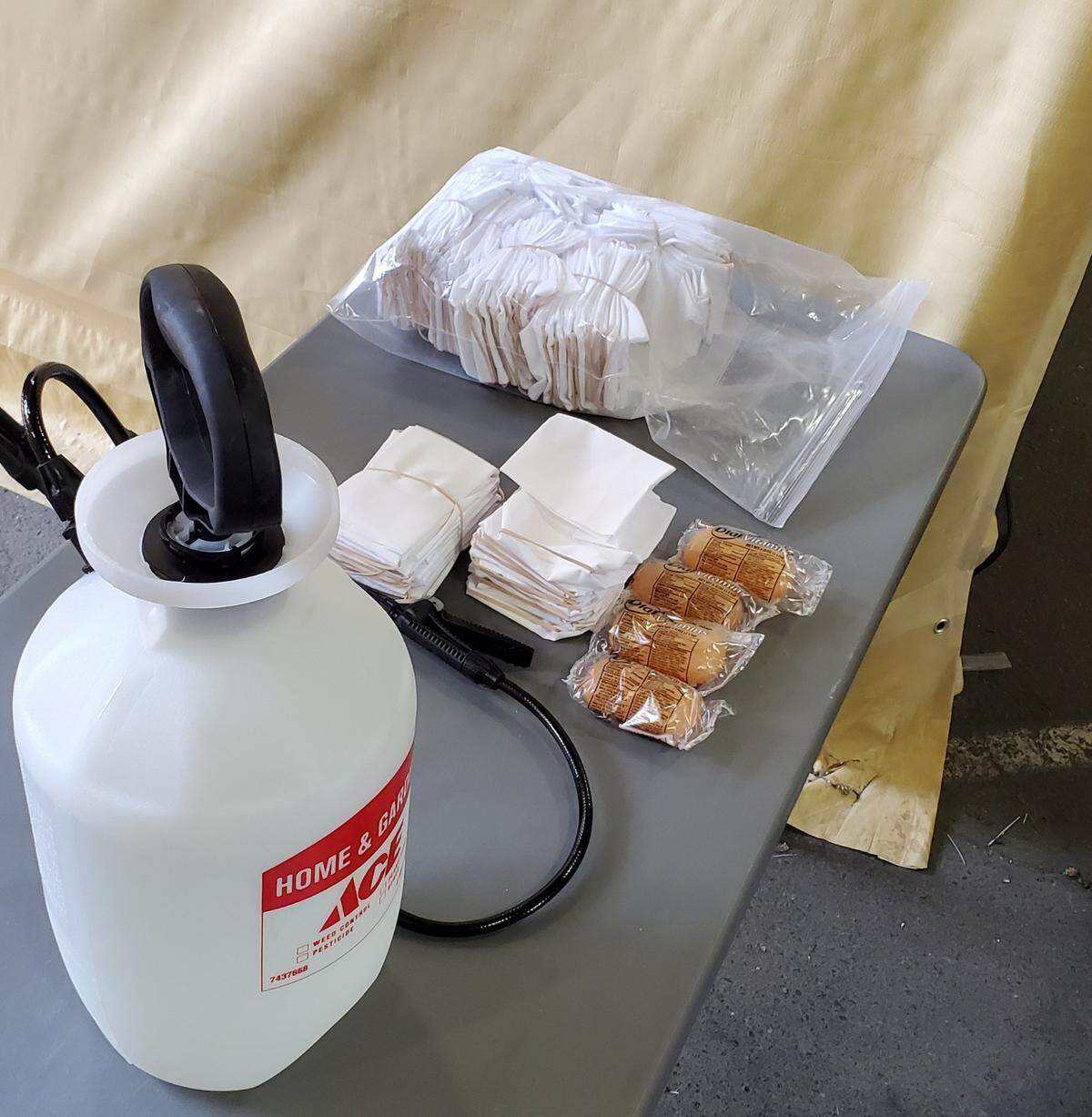
But some who participated in the protests said their loved ones in jail told them they’re not receiving PPE.
“Some of them are wearing their sheets as masks,” said Vanessa Ponce, who has friends who are inmates at the Fresno County Jail and spoke at the protests. “If family doesn’t put money in their commissary, then they have no soap or shampoo.
“How are they supposed to keep themselves clean during a pandemic?”
That’s not true, according to Botti.
He said inmates are given antibacterial bars of soap and two no-sew cloth masks free of charge. In addition, medical staff is available throughout each day in the jail.
“And if someone isn’t feeling well, they can fill out a form and they will be evaluated,” Botti said. “Medical staff will determine if they are to get any sort of medication or transferred to the hospital.”
Genera said inmates sometimes have to wait two or three weeks just to receive Tylenol. Headaches are sometimes a symptom of COVID-19.
“There’s a lot of cross contamination going on,” Genera said. “Something has to be done or it’s going to get worse.”
Enforcing protocol
Gomez said the sheriff’s department has taken steps to better the jail situation.
Officers are required to wear masks inside the facility and are strongly urged to wear eye protection and gloves, he said.
In addition, officers’ temperatures are taken and they’re asked a series of questions regarding their health before receiving clearance to enter the facility.
And in coming weeks, Gomez said officers will start to be tested on a weekly basis at the jail before work.
“As we progress in this pandemic, a lot of things pop up and it’s not always clear how to best address it,” Gomez said. “What we thought was right a month ago might’ve changed. We have to kind of bend like a leaf in the wind.”
Genera said the Fresno County Jail should’ve been better prepared and not waited for officers and inmates to become infected before taking action.
“Why not have this back in January or February when we all knew about this possibility,” Genera said. “I guess late is better than never.”
Protesters, meanwhile, claim protocol isn’t always enforced — that officers don’t always wear masks and inmates don’t always have masks to wear.
Even during a July 10 demonstration outside of the Fresno County Jail, at least one officer who was monitoring the outdoor gathering was not wearing a mask. Another officer next to him did have a mask on. The mask-less officer was scolded by protesters.
Gomez said some masks are uncomfortable to wear for an entire shift. Alternative masks typically are worn by the correctional staff, he said, rather than the jail-issued N-95 masks that are said to provide better protection.
“I challenge anyone to wear that N-95 masks for 12 to 16 hours, which is how long our officers’ shifts last,” Gomez said. “The breathing aspect, it’s very confined. And we’re not just walking from one office to another office.
“It’s tough to do the job that we do and wear that mask for that long.”
When the outbreak started
Through the first three months of the pandemic, the Fresno County Jail had five to six people who tested positive for COVID-19, according to the Fresno County Sheriff’s Office.
Then on June 19, the jail was informed 13 of 25 inmates who had been transferred from Fresno to Wasco State Prison had tested positive. Seven days prior, those inmates had tested negative back in Fresno.
“Everything changed,” Botti said. “We knew those 13 had come off of all floors in the North Jail Annex, so we put that entire facility into a quarantine: Nobody allowed in or out.”
Botti said the jail completed 1,200 tests by June 23, with results coming back sporadically.
The 600-plus inmates who tested positive were placed in quarantine areas.
The jail also is anticipating the possibility of more positive tests coming in after 500-plus more inmates were re-tested despite testing negative initially.
Those who test positive also will be quarantined.
“We are really at the mercy of the calendar and re-testing,” Botti said. “We need time to go by and results to comeback, which will eventually allow us to drive the positive number down to zero.”
Protecting officers and inmates
An attorney with Prison Law Office — a nonprofit public interest law firm based in Berkeley that provides free legal services to adult and juvenile offenders to improve their conditions of confinement — is scheduled to conduct a virtual inspection of the jail and review its protocol Tuesday and Wednesday.
In addition to officers being tested at the downtown facility, Mims stated the jail’s goal is eventually to test inmates for COVID-19 at least once a week.
Genera, meanwhile, said her husband believes he contracted coronavirus after breaking up a fight between inmates.
Since his positive test of COVID-19 on June 25, Cisneros has not been to work and instead quarantined at home.
Cisneros did test negative during his quarantine. But he must test negative a second time before being allowed to work again, under Fresno County Jail protocol.
At a July 2 protest that was attended by about 75 people, family members of inmates spoke of their concerns while in front the jail.
During moments of silence, banging could be heard coming from inside the jail.
Protesters claimed it was the sound of inmates pounding on the jail windows while watching from inside and a sign of support.
“As much as we voice of concerns for our inmates, it’s to benefit the officers, too,” Ponce said. “Who’s going to take care of the town? Who’s going to run things on the floor if all of the officers get sick?
“Improved conditions would benefit everyone.”
This story was originally published July 19, 2020 at 10:03 AM.