T-Mobile wants state to drop mandate to add 1,000 more hires. What’s it mean for Valley jobs?
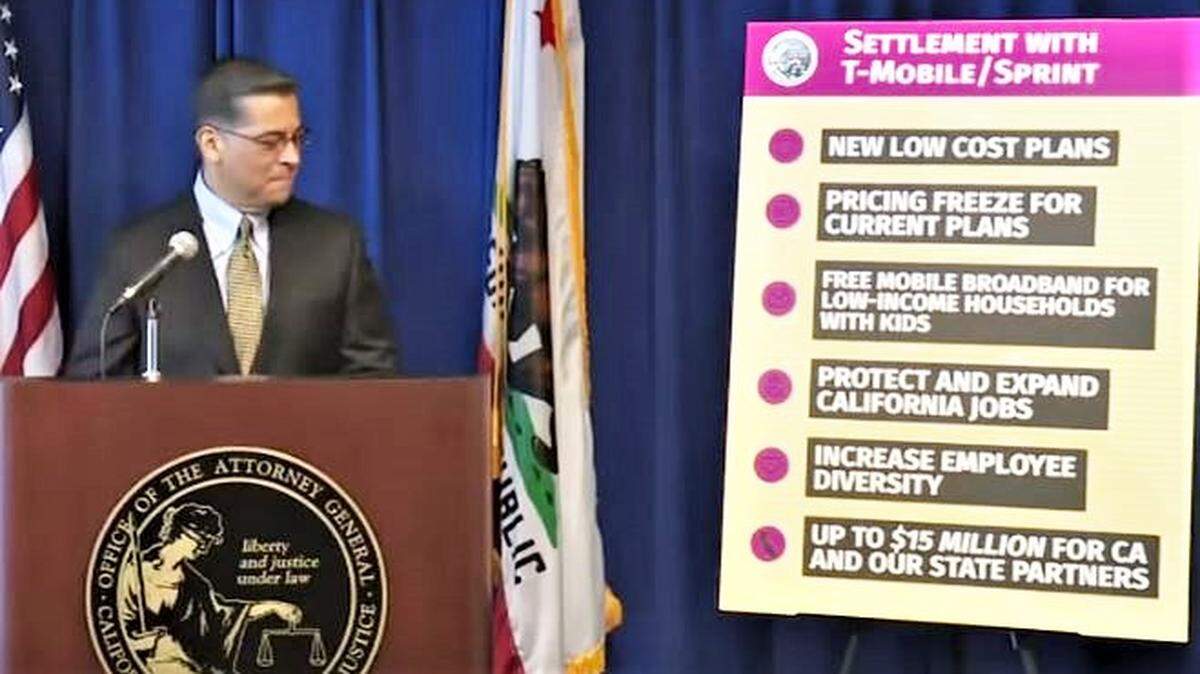
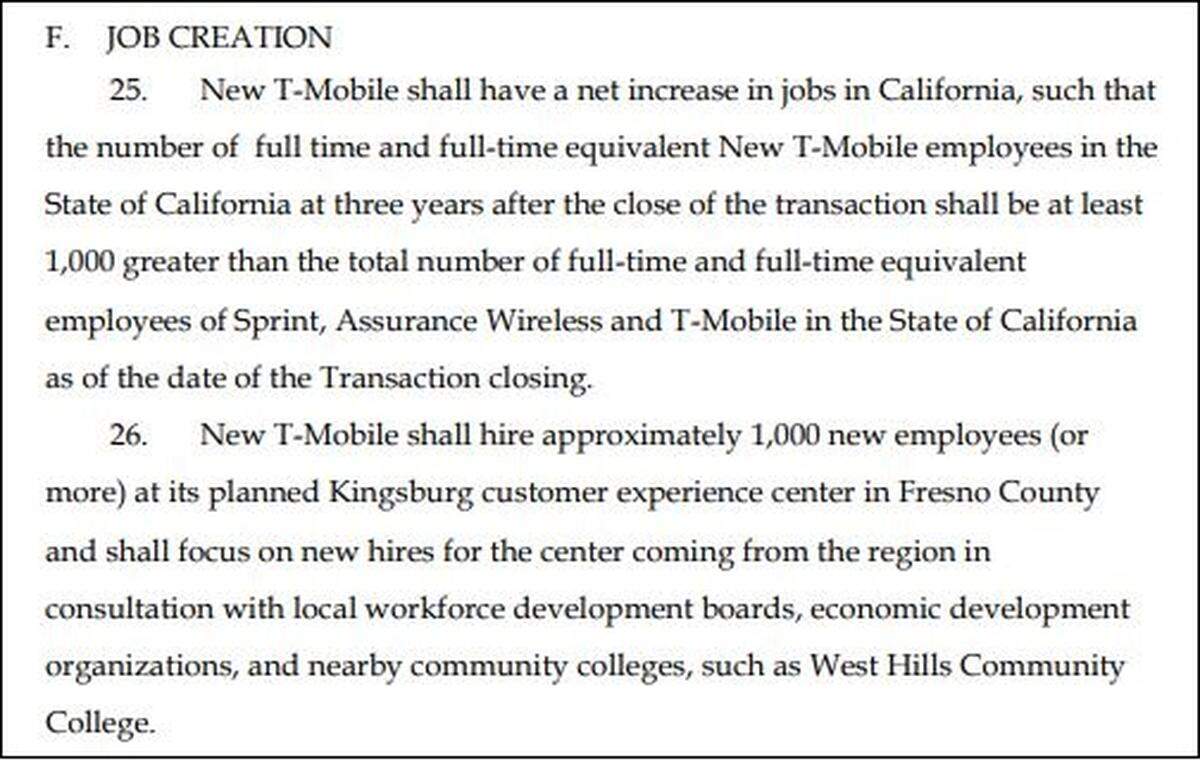
Wireless companies T-Mobile and Sprint are challenging a requirement that, as a condition of their merger, the combined companies increase their net full-time workforce in California by at least 1,000 employees within three years.
What the challenge means to T-Mobile’s plans to hire 1,000 new workers for a customer call center in Kingsburg – or how quickly that center might materialize – is murky.
The establishment of the new call center in Kingsburg, announced more than a year ago, was always contingent on approval of the merger.
In a petition filed Wednesday with the California Public Utiltiies Commission, attorneys for T-Mobile and Sprint contend that “a requirement mandating the creation of new jobs is well outside the Commission’s jurisdiction …,” and is “particularly burdensome and unjustified in light of the current COVID-10 crisis.”
The jobs requirement was among more than 40 conditions imposed by the CPUC in its April 16 decision approving the marriage of the companies into what has been called the “New T-Mobile.” California’s approval followed earlier federal approvals by the U.S. Department of Justice and the Federal Communications Commission, and a settlement between the companies and the state Department of Justice.
Prior to the merger, T-Mobile and Sprint were the third- and fourth-largest wireless carriers in the U.S., well behind Verizon and AT&T. The merger vaulted the new combined company into a more solid third place. To allay federal antitrust concerns, T-Mobile was required to sell off the popular Boost Mobile prepaid wireless service, and other Sprint assets are being sold to DISH, the satellite TV provider that will now get into the wireless phone business.
The CPUC decision actually came a couple of weeks after the formal merger between the two cellular companies. The new-jobs condition was accompanied by a second requirement that “New T-Mobile shall hire approximately 1,000 new employees (or more) at its planned Kingsburg customer experience center in Fresno County ….”
The commission also called for New T-Mobile to focus its hiring efforts on the region surrounding Kingsburg, consulting with local workforce development agencies as well as nearby community colleges.
Kingsburg’s location at the intersection of three sets of county lines – Fresno, Kings and Tulare – means that the call center, when it is developed, would likely attract employees from all three counties. The CPUC’s emphasis on community colleges for recruitment likely brings into play students at Fresno City College and Reedley College in Fresno County, College of the Sequoias with campuses in Visalia and Hanford, and West Hills College’s Lemoore campus.
T-Mobile’s petition doesn’t contest the required hiring of 1,000 workers for the Kingsburg call center. It does oppose the requirement for a net increase of its statewide workforce by 1,000 from T-Mobile’s and Sprint’s pre-merger staffing levels.
A settlement with California Attorney General Javier Becerra required T-Mobile and Sprint to offer “substantially similar employment” to all current T-Mobile and Sprint retail employees in California. The company also committed to having a total number of employees that is equal to or greater than the number of workers by the two separate companies before the merger.
T-Mobile officials say the CPUC’s action took the jobs requirement a step further. “The CPUC mandated an additional 1,000 jobs beyond T-Mobile’s commitment to California and our filing clarifies that the Commission has no authority to do so,” T-Mobile said in a written statement to The Bee. “Through the CPUC process, we committed that in three years the total number of T-Mobile employees in California will be at least as many as the combined total of Sprint and T-Mobile employees in the state at the merger closing.
“Our jobs commitment has not changed,” the statement added. “We continue to stand by that commitment, as well as our separate commitments to offer jobs to all T-Mobile and Sprint retail employees in good standing at closing with T-Mobile and to open a new Customer Experience Center in the state.”
A company spokesman clarified that Kingsburg is indeed the site for the planned call center. But when it will open or how many employees would eventually work there remain unclear. The spokesman also was unable to address what the fallout for the Kingsburg call center plans would be if the CPUC does not modify the requirement.
T-Mobile’s petition to the state commission also cites the effects of the coronavirus pandemic as another reason to modify the additional hiring requirement. “Even if it were permissible for the Commission to impose the jobs condition …, that condition should still be modified because of the major consequences the ongoing COVID-19 pandemic has had on the economy and the long-term effects it may have on companies like T-Mobile over the next several years,” the petition states.
“The current economic crisis makes the imposition of a mandate to create additional jobs infeasible and unwarranted.”
T-Mobile’s petition also asks the state commission to ease up on deadlines for its development of a 5G, or “fifth-generation,” wireless network in California, particularly in rural areas of the state, by two years from 2024 to 2026.
The target is for the company to be able to provide service with an average download speed of 300 megabits per second to 93% of the state’s population. The company also wants the state to allow Federal Communications Commission speed tests to verify the performance of its systems rather than separate drive tests by the state.
An economic analysis commissioned by T-Mobile last year forecast that the Kingsburg call center would have 1,007 employees. “T-Mobile estimates that employees at the center will have an average weekly compensation between $1,129 and $1,254” in both salary and benefits,” the analysis by Berkeley Research Group stated.
Total payroll at the center – which at that time was expected to be fully staffed and operational in 2022 – was estimated to be between $56 million and $65 million a year.