
From The Fresno Bee archive, 2001: The transformation of Jerry Dyer
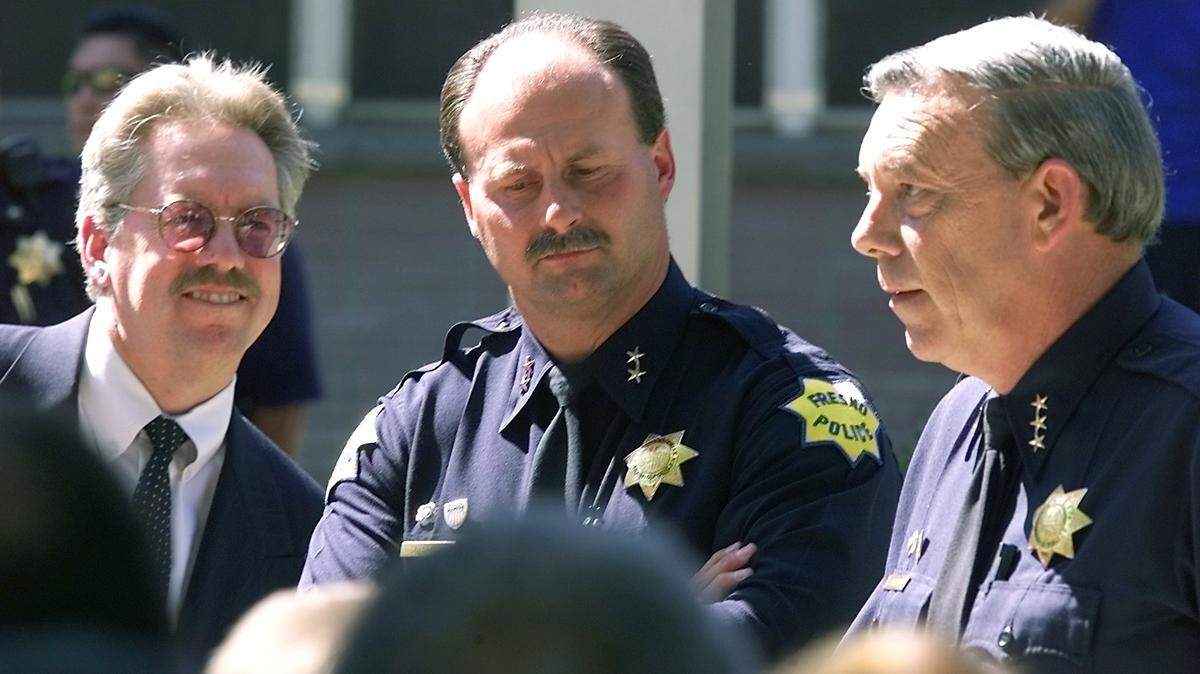
Note: On Sunday, July 22, 2001, The Fresno Bee published two front-page stories about Jerry Dyer, who had been named Fresno police chief five days earlier. Dyer was the only candidate to succeed Ed Winchester, who announced his retirement in May 2001. The stories were the culmination of reporting done by The Bee in the interim. They are being republished in 2019 as Dyer mounts a campaign for mayor of Fresno and talk of his past resurfaces.
By his own admission, Fresno’s next police chief has had two distinct careers.
The first half of Jerry Dyer’s 21 years with the Fresno Police Department was a chaotic time. He repeatedly lost control of his explosive temper. He was the subject of citizen complaints. He lost an automatic weapon at a police-training exercise. He watched and listened one unforgettable night as his wife and girlfriend discussed his lying, philandering ways.
Then came Jesus.
The second half of Dyer’s career was marked by his acceptance of Christ as his savior and a rapid rise within the department’s managerial ranks that saw him advance from sergeant to chief in less than eight years.
During this period, Dyer also helped get the city’s helicopter program off the ground, worked closely with Fresno’s minority communities, earned a master’s degree in management and mended his marriage.
Dyer, 42, was named the new chief Wednesday and will begin his new job around Aug. 1. He was the only candidate.
“I’m the guy that created my past,” Dyer said Thursday, less than 24 hours after the city learned he would replace retiring Chief Ed Winchester.
“The things that I’ve done in my life are things that I’m not proud of. In fact, some of the things I’ve done I’m ashamed of. ... And I have really tried to use my past, coupled with what Christ has done in my life, to glorify God.”
Fresno City Manager Dan Hobbs acknowledged as much when he announced Dyer’s promotion: “He has background/personal history issues that need to be recognized and have been. ... They are in his past.”
Hobbs described these issues as one of the few “weaknesses” weighing against Dyer’s numerous strengths.
But while he is willing to discuss in detail his personal and professional behavior during the second half of his police career, Dyer refuses with the same intensity to shine a public spotlight on the things that caused him shame in the first half. He also refuses to discuss how these troubles may affect his performance as chief.
“It’s not the past that is really important ... to people as much as who that person is today,” Dyer said. “You know, if there had been some personal things in my life, whether it be in my marriage or anything else that have been occurring here ... in the last 10 years, yeah, I think that’s a concern.”
Fresno Mayor Alan Autry, a staunch supporter of Dyer, refuses to discuss the new chief’s behavior as a young police officer. Autry said Dyer’s qualifications and character were thoroughly reviewed by law-enforcement experts, community leaders and city officials. This lengthy process determined that Dyer was the right person for the job, and any detailed public review of Dyer’s professional or personal conduct is both redundant and a violation of the new chief’s privacy, Autry said.
“I think a person’s personal privacy, protected by law, is something that we have to respect,” Autry said.
The mayor said he can assure Fresno that “there’s no record there” to keep Dyer from becoming the city’s next police chief.
“There was an internal disciplinary action that was looked at by two outside experts, two very reputable [experts] that looked at it as I did, and didn’t see anything to disqualify [Dyer],” Autry said.
Autry did not explain the internal disciplinary action against Dyer.
Dyer was twice interviewed by Napa-based police psychologist William Mathis. And U.S. Investigations Services, a private East Coast firm, performed a background investigation on him.
Winchester, who took Dyer under his wing in the mid-1990s and served as his managerial mentor, refuses to discuss his protege’s early professional past.
Hobbs, who has sole authority under the city charter to hire the police chief, assured the public at Wednesday’s news conference that Dyer’s troubles “are in his past.” Hobbs refused to shed any light on them, citing Dyer’s right to privacy.
Yet, questions persist.
What are these “things” and “issues” in the first half of Dyer’s police career? What responsibility, if any, do top officials at City Hall and the Police Department have to inform Fresnans of these “issues?” Why did the city manager, with the mayor’s approval, raise the specter of these “issues” to Fresno’s 427,000 citizens, then refuse to detail their nature to the public?
And, how did someone who grew up in a small Fresno County farm town overcome his many self-described youthful “obstacles” to earn the respect of an array of supporters as diverse as Fresno itself and now find himself on the verge of leading the police force of the sixth-largest city in California?
In short, who is Jerry Dyer?
The basic details of Dyer’s life are clear. He was born in 1959 in Fresno, moved to Fowler in 1964 and graduated in 1977 from Fowler High School, where he played football, basketball and baseball. He and his wife of 21 years, Diane, met as freshmen in high school.
“She was a cheerleader and I was kind of a school jock, and we became boyfriend and girlfriend,” he said.
The Dyers have a 16-year-old son and a 13-year-old daughter.
The son of a former Fresno police officer, Dyer joined the department as an officer in June 1980.
In his Northwest Church testimonial, he described a trait that has characterized him through much of his life: He is a battler.
“I soon learned that what made a good police officer was an individual who could hold his own out on the streets,” Dyer said. “That meant when you got in a fight, you could win that fight.”
Dyer said there was another aspect to life in law enforcement that he embraced just as quickly as fighting -- drinking.
“You needed to hang out at the bars and to socialize with police officers, so I did that very thing,” he told church members. “When our shift was over, we would go to the Old Fresno Hofbrau and we would drink for four, five, six or maybe eight hours. Then we would [go] home and sleep a few hours and come back to work and start the day all over again.”
Dyer said he often gives speeches, or “testimonials,” to faith-based organizations about his life, in part to glorify God, in part to help others who may be struggling with similar personal troubles. In his testimonial at Northwest Church, which was put on the church’s Web site, Dyer said: “There is a place in our police department that most people try to stay away from, Internal Affairs. Due to my behavior, I found myself being in the Internal Affairs office more than I was in my police car.
“Most people in the department at that time put up with me and felt that in time, ‘He will hang himself, he will lose his job, it will be his fault and it would be the right thing.’ “
Internal Affairs investigates the alleged misconduct of police officers. On Thursday, Dyer declined to say why he was in the Internal Affairs office so often. He will say only that he was particularly aggressive in enforcing the law.
“In the early part of my career, I was involved in incidents both on-duty and off-duty that were at that point, and even today, considered to be a violation of department policy,” Dyer told The Bee.
During this part of the 1980s, Dyer said, “I was a very active police officer. I made a lot of arrests. ... I had a vengeance for arresting people that were criminals and putting them in jail and so forth. And, with that, you get complained about.”
He said he doesn’t know how many times he was investigated by Internal Affairs.
“Today, we still have officers that frequent Internal Affairs more than I would like to see them,” Dyer said. “But, you can almost always equate those officers to being hard-working officers. And I always looked at, and still look at, the motive behind a person.
“Are they out there working hard, trying to do good and then get in trouble and make mistakes and end up in [Internal Affairs]? That was the guy I was on-duty. When I made mistakes, I was trying to do the right things, but often times they ended up the wrong way.”
Dyer said he has never had a “sustained excessive force” violation. However, he thinks some citizen complaints did involve such allegations.
“I mean, I can’t tell you ... specifically if there were,” Dyer said. “But, I know that being a police officer you don’t go through your career without having a few. You just don’t.”
He declined to say whether he has been investigated for allegedly committing a crime or for any aspect of his personal life.
“I have to be guarded about certain things and I think that’s just wise,” he said. “I don’t mind opening up on certain things in my life. And what happens is, once you open up the door on rumors and innuendo, then, I think, I’m put in the position to where I have to answer every question of every rumor.”
To answer one rumor might force him to address other rumors, however wild or improbable, back 10 or 20 or 25 years, Dyer said.
Some of his early-career troubles are well-documented. In the mid-1980s, he lost a department-owned automatic weapon during a Special Weapons and Tactics (SWAT) training exercise in Stockton.
While loading gear into a van at the end of the day, Dyer said, he put the automatic weapon on top of a nearby police car. He got inside the van, then asked his fellow officers to hand him the weapon.
“They said, ‘What MP5?’ “ Dyer said. “And I said, ‘The one on the police car.’ And they said, ‘There’s no police car.’ And I jumped out of the van and, sure enough, the police car had driven away.”
The weapon was never recovered, and Dyer paid $839.47 to reimburse the department. Police spokesman Lt. John Fries said Dyer received a letter of reprimand for losing the weapon.
Dyer’s volatility led to an incident while he was a member of the Fresno Police Department’s SWAT team in the 1980s. It happened after the team trained in a rappelling exercise at the city fire station downtown.
Team members, including Dyer, adjourned to a lot near the fire station for some beer and a bull session. Dyer starting crushing beer cans on his head, according to a team member who was there but doesn’t want to be named.
Dyer also challenged another SWAT member to an arm-wrestling match, which he accepted. The arm wrestling match had one condition: Dyer had to win in five seconds.
The battle of the biceps ensued, but there was a dispute about the five-second rule. Tempers flared. An angry Dyer first tore in half a pair of pants the two men had put down on the open tailgate of a pickup where they did their arm wrestling, the former SWAT team member said.
Then Dyer got some landscaping timber from the pickup and started swinging it over his head.
“He was like Conan the Barbarian,” the SWAT member said. “He chased [the other officer] around the parking lot for a while. Winos were running for cover.”
In his Northwest Church testimony in 1999, Dyer said he was a serious weightlifter during this period, often going to the gym seven days a week. His goal was to bench press 500 pounds, which he accomplished.
During Thursday’s interview with The Bee, Dyer declined to discuss whether he used steroids.
“I’m not going to get into that. ... Those parts of my life, distant parts of my life, there are a lot of details that I’ve chosen not to reveal. Even in my testimonies with churches, I’ve not shared [those details],” he said.
Dyer’s name did come to the attention of state agents with the Bureau of Narcotic Enforcement in connection with his alleged steroid use at Danae’s gym, a now-closed facility in central Fresno. Laurie Woods, agent in charge of the Fresno BNE office from 1987-95, said the allegation was made by an unreliable source.
Woods said the source, who went to the gym regularly, was arrested by BNE agents and then eagerly wanted to be an informant.
“He was scrambling out of a bad situation and throwing out names,” said Woods, who now lives in Nashville, Tenn.
One of the names: Dyer. The would-be informant said Dyer was using, not buying or selling steroids, according to Woods, who concluded the informant wasn’t credible. She said neither she nor her agents questioned Dyer.
Woods said possession of steroids was illegal.
Even though the BNE dropped the matter, Woods said she probably passed the information along to the Fresno Police Department’s Internal Affairs office. She doesn’t know if an Internal Affairs investigation of Dyer was conducted.
Woods said Max Downs was chief of police during this time. Downs served as Fresno’s chief from 1983-91.
Downs said he can’t remember if he ever had to meet with Dyer as the subject of an Internal Affairs investigation: “I may have, but I had so many I can’t remember. It’s very possible I did, but I can’t say for sure. It was so long ago.”
Downs described Dyer as a talented young officer who needed to “rechannel” his abilities in the early part of his career. Downs offered a bit of perspective on the chief’s job.
“The question is: Why would anyone want to be chief?” he asked. “I tell anyone, go as high as deputy chief. You have someone over you to take the flak and you still get to be a boss.”
Dyer’s progression to the chief job faced a major obstacle in the mayoral candidacy of Dan Whitehurst, who ran against Autry last November and suffered a landslide defeat. Autry claimed 61% of the vote against Whitehurst, who was Fresno’s mayor from 1977-85.
During the campaign, Whitehurst talked of possibly shaking up the Police Department.
“The chief [Winchester] and Dyer were worried that Whitehurst might win and clean house,” said an officer who asked to remain anonymous. “They both said it at meetings, meetings of the senior staff. They said if Whitehurst won, the chief would be gone, Jerry would be gone, the deputy chiefs are gone.”
Early in his career, Dyer hated to lose and wasn’t embarrassed about it.
Jeff Gunn, a former Fresno police officer and now a private investigator, said he and Dyer played together in several Pig Bowls, where football teams from the
Police Department and Fresno County Sheriff’s Department butted heads.
Gunn said he and Dyer got T-shirts that read: “Linebackers from hell.”
“Other than myself, he’s the most competitive guy I’ve ever known,” Gunn said. “That’s why we have underlying mutual respect. People used to say, ‘Gunn and Dyer have hearts as big as watermelons.’ “
Gunn recalled one Pig Bowl practice at Ratcliffe Stadium. Coaches had the linebackers doing “bunny hops” over a tackling dummy. The challenge: See how many each player could do in 30 seconds.
Dyer did 50 “bunny hops.” Gunn did 52.
Gunn said Dyer didn’t like losing that contest, threw a temper tantrum and his helmet. Then the coach did the drill again, and Dyer beat him, Gunn said.
After one Pig Bowl game, the Police Department’s team gathered at the old Farmers Market food complex downtown. Gunn was named most valuable player for the police team and received a belt buckle.
“Dyer was pissed,” Gunn said.
The two men retreated to a bathroom where Gunn said he told Dyer that the MVP award was just as much his. Dyer seemed satisfied, and they sealed it with a handshake.
Dyer left many memories with the people he encountered as a young officer.
Ken Hahus, today a senior Fresno County deputy district attorney, met Dyer in one of Hahus’ first trials in the DA’s office in the early 1980s.
Hahus was prosecuting a man charged with resisting arrest after he shoplifted from a Fresno store. Dyer was one of the arresting officers, Hahus said, and the defendant claimed he had been beaten by the officers.
Hahus remembers the trial scene clearly: “The defense was going to be that it was police brutality. And in walks my cop [Dyer] and I’m hoping for a normally-built human being. So in walks Arnold Schwarzenegger. I’m thinking this is not good. He was nothing but a muscle with a head.”
Dyer had just come directly from a gym workout, Hahus said.
Hahus said Dyer proved to be a good witness and had “a good presence” with the jury. Dyer committed only one misstep: He repeatedly cracked his knuckles in front of the jury, Hahus said.
“I’m thinking, ‘Stop that. I’m trying to make you out to be the victim,’ “ Hahus said.
Stan Barron, a Fresno police officer who played a pivotal role in Dyer’s religious conversion, has witnessed the transformation in Dyer since then.
Today, Barron said, “he’s a delight to be around. He’s a friend you can count on. He’d be there to help you, pray with you, weep with you.”
Barron said Dyer has taken steps to explain the change that occurred in him. Dyer even wrote a letter to other officers he was supervising detailing what had taken place in his life.
“Most people don’t want to say, ‘I was a rascal.’ Yet Jerry was,” Barron said. “To put that in a letter, I admire him for his honesty, for his willingness to expose himself.”
Barron said the letter had the effect of holding Dyer accountable for staying to the course of his new life.
Barron said Dyer can be an effective leader of the Police Department despite his background: “I think so. I don’t know of anything in his background that would keep him from being police chief. It hasn’t kept him from being assistant chief. It hasn’t kept him from being a captain.”
Larry Bertao, a Fresno police officer for 34 years and president of the Fresno Police Officers Association from 1994-2000, said Dyer’s past shouldn’t lessen his credibility as a top manager.
“If I was one of his drinking buddies from years ago and I’m in front of him [on a disciplinary matter], I might look at him a little askew. But we have hired 400 officers in recent years and they only know him as a staff officer.”
New officers know him as the officer who goes to their softball and football practices and works out with them in the gym.
“He’s very direct,” Bertao said. “He will listen and render a fair decision.”
Bertao said he’s “confident” that nothing in Dyer’s background will “blow up in the department’s face -- nothing that I’m aware of.”
One thing he has learned during his career, Dyer said, is that “you can make mistakes and learn from them and you can fall down in life and get back up and become successful. And that’s where I prefer to leave it.”
Referring to his past mistakes, Dyer said: “That’s not the person I am today. Nor is that the person I’ve been for the last 10 years since Christ came into my life.”
His religious beliefs clearly are a vital part of who Dyer is today. In his acceptance speech Wednesday, he said: “I want to thank, first of all, the Lord Jesus Christ for even allowing me in this position.”
In a testimonial at Northwest Church, Dyer described the turning point in his spiritual life: the night his then-estranged wife walked in on him arguing with his girlfriend.
“It was at that time, I think, my life had hit an all-time low,” Dyer said.
His spiritual awakening began several days later when, at the Downtown Car Wash, he met Barron, a detective who worked with him in the Narcotics Unit, Dyer said. Barron was a “strong Christian man” and sensed Dyer was in despair, Dyer said.
They spoke for several minutes, then Barron delivered what Dyer called “the most important words I have ever heard in my life. He said, ‘Jerry, you need the Lord.’ “
He and his wife went to church several days later and listened to a pastor preach about alcohol abuse, adultery and “mean-spirited people,” Dyer said. “The message was right on point.”
But on that first Sunday and the following Sunday, Dyer said, he was “too proud” and didn’t respond when the pastor asked worshippers to come before the altar and make a personal commitment to serve Jesus Christ. He answered the call on the third Sunday.
“My knees felt like they were locked and my feet were in concrete,” Dyer said. “But I made my way out to that aisle and knelt down at the altar ... and I cried my eyes out that day. I admitted for the first time in my life that I was a sinner, that I needed and deserved to go to hell.”
His wife “rededicated her life to Christ” the next day and she eventually “has been been able to forgive me,” Dyer said. Recalling the Biblical miracles of Christ, Dyer looked at his own spiritual transformation and realized “God has truly performed a miracle in my life that is equal to, or greater than, any of those miracles.”
Asked Thursday in his office about the night his wife and girlfriend met, Dyer said, “It was an embarrassing moment for me” but “it was something that probably had to happen.”
Forgiveness flowed from that night, Dyer said: “I’ll tell you again. God’s forgiven me and my wife’s forgiven me. The people that I have hurt in my life, after I became a Christian, I went back to as many as I could remember and asked for forgiveness. And I believe that was needed for reconciliation and I’ve gotten forgiveness.
“And I’ve gotten forgiveness from my employer. I’ve gotten forgiveness from those that are my bosses today. And I think that’s all I can ask for.”
Dyer said he doesn’t think it necessary, as Fresno’s next police chief, to “pull my soul out to the world” and detail the problems of his first 10 years in the department. It is enough, he said, “for people to know that the person I am today is the one that loves the Lord, wants to serve this city, loves the city, loves the organization, and I’m ready to serve. And, that’s really all I can say.”
In the last 10 years, Dyer has earned the respect of many community leaders as well as police officers who know about his past but still believe he would make a good chief.
As City Manager Hobbs said at Wednesday’s news conference, Dyer has limited experience at the managerial level. Current Chief Winchester said Dyer rose through the ranks quickly because of a strong work ethic, problem solving as an administrator and ability to handle difficult situations in an innovative way.
Winchester cited an incident from several years ago that earned Dyer the nickname “The Oscar Mayer Guy.” A large crowd had gathered at a downtown playground and planned to march to City Hall to protest Proposition 187, the state initiative which would have denied government benefits to undocumented immigrants, Winchester said.
Dyer arrived at the scene and could sense potential trouble. He bought some hot dogs at a market and started barbecuing.
“That act just defused everything,” Winchester said. “It just took the whole tension out of the situation. ... And since that time, he has done other things with the community that’s shown good judgment and a good understanding of why law enforcement agencies exist.”
Winchester also praises Dyer for keeping cruising alive on Kings Canyon Avenue. In the 1990s, cruising in southeast Fresno was in danger of being stopped because of fights and vandalism by some people. Dyer stepped in, met with business people and cruisers. He learned that cruising was popular with many business people and hardworking citizens who valued it.
He worked with the players to help save cruising.
“Jerry got together with some of the cruisers and helped form the Cruise Control Committee, which has allowed families to enjoy that entertainment, the businesses to do well on Kings Canyon and has severely reduced the police problems we’ve had in the past,” Winchester said. “So, he’s very innovative in looking at alternative ways to deal with problems.”
Winchester said Dyer first impressed him by helping start the Operation Skywatch Program: “He took that on as a project when he was sergeant out in narcotics and it basically didn’t have a lot to do directly with his assignment. But, he saw the value in air support and started doing a lot of research, putting together budgets, talking to people.”
Dyer made several Skywatch proposals to the department which were presented to the City Council, Winchester said. The city could provide no money. So Dyer led a community-wide fund-raising campaign, and today helicopters patrol the skies over Fresno.
“I was really impressed by the way he worked with people in the community,” Winchester said.
Dyer has earned the respect of others in the community as well.
H. Spees, chief executive officer of One by One Leadership, a faith-based civic renewal organization in Fresno, said Dyer has matured into a “great leader” by doing three things: Humbling himself to admit private mistakes; disciplining himself to go through “a period of recovery”; and recognizing the role congregations can play in rebuilding Fresno, but not favoring them.
The Rev. Joe McNair, pastor of the Worldwide Church of God, said Dyer has worked with ministers in southeast Fresno to organize a family-oriented celebration on Halloween. Last year, it drew more than 5,000, McNair said.
Among Dyer’s half dozen or so strengths that offset his few weaknesses, Hobbs said, was the new chief’s ability to connect on a personal level with Fresno’s minority communities. It was a sentiment echoed by Hmong International Chief Executive Officer Charlie Vang after Wednesday’s news conference naming Dyer.
Dyer “will listen to every person,” Vang said. “The kids like him. He is comfortable with everyone.”
Dyer also has impressed some people who have heard his story of his becoming a Christian. He spoke two years ago before Armenian Christian Women, a religious group. Karen Daoudian, a board member of the group, said the women were impressed with Dyer’s “honesty and sincerity. They were very happy there was a godly man in the Police Department.”
Dyer’s resume over the past five years sparkles with promotions and awards. He received the department’s Medal of Meritorious Service in 1996 for exceptional performance and an award from the Helicopter International Association last February for implementing the city’s Skywatch program.
Dyer spent only 20 months as a captain before being promoted to deputy chief in February 1999. Nine months later, he was promoted to assistant chief. He had become the second highest-ranking officer in the department.
With each job promotion came more responsibility. Currently, Dyer oversees the department’s day-to-day operations. Before that, he served as the department’s spokesman and was area commander in southeast Fresno.
Paul H. Garcia, a community activist from the southeast neighborhood of Calwa, praised Dyer for being responsive to public-safety issues and for establishing rapport with Fresno’s ethnic communities.
In his private life, Dyer is active at Harmony Free Will Baptist Church in southeast Fresno. Barron, the Fresno police officer and fellow church member, said Dyer is a church deacon, teaches Sunday school, works in the church’s gang ministry and gives money to people in need.
“I don’t think you’ll find a person who has got a bigger heart than Jerry,” Barron said.
That Jerry Dyer is different from the man some people remember as a highly competitive softball player.
“I mean, he didn’t wear 5150 [on his jersey] for nothing,” Barron said. “People thought he was a nut.”
The number 5150 refers to a section of the Health and Welfare Code that allows a 72-hour hold on an individual deemed a “danger to others or to himself.”
Husband and father. Former adulterer. Community builder. Ex-brawling, boozing cop. Award-winning manager. Hyper-competitive jock.
Jerry Dyer is all that, and much more.
Said one Fresno observer: The new police chief’s life “is like a puzzle where the pieces don’t fit together.”
This story was originally published December 5, 2019 at 3:08 PM.