
Historical Perspective: Enduring magic of Storyland came to life in 1962
Fresno’s history is dotted with places that are long gone (the old courthouse, for instance) and places that are barely recognizable as what they once were (Hotel Fresno, for example).
And then there’s Storyland, born from a collective community vision then lovingly restored by a new generation to endure.
One who remembers then and now is Kathy Solt-Winter of Reedley. Back on May 19, 1962 she was a third-grader at John S. Wash Elementary School in the Sunnyside neighborhood. She was part of a select group of children, each representing area cities and towns, lined up for ribbon-cutting duty with special gold-colored scissors.
Behind them was a place that would hold special memories for decades to come, designed to inspire a love of reading and make-believe.
“I remember a sunny day, having to put on my Sunday best and being excited, lining up with the other children behind the ribbon. I wanted to keep my piece and had to hold on tight to it after the ribbon was cut,” Solt-Winter recalls. She stills has her piece of the pink ribbon, tucked away in an album. Afterward, they toured Storyland, “it was magical, so fun!” she says.
Storyland vision
Discussions for the creation of a “children’s storyland” first surfaced in early 1960, according to The Fresno Bee’s archives. Leading the way was Fresno’s Director of Recreation Howard Holman, who endorsed the idea, following the release of a study by his counterpart for the county, Elmer Martin, who urged the creation of a fairyland or storyland. Influencing this were children’s storyland venues which were proving to be successful in Oakland, Sacramento and Stockton. Holman pointed out that it would undoubtedly become a tourist attraction.
He proposed one similar to Stockton’s Pixie Woods, with its shaded area in Louis Park, with “pleasantly designed structures, some inspired by fairy tales and Mother Goose, some adapted from the adult world, and some simply modern whimsy.”
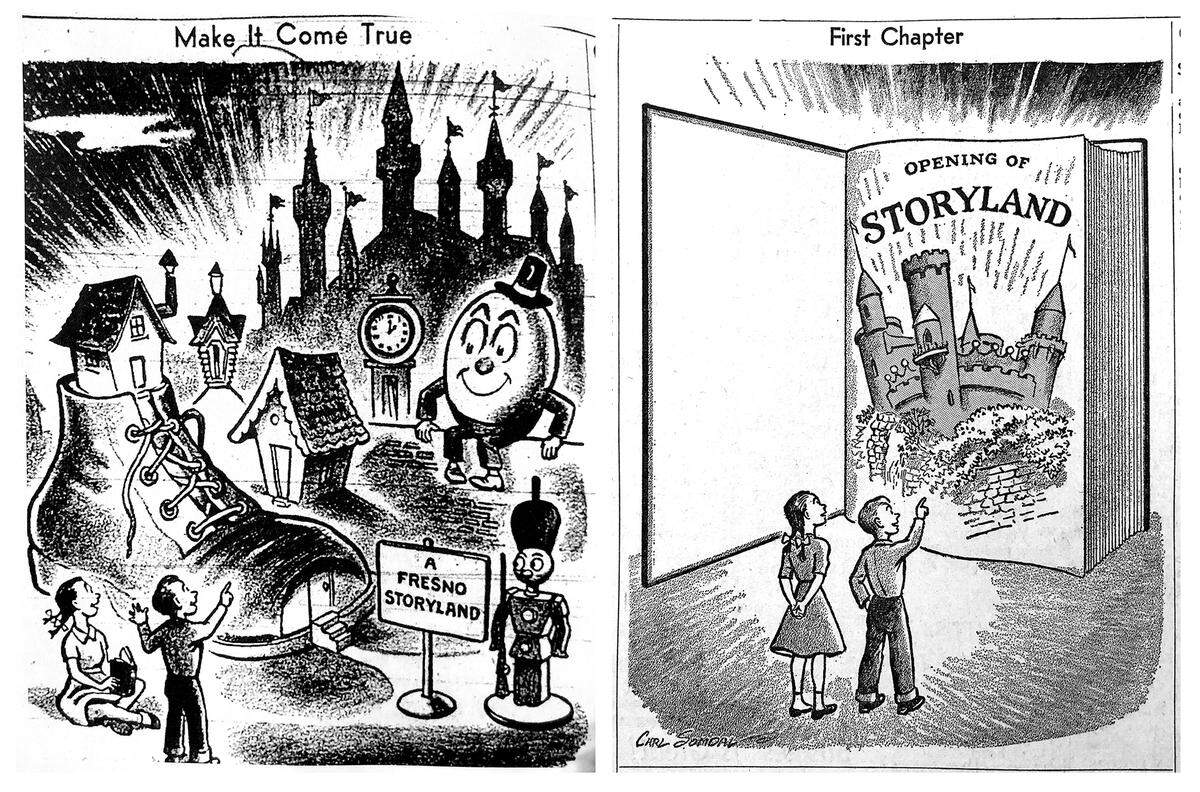
The idea of an attraction where children’s books come to life quickly snowballed. From a Feb. 7, 1960 Bee editorial;
“Humpty Dumpty is looking for a wall. Mary, Mary Quite Contrary needs a garden. And many other characters and things of the make believe world of childhood are waiting for Fresnans to make them almost as real as they are in the minds of youngsters.
“Fresno can make this come true in a children’s storyland. Patterned after Oakland’s Children’s Fairyland, the area would include sets depicting scenes from Mother Goose rhymes and other childhood favorites, possibly rides built in the shapes of animals and other forms designed to please a youngster’s mind and displays of domesticated animals, allowing children to pet and feed them.
“Civic groups would be hard pressed to find a more worthy cause than this effort to bring to Fresno this unusual form of children’s play area.”
At the time, Oakland’s Chamber of Commerce reported that the city’s Fairyland was the city’s No. 1 tourist attraction drawing 500,000 persons a year.
A spot at the fairgrounds?
An early location that surfaced for consideration: the infield of the Fresno Fairground’s racetrack. Holman pointed out the drawbacks: “The location in the infield would have to be depressed or excavated lower than the track to not interfere with the viewing of races, and the issue of getting people to the site would have to be in tunneling,” he said in a Bee story. It was soon taken off the table for consideration.
Another possible location surfaced: a joint venue with the Fresno Museum of Natural History and Junior Museum (now the Discovery Center) on Winery Avenue near the airport.
While its location was debated, a steering committee formed in February 1960 began to develop rough ideas for attractions, or sets as they were called: King Arthur’s Castle; the Old Woman Who Lived in a Shoe; a dragon and a pirate ship.
Ideas that didn’t make the cut: a food concession stand designed with a space station theme and a Western scene with wagons and teepees. Others rejected for various reasons: a Santa Claus North Pole village (“overworked”); a whale (“device used too frequently”); Eskimo village with igloos (“dull and contrived”); Ferdinand the Bull (“not a favorite of children”); Oz characters (“too highly specialized”) and an African village with huts (“having a connotation of bias”).
In June 1960, the concept cleared a major hurdle: the location. A three-acre site in Roeding Park, adjoining Lake Washington and Playland (built in 1955), was settled on. The location was termed “ideal” by the steering committee, and was being used as the city’s tree nursery for its park system (some mature trees that that dot the attraction to this day were in place dating to the nursery days). Another half-acre of vacant land was acquired for the project. A major plus was the idea of connecting Storyland and Playland via the latter’s miniature railroad.
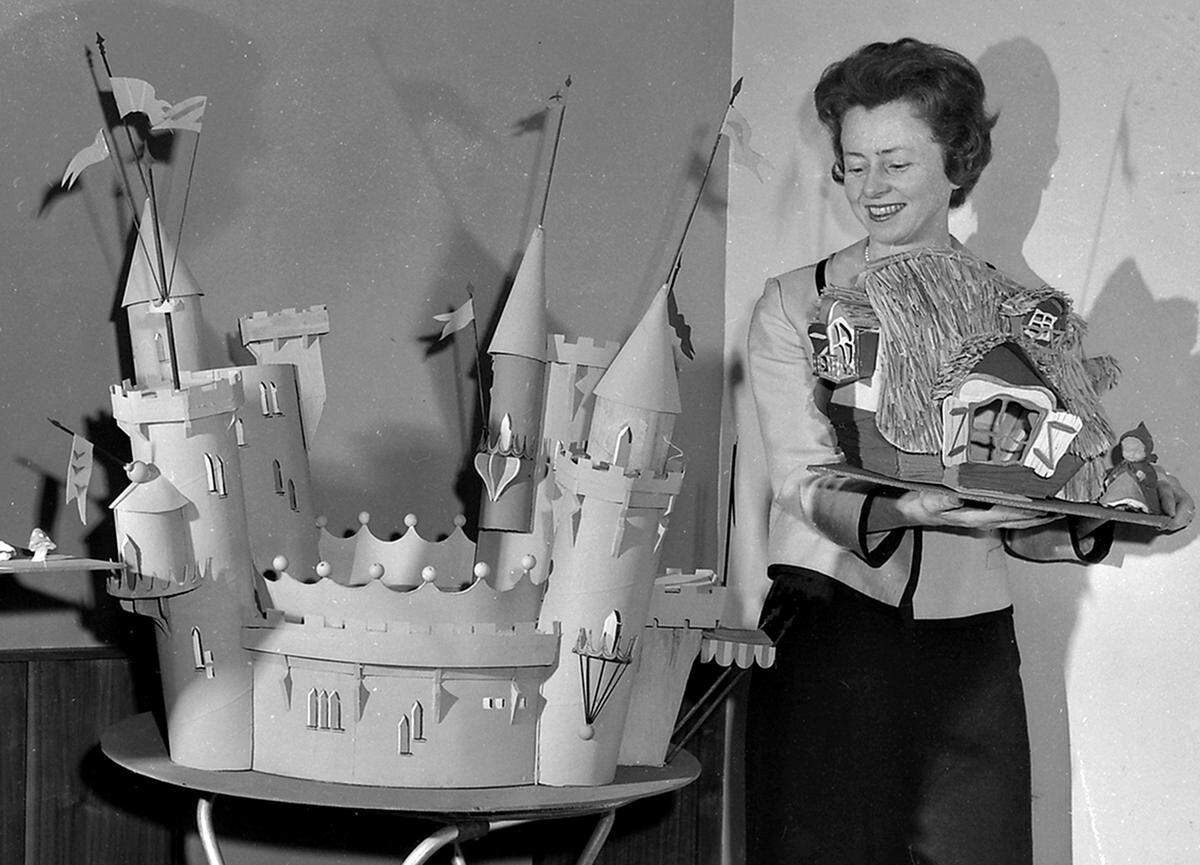
The vision for the concept of the park went to Fresno artist Patricia Hopper, a mother of a boy and a girl, who was selected from a field of 10 applicants to design Storyland. After sketches, she built 1/8th-scale models of the sets for the park.
Another key figure in Storyland becoming a reality emerged: legendary developer Spalding Wathen, who is credited as being Storyland’s builder.
Wathen, then 36 years old, was president of the Home Builders Association of the Greater Valley, a group already working tirelessly in in the booming economy. Wathen, a Navy pilot in World War II, was named as Storyland’s Building Committee chairman. With his brothers Jack, Ron and Dick, they built and handled the construction design and management of Storyland.
Investing in fairy tales
By October, a funding campaign was launched with a goal of $100,000.
The fundraising efforts were very effective. The first major donation was for the construction of King Arthur’s castle, $20,000 from the Builders Association of the San Joaquin Valley.
In March 1961, the first private investor in Storyland stepped forward: Lucille Johnson of Fresno bought $9,000 worth of interest-bearing notes. She was a childless widow, a 13-year resident of Fresno from Illinois.
“I know ways to earn more than 5 per cent on my money,” Johnson told The Bee in a March 5 story, “but the joy the young and the young at heart are going to find in Storyland just can’t be measured in money.”
Days later, on March 10, a parade through crowd-lined streets in downtown Fresno was held to promote the campaign. Characters included Winnie the Pooh, Cinderella, Pecos Bill, the Wizard of Oz, Old Mother Hubbard and Georgie Porgie. A highlight was a float depicting King Arthur’s castle. Cinderella and her friends passed out balloons. The bagpipe band of McLane High School led the parade, including Girl and Boy scouts, Camp Fire Girls, Indian Maidens and Indian Guides.
John J. Sullivan, drive chairman, said all profits from Storyland would be given to support cultural, recreation and educational activities in Fresno. Part of the construction would be financed by the public sale of $75,000 in unsecured promissory notes with 5% interest. The rest of the $100,000 goal would be sought through the sponsorship of individual storybook units, donations of materials and labor and cash contributions. A large donor was builder Spalding Wathen.
Getting on board were the professionals in the San Joaquin Chapter of the American Institute of Architects, who donated their services and were reported as having fun especially in working on the 20-foot-high tower for the Jack and the Beanstalk set.
The Fresno Rotary Club donated $6,000 for the Storyland entrance – a set of oversized storybooks named the Magical Gateway.
Thousands stream in
After Kathy Solt and the other children cut the grand-opening ribbon, families poured in. an estimated 13,000 children and adults in the first two days. “The crowds exceeded our expectations,” said J.D. Stephens, president of Storyland, in a May 21, 1962 Bee story, “and gave ample proof of our convictions that a storybook park for children would fill a long felt need in the recreational and cultured development of our community.”
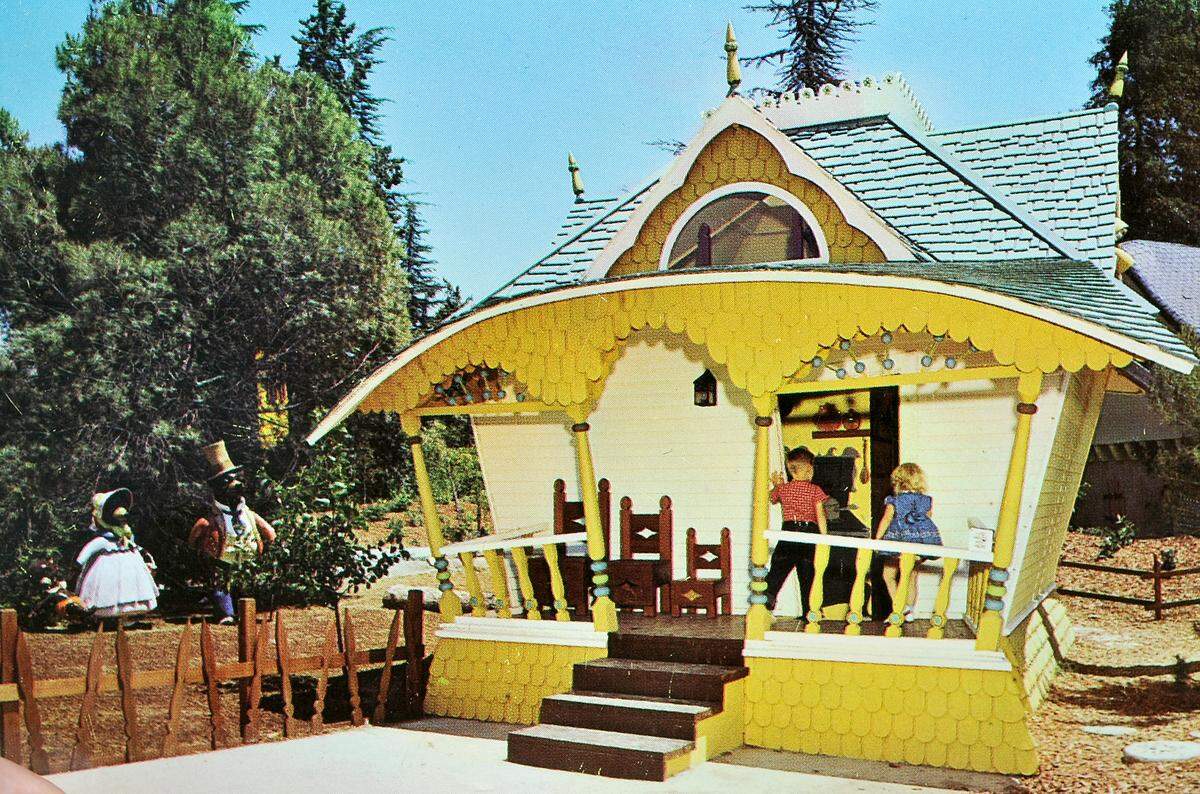
The Caterpillar from Alice in Wonderland (a colorful sculpture cast in fiberglass, the same as with the other characters), perched atop a large toadstool, welcomes visitors and offers encouragement to use their magic keys at each stop along the way to hear stories (recorded by local voice talent) for each attraction. There are winding paths lined with foliage, flowers and shade trees, a meandering creek with small falls, bridges with lollipop and gingerbread men cutouts, and over two dozen sets. Among them: the story of the Three Little Pigs and their houses made of straw, sticks and bricks; The Little Old Woman Who Lived In A Shoe slide; Little Red Riding Hood; Goldilocks and the Three Bears; Gulliver’s Pirate Ship and the climbing tower of Jack and the Beanstalk, with the looming, leering face of the Giant peering through a cloud, bellowing “Fee, fi, fo, fum. I smell the blood of an Englishman.” (Bruce Batti, chairman of the Storyland/Playland board, says “it was a rite of passage” for youngsters in the day to make it to the top.)
The biggest structure in Storyland is King Arthur’s Castle, which still acts as the park’s centerpiece. Perched high atop a knoll, its dramatically leaning walls and towers and a waterfall greet visitors who enter across a small drawbridge. Bright banners adorn the castle’s exterior and interior, where colorful windows illuminate the main room where birthday parties are held.
In the heart of Storyland was the Children’s Chapel, illuminated with brightly colored windows in stained glass style that depict animals from Noah’s Ark. Quotations of scriptures from faiths from around the world were painted on the backs of the tiny pews. The motivating force behind the chapel was Spalding Wathen, who actually pitched in with hammer and nails. His family was devoutly Catholic, and later Wathen gifted all of the land used for Saint Agnes Medical Center and Holy Spirit Catholic Church across from Woodward Park. His original drawings of the chapel and handwritten notes were found years later.
Along with the ship, other slides, a small push-powered carousel at the Gingerbread Man’s House, hopscotch and maze layout and sandboxes all encouraged good old-fashioned childhood play. Adding to the fun were baby animals: pigs, rabbits and sheep.
On the northern shore of Lake Washington, where the tracks of Playland’s locomotive ran, a station connected visitors to both parks.
In the first week alone attendance topped 25,000. From opening day to June 23, attendance totaled 80,366, amazing Storyland officials who predicted 150,000 for the year. Tickets were priced at 25 cents for children and adults. By June 23, 172 birthday parties had been held in King Arthur’s castle and Alice In Wonderland’s birthday court, with 100 more reservations made for the summer. On July 3, 1962, Shirley Barritt, 7, of Friant, became Princess Shirley for the day when she became the 100,000th visitor. She was given prizes, dinner for her family at a Fresno restaurant and a party in the castle.
“Having a birthday party in the castle was quite the big deal for many years,” says Solt-Winter.
Next generation
In 1994, Storyland became part of Rotary Playland, gaining support and operational guidance. The two attractions suffered with much-needed repairs, dwindling attendance and debt. In 2014, the Storyland/Playland board was formed and took over from Rotary.
2015 was a crisis year, and for the first time in over 60 years the parks were closed in March of that year. Both needed a combined $850,000 to $900,000 in repairs, upgrades and operational costs.
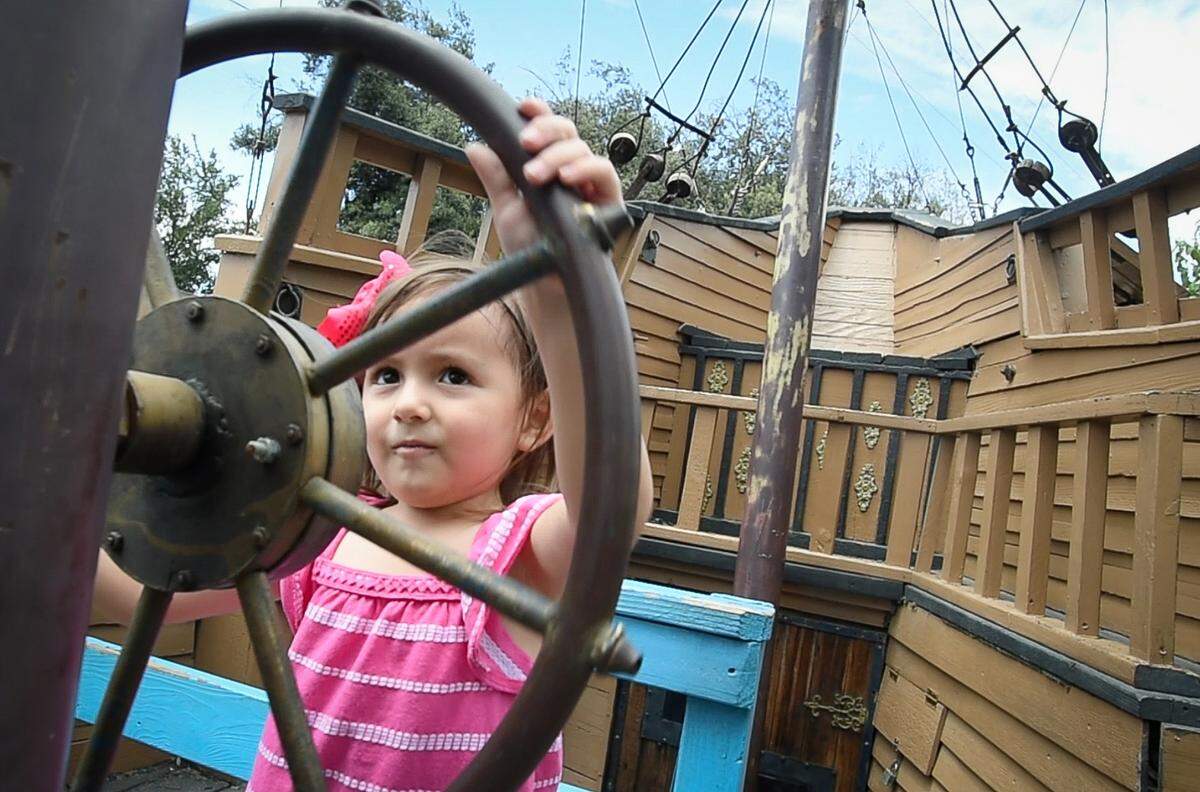
Fresno stepped up. “The love and respect for Storyland is almost unmatched in our community,” says Batti, the Storyland/Playland board chairman. “Job One was to bring it back to where it was in 1962, new paint, plants in the ground, landscape brought back, trains running, all those necessary things along with paying down the debt.
“There are people that this park has touched generationally who have brought their kids out and then their kids have brought their kids out here and on and on.”
Major fundraising efforts succeeded. Storyland, restored by an army of volunteers, reopened in September 2015. (Playland came back iin 2016.)
Imagination destination
“The name of the park is Storyland, so we’ve made a strong commitment to reading and literacy.” Batti says, ”But most of all, it’s make-believe. In this day and age where there are electronic devices, people said you should put iPads up there and show all these visual stories … we were like, ‘No, what really need to do is something that people can play, role play, kids do this really well when given the opportunity, and not only do they do it well, they love it!’
“So our jobs early on was to make sure that storytelling was still part of that and we put kids in positions to have a little bit of make-believe happen.”
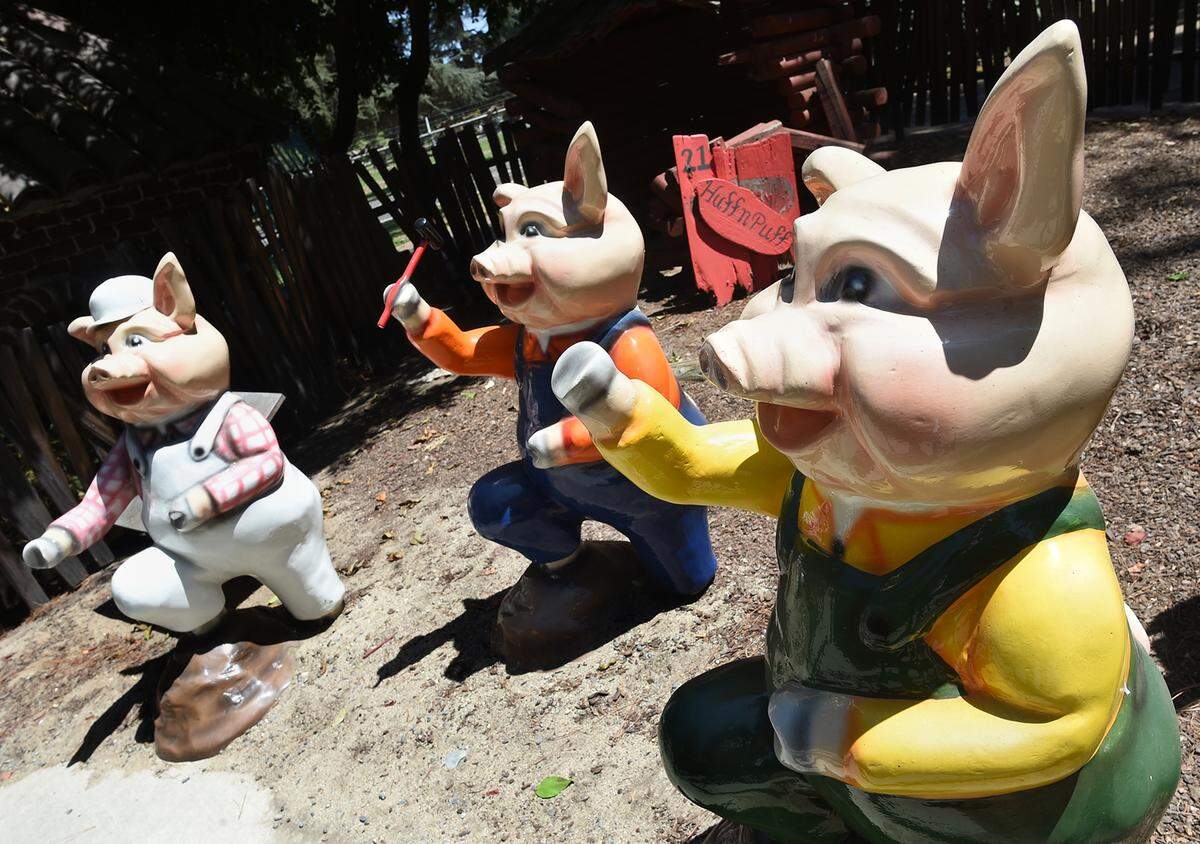
It’s a place where imaginations replace the ever-present smart phones. For adults like Solt-Winter, it’s a nostalgic place for those who once stepped into a magical place in their childhood. Many have kept their magic keys, which are the same as those used from the first day and still work.
“The legacy of Storyland entails capturing an innocence of childhood. Storyland brought all the popular fairy tales to life, and in its own way encouraged an endearing emphasis on reading,” Solt-Winter says.
Amazingly, she has remained friends with several of the children from different towns who lined up with her for that ribbon-cutting on that May day when Storyland came to life.
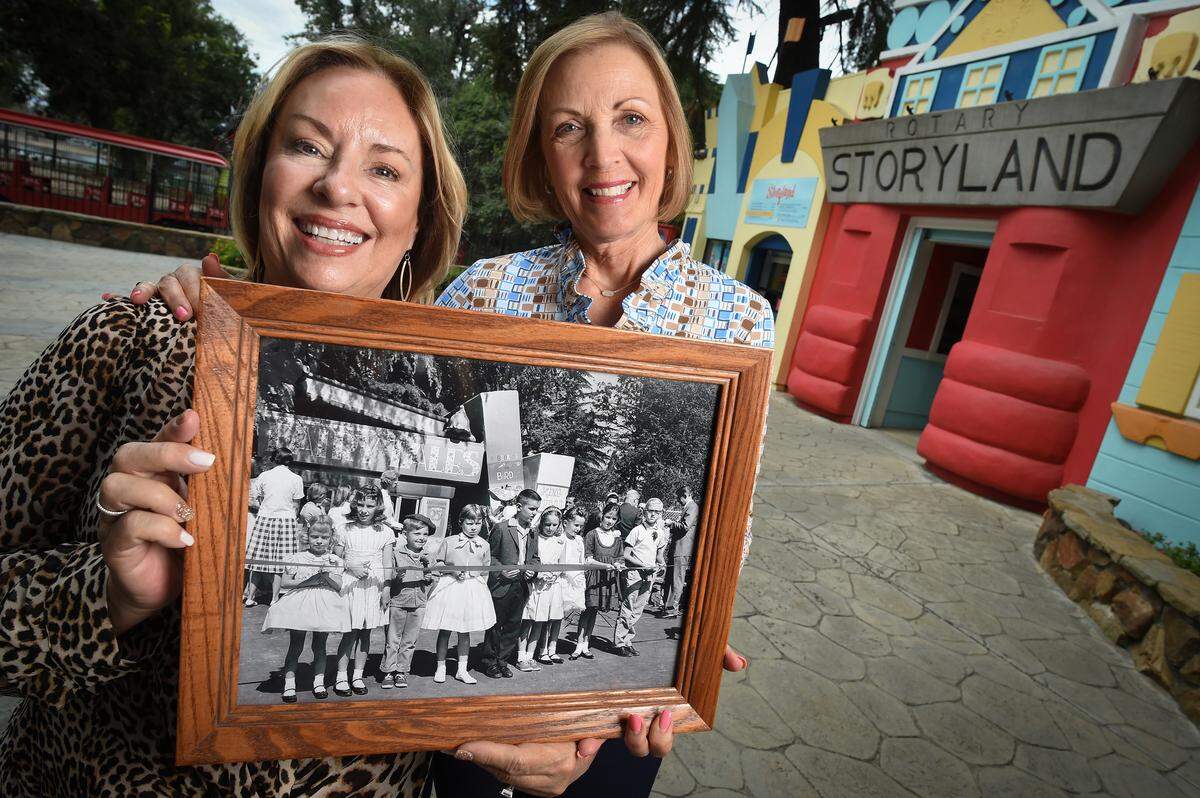
One of those is Marcia Pell-Nash of Clovis. “I think it is very unique because it is part of the nursery rhymes, which are still relevant today. People still read nursery rhymes to their young children, and I did, and I know I read them to my grandchildren. I think it’s something that comes to life when you come here, because you see Mother Goose and the castle and all the things that are written about in the storybooks. It is something that will live on. I’m so happy that I was part of it. It was a very special time.”
If you go
Storyland is open year-round, 10 a.m. to 4 p.m., closed Mondays and Tuesdays. Admission is $6, $5 for seniors and $4 for children.
Playland is open weekends 10 a.m. to 4 p.m.
This story was originally published November 29, 2019 at 1:51 PM.