
Antitrust settlement removes an obstacle to potential Fresno County call-center jobs
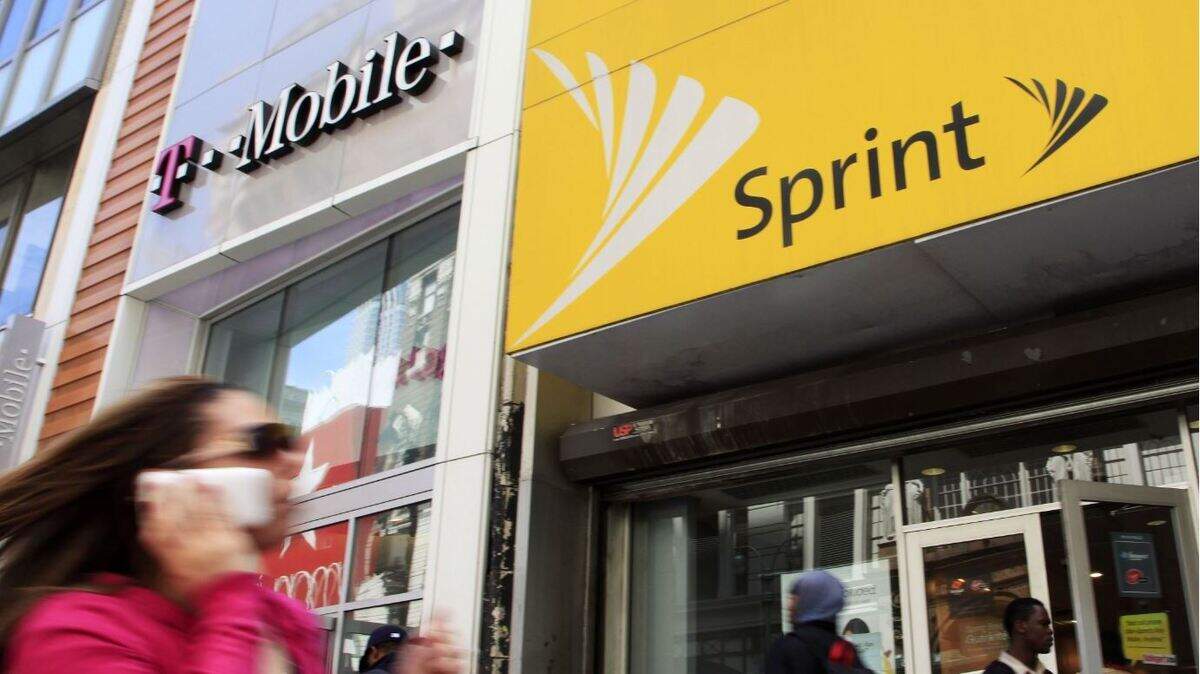
A decision Friday by federal antitrust regulators approving the proposed merger between wireless companies T-Mobile and Sprint removes a major obstacle to prospects for hundreds of jobs in Kingsburg.
The U.S. Department of Justice announced that it, along with the attorneys general of Nebraska, Kansas, Ohio, Oklahoma and South Dakota, reached a settlement with the two companies — conditioned on Sprint selling off its prepaid cellular business and some of its wireless spectrum rights to satellite TV provider DISH.
Earlier this year, T-Mobile and Sprint declared their intention to build a new customer call center that would bring about 1,000 jobs to Kingsburg, a city of 12,400 people along Highway 99 about 20 miles south of Fresno.
But, a company spokesman acknowledged, the Kingsburg center, along with other new centers in Kansas and New York, would materialize only if the $26 billion merger is approved.
An economic analysis commissioned by T-Mobile earlier this year indicated that if the merger successfully closes this year, the Kingsburg call center would not be fully staffed and operational until 2022, more than two years from now.
A federal court in Washington, D.C., must still approve the terms of the settlement. In addition to the Department of Justice clearance, the merger also requires the Federal Communications Commission to sign off on allowing the radio frequency licenses now held by Sprint and its subsidiaries to be transferred to T-Mobile.
What it means for Kingsburg
In April, when the companies announced Kingsburg as their choice for locating the center, Kingsburg City Manager Alexander Henderson said it was his understanding that T-Mobile was involved in negotiations for multiple sites within the city. “Between the jobs and an economic boost from having 1,000 people coming into Kingsburg, it’s very good news,” Henderson said.
Henderson added that the city would likely benefit from increased property taxes from the center.
An economic analysis commissioned by T-Mobile and prepared by Emeryville-based Berkeley Research Group earlier this year forecast that the Kingsburg center would employ 1,007 workers, including more than 840 customer representatives plus managers and support staff.
“T-Mobile estimates that employees at the center will have an average weekly compensation between $1,129 and $1,254,” including both salary and benefits, the Berkeley Research report stated. The total payroll at the center, including benefits, is expected to be between $56 million and $65 million a year.
The report forecasts that annual lease costs for the call center would be about $1.5 million.
Boon for 5G technology
In its announcement of the settlement, the Justice Department said allowing T-Mobile and Sprint to merge will speed the development and deployment of 5G technology, the next step up from current 4G cellular technology.
“With this merger and accompanying divestiture, we are expanding output significantly by ensuring that large amounts of currently unused or underused spectrum are made available to American consumers in the form of high quality 5G networks,” said Makan Delrahim, assistant attorney general in the antitrust division of the Justice Department.
Still complicating matters is a separate lawsuit filed in June by the attorneys general of California, New York, Colorado, Connecticut, Maryland, Michigan, Mississippi, Virginia, Wisconsin and the District of Columbia challenging the merger.
Hawaii, Massachusetts, Minnesota and Nevada have since signed on as plaintiffs. That suit, filed in a New York federal court, argues the merger would create the largest wireless company in the country, leapfrogging past Verizon and AT&T, with the effect of reducing competition and potentially increasing prices for customers.
The states’ lawsuit seeks a ruling that the merger violates federal antitrust law and asks the court to issue an injunction blocking the merger.
T-Mobile and Sprint are the third- and fourth-largest wireless companies in the U.S. Earlier this year, T-Mobile reported that it had more than 81.3 million subscribers, while Sprint reported nearly 55 million subscribers.
The federal settlement requires the combined companies, known as New T-Mobile, to sell Sprint’s prepaid wireless phone businesses, including Boost Mobile and Virgin Mobile to DISH for $1.4 billion. T-Mobile and Sprint must also make available to DISH at least 20,000 cellular sites and hundreds of retail locations that would be decommissioned by the merger, and provide DISH with access to T-Mobile’s network for seven years while DISH works to build its own 5G network.
Federal regulators said the settlement effectively will enable DISH to expand its business beyond satellite TV and become a significant player in the wireless industry. A statement issued by the Department of Justice said that without the divestiture of the Sprint assets to DISH, “the proposed acquisition would eliminate competition between two of only four facilities-based suppliers of nationwide mobile wireless services.”
Merger could reduce competition, says Becerra
California Attorney General Xavier Becerra remains unconvinced. “Our concerns with this merger have been, are, and continue to be about the harms posed by over-consolidation and diminished market competition,” Becerra said in a statement reacting to the federal settlement. “A marketplace with fewer active competitors drives up costs, reduces consumer choice, and thwarts innovation.”
Becerra said California and the other states would continue to oppose the merger in court. Becerra said their concerns include whether DISH has the ability to perform its obligations under the federal settlement.
“DISH does not have the network to operate as an independent competitor, like Sprint does today, and will instead remain reliant on the T-Mobile network for the foreseeabel future,” according to a statement from Becerra’s office.
“T-Mobile and Sprint are asking Americans to trust that this new mega-corporation will act directly against its own economic interests by helping transform DISH into an independent competitor that rivals this new company.”
This story was originally published July 26, 2019 at 12:51 PM.