
What’s it take to shut down a Fresno County restaurant? The reasons may turn your stomach
There are more than 5,300 restaurants, snack bars, commissaries, delicatessens, grocery stores and food vendors across Fresno County, and inspectors for the county’s Department of Public Health conducted more than 11,300 spot checks of them over the last 13 months.
Usually, if inspectors find an issue, it’s something that can be fixed on the spot – things like having enough bleach in the water used to wipe down food-preparation counters, replacing lids on food containers in the walk-in refrigerator, resupplying paper towels in the restrooms or reminding employees to wear gloves or hairnets and to wash their hands.
Remarkably – and perhaps thankfully – only about 80 of those inspections from July 2017 through July 2018 turned up more serious violations that prompted inspectors to shut down a place on the spot – sometimes for a few hours, sometimes for a day or two, sometimes longer. For a few, the problems were relatively innocuous – being overdue in paying their permit fees or expanding their kitchen without submitting proper construction plans.
For others, however, the violations are the kinds of things that become stomach-turning for customers: infestations of rodents, cockroaches or other insects; refrigerators that don’t keep cold food cold enough and steam tables that don’t keep food hot enough to inhibit bacteria; a lack of hot water for dishwashing or handwashing, or plumbing problems including backed-up drains and toilets.
“We don’t want a restaurant closed, but we also don’t want them endangering public health,” said Wayne Fox, director of the county’s Environmental Health Division which oversees restaurant and food safety inspections. “So they have to get it fixed. … Most of the time they can jump on it and get it fixed.”
“It could be for a day, or two days,” Fox added. “We try to be very accommodating and get back out (for a re-inspection) the next day or couple of days.”
Inspectors typically make routine, unannounced visits to restaurants or other food facilities three to four times a year. That, officials hope, is enough to keep places on their toes and maintaining clean conditions in their kitchens.
Unwanted infestations
Sometimes, however, things get out of hand.
Jay’s Flame-Grilled Chicken, a restaurant in the food court at the Fresno Fashion Fair shopping mall, was twice closed by inspectors – once in November, and again in January – for rodent infestations. In November, an inspector “observed (a) significant rodent infestation immediately upon my arrival.”
“Rodent feces was observed on floors throughout the facility, in walk-in refrigerator, on food containers, shelving, oven, grills, under and behind equipment (and) on soda syrup boxes …” the report noted. Rodents had also chewed through a bag to munch on some tortillas. The restaurant was ordered to dispose of two bags of tortillas, a pot of chili, and gallons of other potentially contaminated food. Inspectors approved it for reopening a day later after a thorough cleaning and pest treatment.
Two months later, however, a return visit to Jay’s by a health inspector revealed that rodents were back, with droppings once again found in various places including under the soda machine, on the soft drink syrup boxes, on a container of rice, behind the ice machine, in a mop sink and mop bucket, along the walls and elsewhere. A refrigerator in the food-preparation area was also not keeping cold food at proper temperatures.
By the time the inspector finished his visit at 1:30 p.m., he ordered the restaurant closed until the place could be cleaned and sanitized. That was accomplished later in the day and a re-inspection cleared the way for reopening.
In another case, inspectors visited the Casa de Tamales commissary in west-central Fresno in late December, following up on a complaint from the public that about 30 people fell ill on Christmas Eve after consuming tamales, rice, beans, salad and salsa that were prepared by the kitchen.
The inspection came after the commissary had been closed for about four days after the big Christmas rush of tamale-making. And while the illnesses were found to be unrelated to the food handling, the inspection turned up other issues.
An unused dishwashing machine had rodent droppings in it, and droppings were found in several food prep areas, on shelving, on food containers and elsewhere. About 12 pounds of masa for tamales had been left out and found contaminated with mold and ordered thrown away.
Inspectors ordered the commissary closed because of the rodent infestation, with requirements to vermin-proof and thoroughly clean and sanitize the business and call a professional pest-control company to eliminate all vermin.
Casa de Tamales owner Liz Sanchez said the incident was a “shocking” wake-up call about how quickly things can go awry if managers and employees don’t take proper care with sanitation.
“Everyone was in a rush to close up and get out after the busiest week of the year,” Sanchez said. “We dropped the ball.” Things weren’t properly cleaned and put away, and a door was not fully closed while employees were off, enough to let rodents get into the building.
“This is an unforgiving environment,” she added. “You have to stay on top of it from the second you come in the door in the morning until you close the door at night.”
Sanchez called her entire crew of workers in to correct the problems quickly. By the next day, all of the violations – from sealing holes in walls through which rodents could get into the kitchen and other parts of the building to proof of pest-control service to fixing a leaking pipe under a sink – had been remedied and the commissary was allowed to reopen.
“We were able to bounce back quickly because it wasn’t a systemic problem. We just weren’t here for a week,” she said. “I’m so grateful that there was no food-borne illness with our food. But we got a lot of learning out of it.
“We did a refresher course in food handling and sanitation. We use flashlights to look under and behind equipment to make sure it’s clean, but now we do it every night instead of twice a week,” Sanchez said. The restaurant has maintained a clean bill of health in its inspections since December.
Rodents were also the issue in November when an inspector closed Romauldo’s Bar, a bar and restaurant in the western Fresno County town of Huron. The inspector “observed (a) bag of rice and (a) bag of tortillas that had been freshly chewed through by mice,” as well as a “container of sugar that had been contaminated by rodent droppings.” Dead baby mice were found in a large pot near the stove, and rodent droppings were found throughout the kitchen.
The rodent droppings and dead mice by themselves would have been enough to order the restaurant closed, but on the bar side, insects were found inside some of the liquor bottles.
Three weeks later, after throwing away the affected food and liquor, a professional pest control treatment and a thorough cleaning, the restaurant was given an all-clear to reopen for business.
Such unsavory discoveries, however quickly they are remedied, give rise to the question: How long had conditions been that way before the inspectors arrived? And how long would they have continued if the inspectors hadn’t shown up when they did?
County health specialists can’t be on-site every day. There are only 21 inspectors to cover the entire county, and in addition to restaurants, some inspect other facilities such as tattoo or body art parlors, public swimming pools and other sites.
“We’re there for 30 minutes or an hour four times a year, so what are they doing on the other days of the year?” Fox said. “We need them to buy into the program, into the belief that it’s good for business to follow these standards because you’re going to have healthy, satisfied customers and they’re going to come back.”
What inspectors look for
When inspectors visit a restaurant, commissary, food truck or any other food-serving site, there is a lengthy – and detailed – list of more than 50 things that fall under their scrutiny. They include whether the manager and all of the workers have the required food safety or food-handling certifications, the hygiene of individual employees, ways to keep cold food at or below 41 degrees and hot food above 135 degrees, use of proper sterilization for counters, utensils and cookware, keeping food protected from contamination, overall cleanliness, proper drainage of sinks and floor drains, keeping the restrooms stocked with supplies, and whether the site is operating with the proper permit.
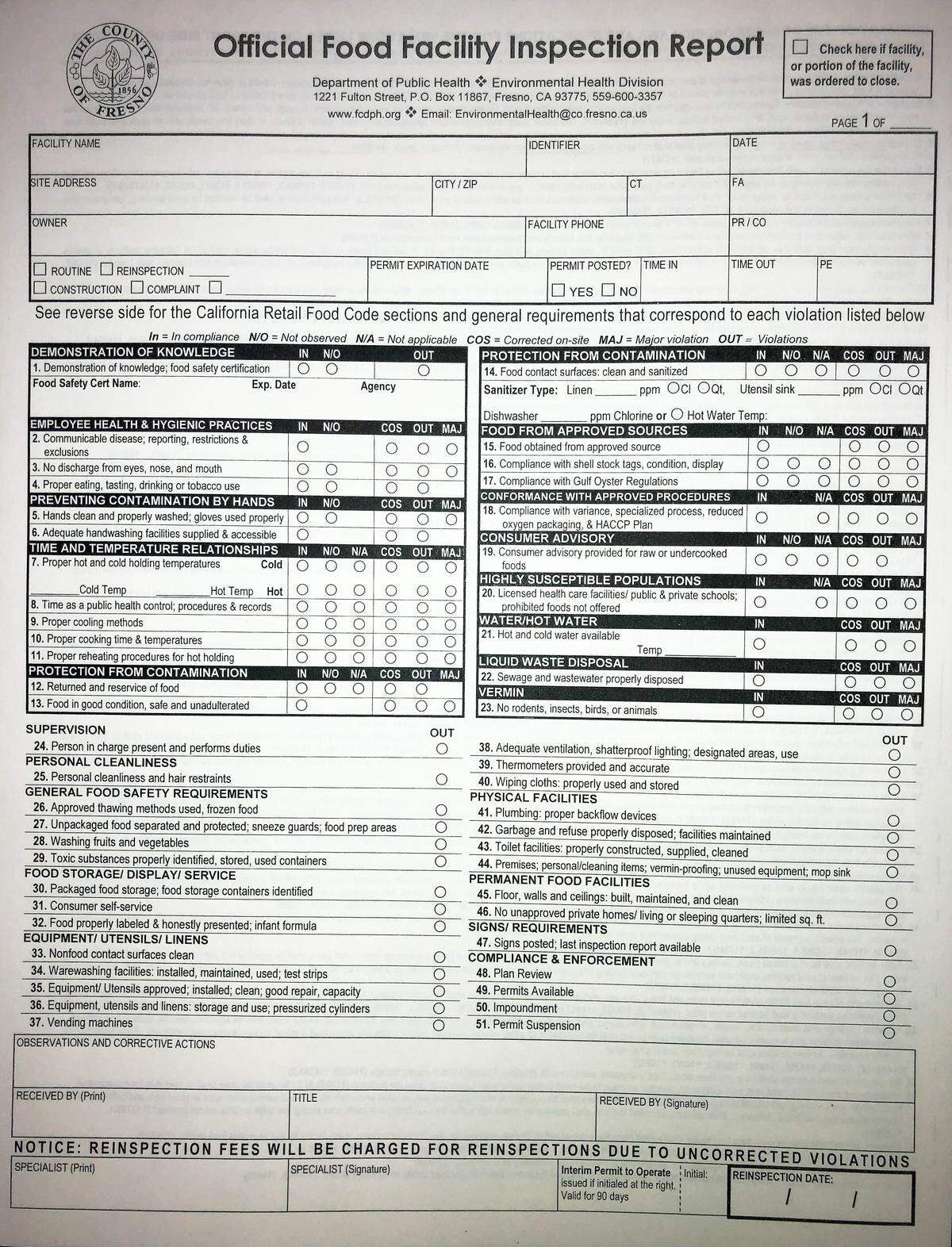
Not every violation has its genesis in inspectors’ observations. In some instances, members of the public will call or send emails to report problems they’ve seen at a restaurant.
“The public is very discerning nowadays. They watch, they look and they are quick to report things they see,” Fox said. “Our operators, for the most part, understand that and work very hard to stay on top of that.”
Among the common complaints from the public are watching an employee handle cash and then prepare food without washing their hands first, or not using gloves. Sometimes the issues are more serious, including complaints about possible food-borne illness, sightings of insects or rodents, or backed-up plumbing.
The county also makes its inspection reports public on its website, www.fresnohealthinspections.org, where people can search for a restaurant, grocery store, convenience store or other food site by name or address and see for themselves what inspectors find.
“Most discerning people can look at an inspection report and say, ‘Oh, no paper towels? That probably doesn’t affect my food,’ “ Fox said. “But rodents, no hot water, whatever the other things are, they’re a little more concerned about that.”
“And there are some people who tell you, ‘I like that restaurant. I don’t even want to know,’” he added.
Two neighboring central San Joaquin Valley counties also have ways for the public to search online for results of food facility inspections done by their respective environmental health departments.
- Tulare County: tularecountyeh.org/eh/index.cfm/our-services/food/, click on the “food inspection results” link in the right-hand column of the web page.
- Kings County: www.countyofkings.com/departments/environment-health-service/online-inspection-reports.
- Madera County does not post its food facility inspection reports or results online.
While Fresno County posts its inspection reports online, it has not adopted a system used in some other California counties that awards letter grades to restaurants based on their inspection results.
“I think posting things to a website where people can do their own independent evaluation is fine and very helpful,” said David Pomaville, director of the Fresno County Department of Public Health. But, Pomaville and Fox added, letter grades can become meaningless if almost every facility that passes gets an A grade.
Instead, Fresno County’s rating is simple: you either pass or you don’t. “If they’re allowed to open and operate, if they have their permit, if they’ve met all the conditions, then they’re lawfully operating,” Pomaville said. “If not, we direct them to close until the problems are corrected. It’s a pass-fail system.”
How we reported this story
The reporting for this story included a request to the Fresno County Department of Public Health for a list of restaurants and other food facilities closed any time from July 2017 through July 2018 as a result of findings during health inspections, as well as the issues that inspectors found and ordered the facilities closed until problems could be corrected.
The reporter used the list to review the county’s searchable database to seek re-inspection reports indicating when a restaurant or facility was authorized by inspectors to reopen after fixing problems. The list also was the basis for the reporter to produce the interactive map that accompanies the online version of this story.
Interviews for the story over a one-week period included Fresno County Director of Public Health David Pomaville, Environmental Health Director Wayne Fox, environmental health specialist Matthew Gore, supervising environmental health specialist Stephanie Kahl, and restaurateur Liz Sanchez, owner of Casa de Tamales.
Local news matters: We rely on readers like you more than ever before, and we currently offer free access to five stories a month. Support us further with a digital subscription to help ensure we can provide strong local journalism for many years to come. #ReadLocal
This story was originally published August 27, 2018 at 1:29 PM.