
Can lower fines create water savings for Fresno residents? Study hopes to find out
More than 100,000 Fresno homes will be part of a "groundbreaking" and "novel" three-month research study to see whether easing up on water restrictions and reducing fines for excessive water use will actually spur greater conservation by residents.
The University of Chicago's Energy and Environment Lab is working with the city's Public Utilities Department on the summer pilot project. It involves a detailed study of real-time water use data from residential water meters coupled with different sets of conservation thresholds and penalties to see if there is a "sweet spot" that results in the highest level of compliance.
The Fresno City Council approved the experiment on a 5-2 vote on Thursday.
"The whole point of this pilot study is to gather information about how our customers use water in the city … and make better informed policy decisions going forward," said Michael Carbajal, interim assistant director of utilities . "It might even result in lower fines in the future."
The city requires the installation of water meters on all new homes. Last year, the Fresno City Council adopted regulations that defined excessive water use as using more than 300 gallons in an hour when it's not on their established outdoor watering day. New penalties were also set for households that exceed that threshold: a courtesy notice for a first violation, $50 for a second, $100 for a third, and $200 for every subsequent violation.
That fine structure took effect in January. "We've gone a few months, and we're not seeing any real change," said Mark Standriff, a spokesman for the city. "We're still every week getting 1,000 to 1,100 people who are watering every single day."
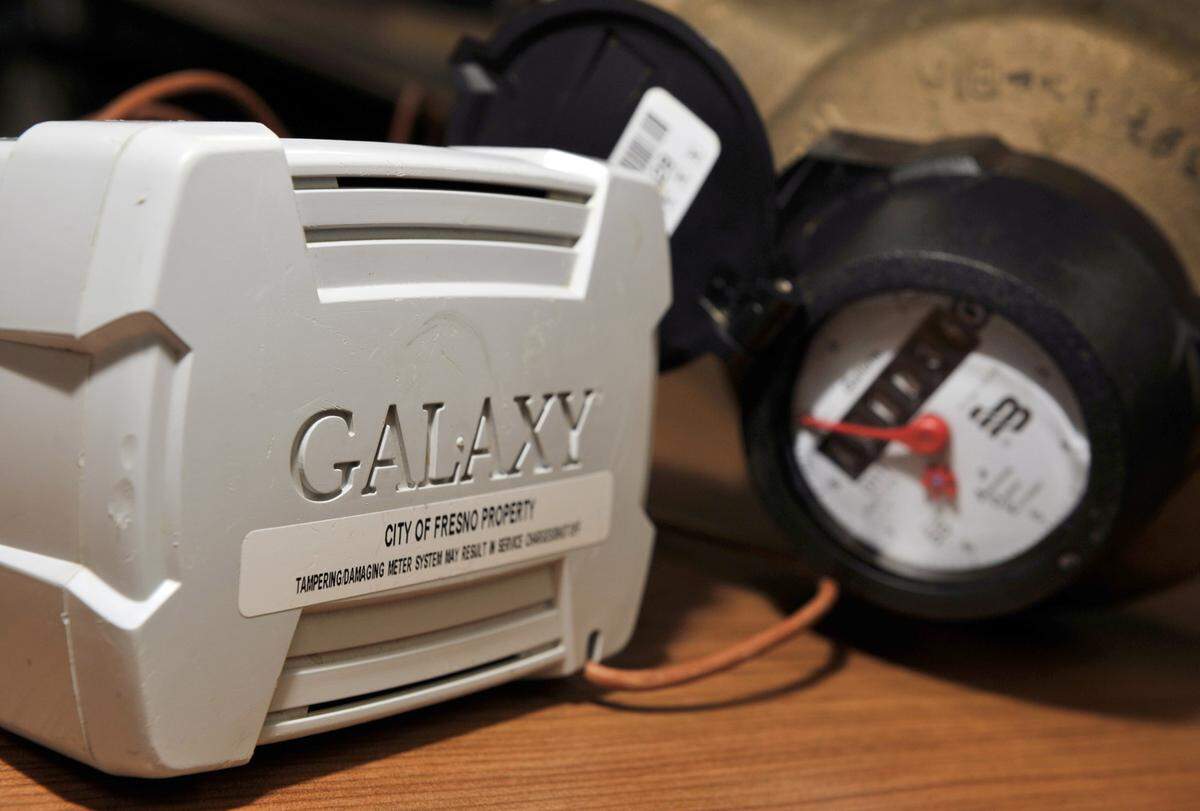
But water meters have not been used directly for enforcement. Instead, they serve as an indicator for representatives from the water division to go into a neighborhood and look for places where watering is happening on the wrong days or hours — a labor-intensive process that has employees out in the middle of the night hunting for violations.
Under the summer experiment, the automated water meter data will be the trigger for notices of violations for nearly half of Fresno households. About 45,000 homes will continue to be subject to the status quo enforcement of a visual inspection, a 300-gallon-per-hour threshold and the current levels of fines. They will serve as a control group to compare with the rest of the homes in Fresno, where nearly a dozen alternative strategies will be examined: different combinations of visual inspections or automated monitoring, more lenient water-use thresholds of 500 or 700 gallons per hour, and fines that are discounted by 50 or 75 percent from the penalties now on the books.
"All of the things we're testing in Fresno are lower fines" rather than increasing the penalties, said Olga Rostapshova, executive director of the Energy and Environment Lab, in a presentation Thursday to the Fresno City Council. "Can Fresno do just as well with lower fines? … You have these meters installed, and the data is already being used. All of our suggestions are to decrease the fine numbers" and increase the water-use thresholds."
After the vote, Rostapshova and Ludovica Gazze, a post-doctoral fellow with the University of Chicago lab, described the study as unique in the world of water conservation.
"Some of these enforcement policies actually seem to be effective, but at the same time not a lot of the people who were actually using a lot of water were actually getting fined," Gazze said. "It could be that if it's 300 gallons an hour for enforcement and you fine people, you might be putting too much of a burden on customers. … We want to make sure we understand that maybe smaller fines work better than higher fines."
"This is pretty novel. One of the exciting parts of this experiment is that it's going to be groundbreaking," Rostapshova added. "This is Fresno leading the way globally in implementing this new (meter) technology and figuring out how to use it intelligently without overburdening the people."
Next week, the city will roll out a new smartphone mobile app called EyeOnWater that customers will be able to use to monitor their household's water use and get alerts when their water meter detects consumption that is potentially in violation of the regulations.
If the city can successfully convert to automated enforcement using the water meter data, Carbajal said the representatives who now are in the field looking for violations will be freed up to instead work with customers who receive violation notices to find ways to reduce their use, including re-setting irrigation timers or doing leak assessments. "That's the opportunity to fix the situation before we fine," Carbajal said.
This story was originally published May 17, 2018 at 3:56 PM with the headline "Can lower fines create water savings for Fresno residents? Study hopes to find out."