‘We’re not out of the woods.’ Fresno doctors urge caution as state relaxes indoor mask rules
A sharp decline in the number of new coronavirus infections, both statewide and in the central San Joaquin Valley, is one of the chief factors in a decision by California health officials to ease up on a universal mandate for people to wear face masks in indoor public spaces like stores and restaurants.
Instead, only those people who are not fully vaccinated will be “required” to wear face masks in most indoor settings after Feb. 15, according to guidance offered this week by the California Department of Public Health.
“There’s a recognition that with our numbers coming down in terms of case rates, with the rest of the state having even better improvement than what we’re having in the Central Valley, as a state it might be time to move forward toward a little bit less restricted activities,” Dr. Rais Vohra, interim health officer with the Fresno County Department of Public Health, said Thursday in a briefing with reporters.
On Thursday, the average number of new COVID-19 cases over a seven-day period was just over 1,000 per day. That’s compared to a seven-day average of almost 2,500 new cases each day two weeks ago. The reduction is even more marked on the statewide level, Vohra said.
But in Fresno County, where there has at times been vocal resistance to masks as a measure to prevent the spread of COVID-19 in the community, there’s not an expectation for big changes in behavior next week, regardless of whether people are vaccinated against COVID-19. Vohra acknowledged Thursday that there will be no particular effort at enforcement by local health leaders.
“Voluntary compliance is what people have come to expect” over the course of the past 23 months of the pandemic, Vohra said, adding that his agency won’t be adopting any measures that are more stringent than the state’s guidance.
“Honestly, I don’t think we’re going to see a huge change in people’s habits,” he added. “I think people have made up their minds about how they want to practice their daily activities.”
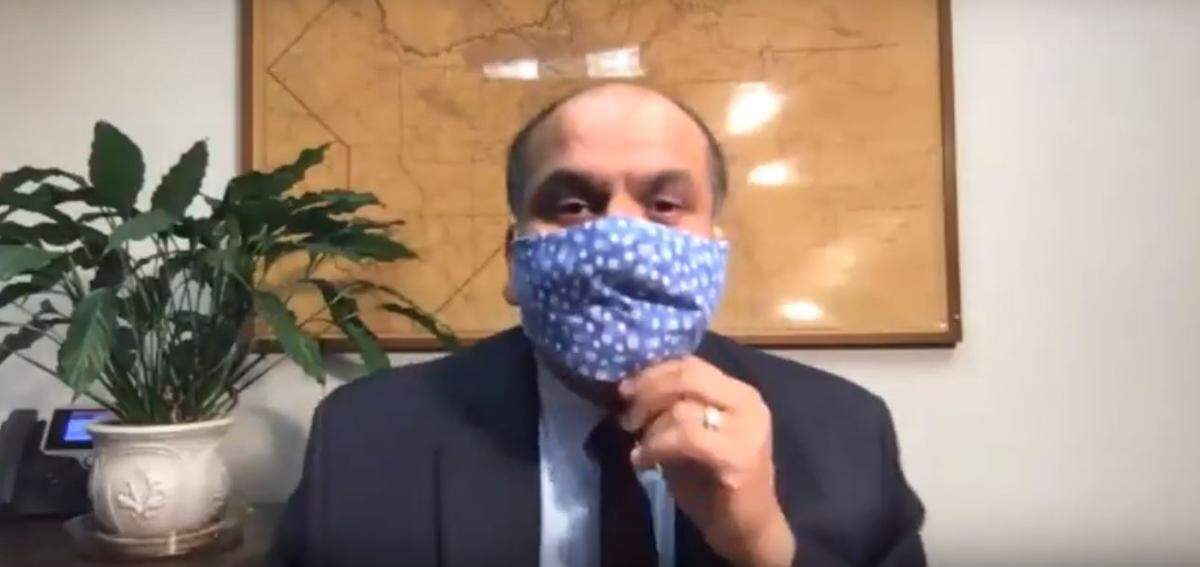
Even after Feb. 15, there will be some high-risk settings in which masks will remain mandatory for everyone, regardless of vaccination status. Those, Vohra said, include medical and health-care facilities, congregated living situations such as nursing homes, and aboard public transportation.
“When our case numbers are coming down, when our hospitals are not as full and not as strained, then it makes sense to liberalize some of these restrictions,” Vohra said. “And when things are going the other way, all of us need to understand that as a community we all need to make some changes in how we do things.”
Fresno County doctors are urging caution for two reasons. First, the rates of new infections in Fresno County and the Valley remain much higher than they were for most of last year before the latest winter surge, due mainly to the highly contagious omicron variant of coronavirus.
Plus, the percentage of vaccinated people in Fresno County and neighboring Valley counties still lags well behind the statewide average.
“There is happy news about the case rates, but we’re not out of the woods yet,” Vohra said Thursday.
But as case rates slide, Vohra noted that there is a desire and cry to do away with mask requirements. “Whenever we’re on the downslope, every single time we’ve had one of these surges, we have these dynamics where some of us get more impatient,” he said. “We really want to rush to making things normal and opening things up. … Some of us are just vocalizing our impatience a little bit more loudly. That’s to be expected.”
Fresno County’s health department “encourages everyone, whether fully vaccinated and boosted or not, to consider wearing a well-fitting mask (such as) KN95, N95 or surgical masks rather than a cloth mask in high-risk situations such as when indoors, in crowded settings and around others who are unmasked or unvaccinated,” Dr. John Zweiffler, a public health physician with the county, said earlier this week.
Vohra said Thursday that while N95 and KN95 masks are the most effective at filtering out the omicron variant of coronavirus, surgical masks are sufficient for the everyday needs of most people.
“The higher the quality of mask, the lower the risk of catching COVID,” Vohra said. But, he added, “even a cloth mask is better than no mask at all.”