State’s focus on vaccine equity could pave way for Fresno to reopen, expand more businesses
The growing availability of vaccines to inoculate people against COVID-19 is prompting California to tweak its Blueprint for a Safer Economy that could enable Fresno County and other Valley counties to reopen segments of their business communities sooner rather than later.
How soon that could happen, however, will depend on how quickly the state can achieve a new goal of providing 2 million doses of vaccine to residents in some of the lowest-income neighborhoods across California – census tracts and ZIP codes that Gov. Gavin Newsom said Thursday have been disproportionately affected by coronavirus infections, illnesses and deaths compared to more-affluent communities.
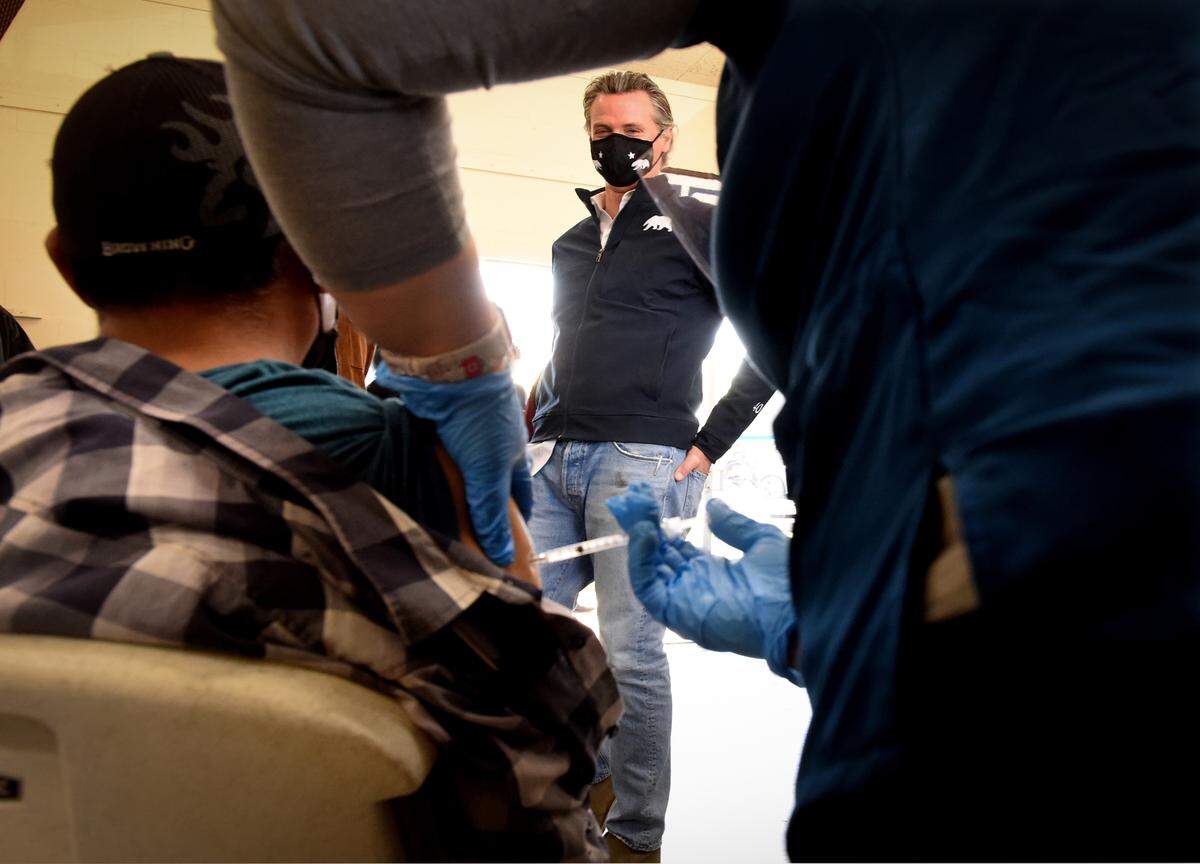
Newsom, speaking at a vaccine clinic in Stockton, said that while more than 9.5 million doses of COVID-19 vaccines have been given to date in California since they became available in mid-December – including about 1.7 million doses over the past seven days – “we’re still falling short” of assuring equitable access to the shots.
The state is now earmarking 40% of its vaccine allocations for the 25% of California ZIP codes and census tracts identified as having the greatest disadvantage on a health equity index – areas with greater disparities of environmental justice, access to healthcare, transportation, education and other socioeconomic factors. “That’s a way we’re going to make real progress in advancing our cause … of equity,” the governor told reporters.
Until that happens, “I don’t think we’ll truly meet the moment and we will not mark real and demonstrable progress to address the issue of the hardest-hit communities that have been underserved across the spectrum,” Newsom said, “and currently are being underserved in terms of access to vaccinations.”
Currently, about 1.6 million doses of vaccine have been provided to residents in those disadvantaged areas statewide. The governor estimated that the 2 million-dose target could be reached within a couple of weeks.
Once that happens, it will trigger what Newsom described as “a modest loosening” of criteria in the state’s color-coded system of tiers for reopening businesses from measures that have been aimed at reducing the spread of the virus.
Those tier adjustments, first announced Wednesday evening, would let counties that are now in purple Tier 1 of the state’s blueprint progress into the less restrictive red Tier 2 sooner – once they bring their rate of daily new cases to 10 or fewer per 100,000 residents instead of the existing threshold of seven cases per 100,000.
Under the red tier, restaurants can reopen for indoor dining at up to 25% of their capacity; gyms and fitness clubs can resume indoor operations at up to 10% of capacity, and other businesses can increase their indoor operations. All of the relaxed standards are conditioned upon requiring physical distancing and masks or face coverings for a business’ staff and customers.
Relaxing the bar
The daily new-case rate is one of the key criteria that dictates when counties can move from one tier into another within the blueprint. Fresno, Kings, Madera, Merced and Tulare counties are currently in purple Tier 1, the most restrictive of the four levels, in which restaurants are limited to offering only outdoor dining or to-go orders, and gyms are allowed to only operate outdoors – although numerous restaurants, gyms and other businesses have been open indoors in defiance of the program.
The other measures are testing positivity, or the percentage of positive test results among residents who get tested for COVID-19 over the course of a week; and a health equity score based on testing positivity in the most disadvantaged neighborhoods, to assess whether residents in those areas are not being left behind in disease-prevention efforts.
All five of the Valley counties already meet the “graduation” threshold for both testing positivity and health equity – 8% or fewer tests returning as positive for the virus. What’s holding them back is the new-case rate.
Fresno County, which had a brief run in red Tier 2 last fall before backsliding into purple, this week had a rate of 14 new daily cases of coronavirus per 100,000 residents – double the seven-per-day threshold. When the state reaches the 2-million-dose goal, that trigger would be raised to 10 cases per 100,000, a less daunting threshold for the county to achieve.
But Madera and Tulare counties, which last fall did not manage to make it into the red tier, are already on the cusp of movement when the trigger reaches 10 cases per 100,000. Madera County’s new-case rate this week was reported at 10.8 per 100,000 people, with Tulare County not far behind at with a rate of 11 cases per 100,000 people.
For a county to move from one tier into a less restrictive tier, it must meet or beat all three marks – the new-case rate, testing positivity, and the health equity score – for two consecutive weeks..
Caution in reopening
Dr. Rais Vohra, interim health officer with the Fresno County Department of Public Health, said county health leaders have not been given details about the changes to the blueprint.
“We are optimistic that because of our robust partnerships with community organizations in helping disadvantaged communities all throughout the pandemic, that we can continue to work in alignment with the state’s plans to ensure that equity is central to reopening and vaccination plans,” Vohra told The Bee by email Thursday. “We look forward to getting more information from CDPH about what specifically will be changed and how progress will be tracked.”
Accelerating the reopening of businesses does not come without concern, however. Reopening too quickly carries the potential for infections, and subsequent hospitalizations and deaths, to increase as they did last summer when business restrictions were eased statewide.
Getting more vaccinations into the arms of residents is crucial to preventing a repeat of surges that happened last summer and over the winter months.
“There is certainly a risk that increased cases may result due to increased indoor activity outside the home, and possibly as a result of more contagious variants,” Vohra said. “It really feels like a race against time to vaccinate our most vulnerable, elderly and essential occupations throughout the month of March so that we can protect a maximum number of Fresno County residents before we begin to see any upticks in the number of cases we track.”
In Stockton, Newsom reiterated the need to focus vaccines toward disadvantaged communities. Of the more than 53,000 people who have died from COVID-19 over the past year, about 46% have been Latino, Newsom said.
Households with incomes under $40,000 a year have been affected by COVID-19 at a rate that is double that for families that earn $120,000 a year or more, Newsom said. At the same time, he added, higher-income households have had twice as much access to vaccines to date.
“We have to own up to that,” he said. “We are doing something that is necessary at this moment, not only to do the right thing for communities that have been disproportionately impacted, but also to safely open our economy.”
“We can’t safely reopen our economy until we get this disease behind us,” he added. “And we can’t honestly do that unless we address those communities that are disproportionately vulnerable to this pandemic and its deadly impact.”
This story was originally published March 4, 2021 at 2:48 PM.