
‘He doesn’t get rattled’: Doctor leads Fresno County through coronavirus pandemic
When Dr. Rais Vohra thinks about what prepared him to lead Fresno County through a historic pandemic, he’s got a treasure trove of sparkly and scary experiences to consider.
Born in India, grew up in Texas, living in Los Angeles. Emergency room doctor, treating earthquake victims in a foreign country, leading a region’s poison control center. Being a husband and a father.
Without skipping a beat, he chooses the earthquake response and launches into a story.
“Let me take you back 10 years. So in 2010 there was a giant earthquake in Haiti. Do you remember that? I was an ER doctor in LA – young, single, adventurous, immortal, you would say. It was really just, ‘Let’s go have an adventure.’ I had friends that were going to work on the response there two weeks after that earthquake. So I said, sure, I’ll come along.”
Vohra said he drew on that experience when he recognized the coronavirus as a public health crisis early on. But what he didn’t realize, he said, is that it would play out in slow motion.
Since Vohra announced the first case of COVID-19 in Fresno County in early March, he has been the region’s leading voice and a decision-maker for 1 million residents – all after spending only a few months in a new job as the county’s interim health officer.
His vast life experiences are why most people agree he’s the right man for the monumental task at hand.
Cool and collected
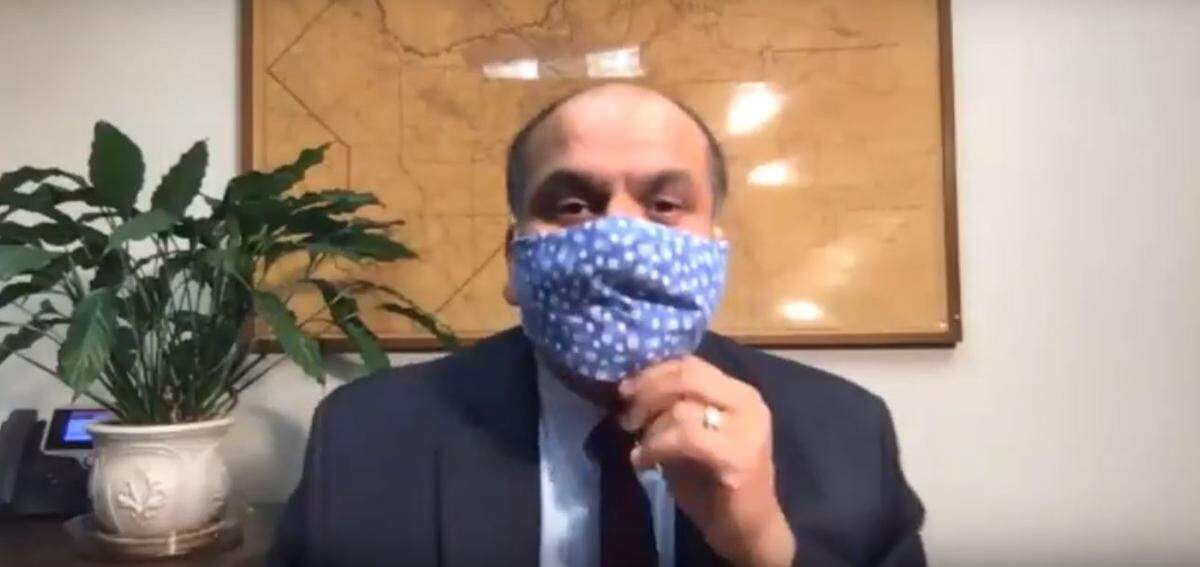
Vohra answers media questions three times a week during a Zoom teleconference. In one briefing, a television anchor hammered away at questions about a released inmate who tested positive for coronavirus. The doctor remained calm and unwavering in his response.
No, county officials would not release the man’s identity.
“I feel that the right thing is being done. I know there’s a lot of frustration about this situation,” Vohra said. “We’re trying to address it as best as we can. And I apologize for any inconvenience that this is causing.”
That cool and collected demeanor is something you can count on from Vohra in tough situations, according to his friends, colleagues and mentors.
Vohra began as interim health officer for Fresno County in the fall of 2019. It’s difficult to find a qualified public health officer who has experience both in practicing medicine and public health policy, said Jean Rousseau, Fresno County’s administrative officer.
Vohra still works shifts in the emergency department at Community Regional Medical Center in downtown Fresno and serves as the medical director for the Fresno/Madera Poison Control Division, so he agreed to take the job part-time, Rousseau said.
Then coronavirus hit, and hiring decisions or thoughts about making Vohra’s role more permanent were pushed to the back burner, Rousseau said. He added that Vohra has done an excellent job, and if he’d like the job full-time the county would love to have him.
“He’s just added a level of stability in that role during this difficult time,” Rousseau said. “The community’s blessed to have him.”
Leading Fresno through a pandemic
Vohra said he draws on the skills he learned during “Haiti earthquake summer camp” to navigate the coronavirus pandemic. While there, he and his colleagues worked out of tents.
“You had to really just fiddle with whatever you had with you because you have no other resources,” he said. “And you just had to create a solution. It wasn’t the prettiest solution. It wasn’t optimal. But that’s all you really had to deal with. And I feel like so much of this crisis around the world is watching people having to do that same thing.”
That experience taught him what a disaster looks like. But, more importantly, it taught him that no disaster looks the same, and every disaster looks different at various points in time, he said.
“Communication was fractured, at best,” he said. “People were angry. People had their lives totally turned upside down, and there were a lot of just tragic deaths.”
So far with coronavirus, Vohra said he has found it most frustrating and challenging to reach those in rural communities who may not speak English in order to arm them with credible and educational information to protect themselves. He has also found it tough protecting the identities of those who do have the virus and shield them from the stigma and other mental health challenges that accompany it.
Besides learning a new job and researching a virus new to the rest of the world, Vohra had to learn something else in his new role: how to navigate politics. He talks with his friend, Jerry Neufeld, a social worker at CRMC, about how to manage and balance the political voices, both at the city and county level.
“I think that’s probably the biggest challenge that we have talked about – is how to find that space to be able to continue to tell the story about the reason that we can make our way through this” pandemic, Neufeld said.
If that’s the case, Vohra hasn’t let on. He said the county supervisors and administrators he works with are bright, empathetic, insightful and willing to lend an ear.
“Even though we’ve made some difficult decisions together, I really feel like they have my back,” Vohra said. “They’ve actually given me insights about how to do my job better.”
Buddy Mendes, the chair of the Fresno County Board of Supervisors, said Vohra is refreshing and straightforward. He likes that Vohra still works in the emergency department and sees firsthand what’s happening there.
“He’s not a guy who just works in the theoretical world. He works in the real world,” Mendes said. “He seems very practical, and I like practical people. …You hear stuff from the press but you get the real story from him.”
Rousseau, the county administrator, said he appreciates that Vohra hasn’t been heavy-handed. The few health officer orders Vohra signed have been directives that encourage voluntary compliance rather than quickly issuing citations and making arrests, Rousseau said.
Tough decisions: Burials, graduations
The toughest decision Vohra made so far was about burials.
The first two people to die in the county from coronavirus were a Firebaugh couple in their 80s, Agustin and Antonia Gordillo. The couple’s children caught the virus while caring for their parents and weren’t able to say goodbye. The children pleaded with county officials to get out of their cars to watch their parents’ burial at the cemetery.
Talking to that family, “my heart just broke,” Vohra said.
In the end, the family was allowed to have 10 people at the burial, including the priest.
That tough decision led to productive conversations, Vohra said.
“It really made us think through every single step of how someone is going to be given their their final goodbye, and I hope we’ve come to at least an acceptable resolution,” he said. “I know it’s not what everybody wants.…That’s an important marker in one’s life journey, but it was one that was a really hard decision for us.”
High school graduation was another particularly difficult conversation Vohra faced. He remembers his like it was yesterday, he said, and it was one of the most joyful times in his life.
He remembers that day as the last happy time with his family. The next day, his parents split up.
“I get it. These kids, I don’t even know if they know what they’re going to miss out on,” he said. “And I just feel so awful, and again, I’m very much struggling with how we can make this happen.
“I really hope that we can come to some kind of an agreement to where people can learn how to survive in this new normal, and still have these rites of passage, all of these different markers in life’s journey,” he said.
Life BC (before coronavirus)
Vohra, 44, was born in India and immigrated with his family to Texas when he was 8.
That’s where he got his education, including college.
He earned his bachelor’s and medical degrees in Texas. He completed his residency in emergency medicine at Parkland Memorial Hospital in Dallas, where President John F. Kennedy died after he was a shot in a motorcade.
Vohra went on to complete a fellowship in toxicology in San Diego, meaning he had to leave Texas, “which I never thought I’d do,” he said. From there he accepted a faculty position at UCLA.
But LA doesn’t have a poison control center, and he wasn’t practicing the kind of medicine in which he trained.
As it turns out, the poison control division that covers LA is based in Madera at Valley Children’s Hospital. California’s poison control system is the largest in the country and provides treatment advice and information on poison exposure for both residents and health professionals.
Geller, the former poison control medical director, never had an associate and wasn’t looking for one. Vohra essentially cold-called him looking for a job, Geller said.
“There was just something about him,” Geller said. “When I first met Rais, I just really liked him. He impressed me with his intelligence, and he had a sense of dignity and integrity about him that I found attractive.”
Vohra was hired. Along the way, Geller and Vohra became friends. Vohra called Geller a mentor. In 2018, Geller retired, and Vohra became the medical director, a position he still holds.
In 2009, Vohra also joined UCSF Fresno as a faculty member. He’s an emergency doctor at Community Regional Medical Center, where he also teaches residents. Vohra’s wife, Dr. Stacy Sawtelle Vohra, also is an emergency room doctor and the residency program director for UCSF Fresno emergency medicine. They have two children.
Geller said Vohra took to fatherhood “like a duck to water,” and said he’s a “mush ball” with his daughters. “That’s partly the measure of a man, as well, in my opinion, is how they take to fatherhood,” Geller said.
Neufeld, the social worker, calls Vohra a friend. They discuss articles in The New Yorker and other publications, and sometimes their talks ramble on for so long they lose track of time. Vohra gave Neufeld a book for Christmas that he said changed his life (“Shantaram” by Gregory David Roberts). And Neufeld recommended a silent retreat in North Fork to Vohra, who expressed great interest.
“He’s got good energy,” Neufeld said.
This story was originally published May 7, 2020 at 10:37 AM.