Fight brewing over aid, protections for the San Joaquin Valley’s undocumented workers
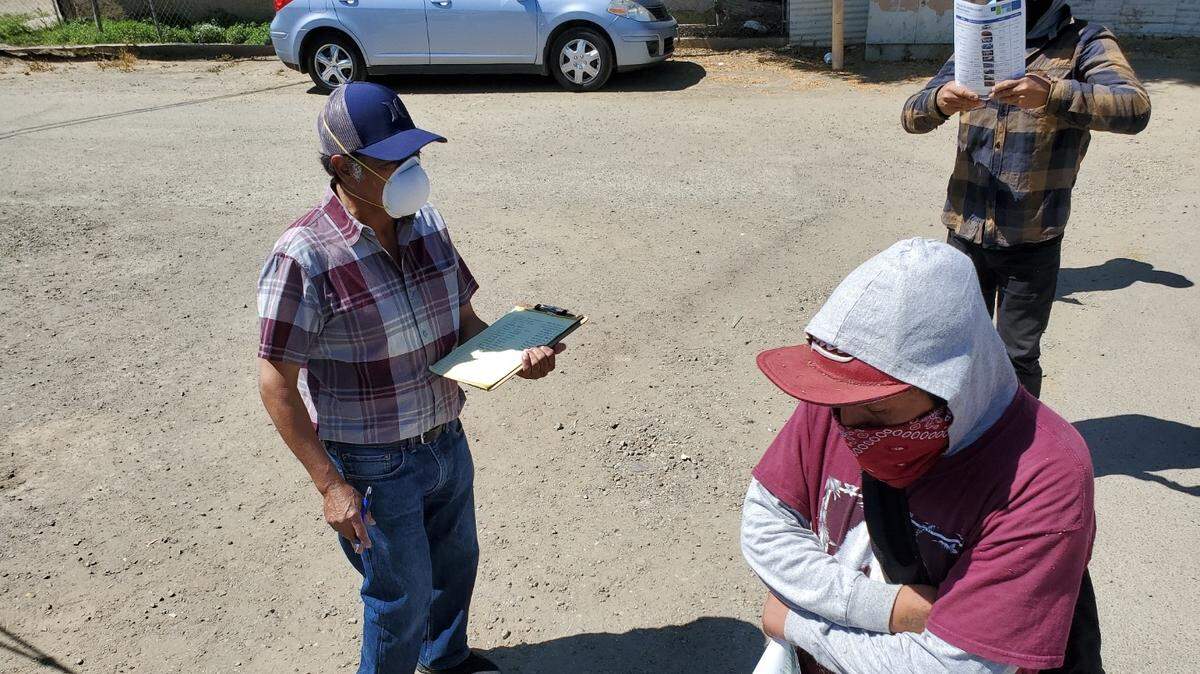
On a recent Saturday afternoon, dozens of farmworkers came to a dirt lot in Huron, in western Fresno County, to trade bandanas for handmade face masks.
The distribution, led by the Huron mayor and a few volunteers, came as farm labor advocates are pushing for increased safety gear for workers amid fears the spreading virus could overwhelm rural-area health clinics.
The rise in positive coronavirus cases in rural Fresno-area towns concerns town leaders who say farmworkers and rural low-income residents remain particularly vulnerable to the virus.
Congressional leaders this week urged the National Institute of Health director and Gov. Gavin Newsom to prioritize COVID-19 testing for front-line food workers, including farmworkers. Health experts have said remote communities in central California may have been undercounting cases.
“We must act quickly before the virus devastates our rural health system and keep these essential workers safe and healthy during this crisis,” U.S. Rep. TJ Cox said in a statement.
But the fight for worker protections, advocates say, goes beyond short-term needs like masks and testings. Many of the Latino elected officials representing the rural-area communities are former farmworkers themselves who say their constituents, some of whom are undocumented, have long sought permanent labor protections.
Getting those protections — paid sick leave, medical coverage, federal aid — has become critical, they say.
Politics, immigration
Much of the discussion around spending to protect workers hinges on political differences over immigration and a large undocumented workforce.
In a rare step last month, Newsom announced $125 million in funding for workers left out of federal stimulus funding, including the undocumented. About $75 million would be picked up by the taxpayers. The other $50 million would come from philanthropic donations.
The state proposes a one-time payment of $500 per undocumented person or $1,000 per household.
Additionally, the proposed funding won’t be nearly enough to help all of California’s roughly 2 million undocumented residents, according to Edward Flores, an associate professor at UC Merced.
Flores said only about 150,000 undocumented residents in the state would benefit from the governor’s proposal. He said there are about 112,000 undocumented individuals just in the San Joaquin Valley.
Flores projects that nearly 270,000 undocumented workers in California have lost their jobs during the pandemic.
In his research, Flores estimates the state’s undocumented workers would have access to around $2.82 billion in unemployment benefits over 39 weeks if they had legal status.
But while some say the proposal isn’t enough to help, opponents say it’s still too much.
Within days of the proposal’s announcement, a lawsuit was filed by The Center for American Liberty and Dhillon Law Group to block the effort.
The Fresno County Republican Party, which supports the lawsuit, said any help during the coronavirus pandemic should go exclusively to U.S. citizens.
“In these times of uncertainty with the economy and shrinking budgets at the state level, we must focus our resources on ensuring that Californians have the healthcare and support they need. There are many different segments of Californian’s population that desperately need resources because of COVID,” said Fred Vanderhoof, chairman of the county’s GOP.
Groups in need include disabled veterans, citizens struggling with job losses, and small businesses trying to stay afloat, Vanderhoof said.
“We do agree ... that the payments are unconstitutional and illegal,” Vanderhoof said.
Fresno-area politicians push for protections
Nationally, nearly half of the farm labor workforce has no official employment authorization, according to the most recent data from the U.S. Department of Agriculture.
Seth Holmes, a medical doctor and anthropologist at UC Berkeley, said providing agricultural workers with protections such as paid time off from work and job security could limit disruption to the workforce.
He said arguments that farmworkers, and those who are undocumented, are not contributing to society have often been misleading.
“Many politicians, many people on school boards, many teachers, many doctors and nurses, have been farmworkers or are children of farmworkers,” Holmes said. “The farmworkers themselves are contributing as farmworkers.”
That’s also true of many rural-area elected leaders in Fresno County who are former farm laborers or the children of farmworkers.
Espi Sandoval, one of two Latino city councilmembers in Kerman, is part of a wave of first-time, rural-area elected officials who have been thrust into what they say is an urgent battle for worker benefits.
“As soon as the pandemic is over, we’re going to go back to what it was before,” Sandoval said. “Right now is the time to hold the federal government accountable.”
Sandoval is part of a small group of elected leaders in Fresno County pushing for more farmworker protections like a pathway to citizenship and inclusion in coronavirus financial relief. The two-year-old group, dubbed the Central Valley Leadership Round Table, is made up of rural community leaders.
Eliseo Gamiño, a Firebaugh city councilmember and the group’s president, said the needs of rural workers have long been ignored. The coalition recently sent a letter to Cox and U.S. Rep. Jim Costa calling for permanent protections for laborers.
“Agricultural workers are the economic engine of our American economy, if you ask me,” Gamiño said.
A workers’ bill of rights?
Dillion Savory, executive director with the Fresno-Madera-Tulare-Kings Central Labor Council, said the labor federation plans to push for the workers’ bill of rights in California.
The bill would include proposed aid for food, paid sick leave and child care for workers.
“Ultimately, the statewide labor movement is trying to make a bigger push to get a comprehensive approach that covers all workers,” he said.
The bill will seek funding for direct relief assistance to state workers, but specific details haven’t yet been worked out. Savory said he hopes to address things such as loopholes in the first federal stimulus package, which kept working families with mixed immigration status from getting assistance.
Savory said he is confident in the steps California has taken to support vulnerable workers. But the push will need to go national, he said.
“We are almost essentially in a wartime ... what better time than now to recognize the contributions that undocumented people are providing to not just the country,” Savory said. “We should be recognizing these people with some sort of a permanent status that sets a pathway to citizenship.”
Congressman Costa has said he will push to include provisions outlined in the Farm Workforce Modernization Act — which would protect against deportation to about 800,000 farmworkers — into a federal package expected to be introduced this month.
“We just have to keep trying, keep putting it on the table,” he said.
This story was originally published May 7, 2020 at 10:51 AM.
.jpg)