
Protecting the sequoias: Giant trees wrapped in aluminum blankets as raging wildfire nears
As the KNP Complex Fire continued to spread through Sequoia National Park, the National Park Service put special focus on protecting a collection of famed giant sequoias, the largest trees in the world.
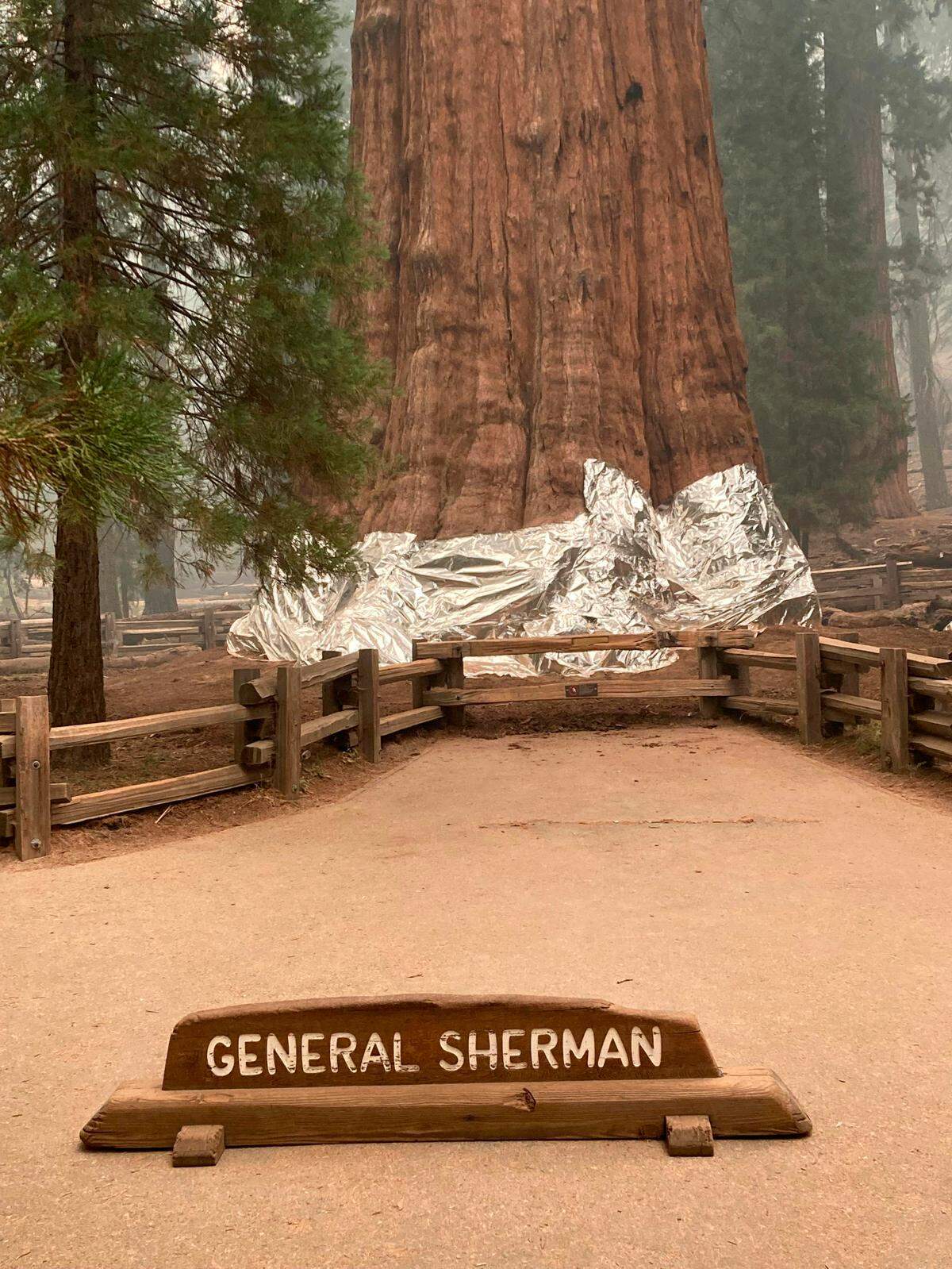
Among the safeguards: Wrapping the base of these old, massive trees in aluminum-based, burn-resistant foil to reduce the threat of the extreme heat from the raging wildfire.
The General Sherman — the largest known living single-stem tree on earth at 275 feet tall and more than 36 feet in diameter at the base — joined the other giant sequoias in undergoing the emergency measure.
Giant Forest inside Sequoia National Park is home to more than 2,000 sequoias.
“We basically told the fire crews to treat all our special sequoias like they were buildings and wrap them all up, and rake all the litter away and roll away the heavy logs,” Christy Brigham, chief of resource management and science for the Sequoia and Kings Canyon National Parks, told CNN.
The National Park Service said the sequoias are at least hundreds of years if not in some cases more than 3,000 years old.
The aluminum “fire blanket” offers reflection of 96% of the radiant heat and 92% of the convective heat, according to manufacturer Firezat.
Dan Hirning, founder of Firezat, told Newsweek the blanket technique should offer the massive trees at least short-term protection from the flames.
“Aluminized structure wrap has been used for years by archeologists working in the U.S. Forest Service and national parks to protect historical structures of all sorts, from rocks containing Indian glyphs, all kinds of building structures such as Pony Express waypoints, and even giant sequoias,” Hirning told Newsweek. “By clearing debris away from the base and wrapping it with structure wrap, they try to spare the tree’s base from the fires.
“While the bark can be up to 12 inches thick and full of fire-resistant tannins, after decades of wildfires burning holes in the base of the tree they can become unstable and topple. Sequoias are normally most vulnerable to crown fires, which ignite the trees at the top and burn down.”
Another measure that firefighters are taking to preserve the giant sequoias is intentionally setting fires to burn away nearby flammable vegetation before the wildfire possibly arrives to help slow — if not stop — or redirect the blaze.
As of Saturday morning, the KNP Complex Fire had burned nearly 18,000 acres. Sparked by lightning Sept. 9, it comprises the merged Paradise and Colony fires.
An estimated 7,500 to 10,600 large sequoias already were killed during last year’s Castle Fire, which also was started by lightning Aug. 19, 2020. That number of dead sequoia trees was equivalent to 10% to 14 % of all large sequoias across the trees’ natural range in the Sierra Nevada, according to the National Park Service.
“Hopefully,” Rebecca Paterson, a spokeswoman for Sequoia National Park, told The Associated Press, “the Giant Forest will emerge from this unscathed.”
This story was originally published September 17, 2021 at 7:15 PM.