
Gavin Newsom strikes wildfire deal to put $536 million toward home-hardening, prevention
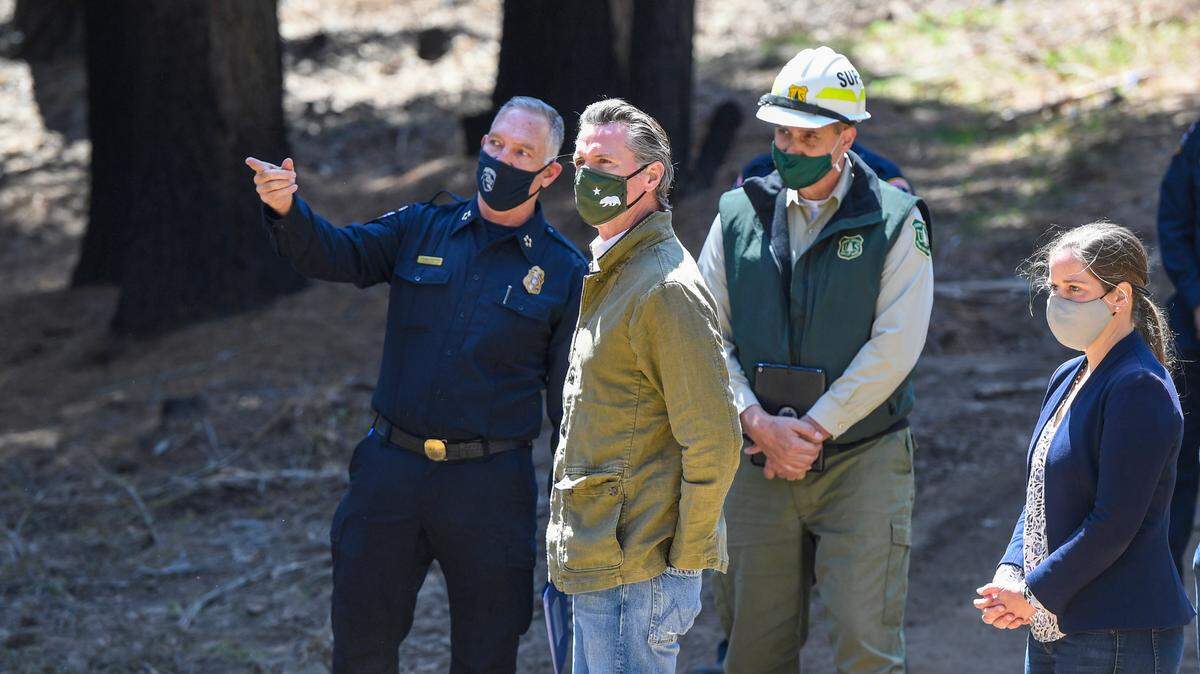
With California likely facing another brutal wildfire season, Gov. Gavin Newsom announced a deal with legislative leaders Thursday on $536 million in additional funding to increase fire prevention in the parched state.
While the Legislature has increased Cal Fire’s budget by hundreds of millions of dollars in recent years, adding additional helicopters, airplanes and firefighters, Thursday’s agreement by Newsom, Assembly Speaker Anthony Rendon and Senate President Toni Atkins centers largely on money for increasing the resiliency of California’s forests and other vulnerable areas.
The money would go toward forestry management, improvements in defensible space around rural homes, vegetation management. The agreement also provides money for “home hardening” — the desperately needed retrofitting of homes in wildfire-prone areas.
The agreement comes on the heels of the worst wildfire season in modern California history, in which more than 4 million acres burned across the state. The deal also follows Newsom’s signature on a memorandum of understanding with the U.S. Forest Service last summer, in which both governments agreed to dramatically increase forest management.
A second straight dry winter has plunged California into drought-like conditions and sets the stage for another potentially difficult wildfire season.
Newsom in January proposed spending $1 billion on fire prevention in the upcoming fiscal year, which begins July 1; the package announced Thursday is an early action item, meaning about half of the money he proposed in January would be spent before July.
Speaking to reporters near Shaver Lake — site of last fall’s devastating Creek Fire in Fresno County — the governor said the he expects the Legislature to appropriate the early-action Monday and he’ll sign it into law Tuesday.
He promised that this year his administration would focus on preventing fires with “a greater sense of urgency than ever in contemporary California history.”
Newsom has increased Cal Fire’s firefighting budget by more than $700 million since taking office in 2019, but he acknowledged that more must be done on the prevention side. To that end, he said he looks forward to a better relationship with the U.S. Forest Service after four contentious years of dealing with the Trump administration.
While Trump frequently blamed California for its wildfires and refused to acknowledge the role of climate change, Newsom said President Joe Biden’s administration will be more collaborative. “During the transition he reached out on two subjects: climate change and forest fires, wildfires broadly defined, and we talked about the nuances,” Newsom said.
Newsom’s approval fell in 2019 fires
Newsom, who is likely facing a recall vote over his handling of the COVID-19 pandemic and other issues, saw his approval ratings falter in October 2019, amid a massive wildfire in Sonoma County and a series of major blackouts imposed by PG&E Corp. in an effort to lower fire risks.
Last fall, after the North Complex fire killed 15 people in the Butte County community of Berry Creek, Newsom visited the area and announced measures to ramp up the state’s fight against climate change, which he blamed for the rash of 2020 fires. Newsom reiterated that point Thursday, telling climate skeptics to “believe your own damn eyes.”
A group of legislative Republicans said the funding deal announced Thursday is too small.
“The Governor’s efforts, while appreciated, are quite simply not enough and do not recognize the urgency of the situation,” said a joint statement from Assembly members James Gallagher, Megan Dahle and Frank Bigelow, all of whom represent north state districts that have been vulnerable to wildfires. “This fire season is already trending worse than last year, and the last five years have been some of our worst. Yet, the Governor is proposing the same funding as last year for forestry management projects. We need to double it. Not five years from now, right now.”
Protecting homes from wildfire
Others, however, praised the plan.
“No amount of money can fix our fire problem overnight, but it’s a really good start, getting us down a road toward some solutions,” said Bill Tripp, a leader of the Karuk Tribe in the Klamath region of Northern California. The tribe has been a leader in advocating more aggressive management of forests to reduce fire risks.
State Sen. Bill Dodd, D-Napa, who has been a key lawmaker on wildfire issues, said about $480 million would be spent on forest management and fuel breaks — the elimination of flammable brush and other vegetation in strategic areas.
“This makes sound investments in what we need to safeguard life and property,” Dodd said in a prepared statement. “I applaud my fellow lawmakers for taking this proactive step toward avoiding the devastation we’ve seen over the past five years.”
He said $30 million would be spent on home hardening, an issue that has taken on increasing importance in recent years. After the 2018 Camp Fire destroyed most of Paradise, an investigation by McClatchy found that newer homes — built to California’s exacting wildfire-resilience standards — were more likely to survive the fire than older homes.
The package, if approved by the Legislature, will be funded with $411 million in general fund money and $125 million from the state’s greenhouse gas reduction program. The greenhouse gas program is largely funded by large industrial companies that have to buy credits through the state’s cap-and-trade program, which is designed to curtail carbon emissions.
This story was originally published April 8, 2021 at 10:30 AM with the headline "Gavin Newsom strikes wildfire deal to put $536 million toward home-hardening, prevention."