
Planet parade, ‘haunting’ lunar eclipse to appear in CA sky. Here’s when
Californians will soon have another chance to glimpse six planets hanging overhead at once.
In March, stargazers can catch a total lunar eclipse transforming the full moon into an orange-hued orb.
March marks the start of a new season as well.
Here’s how to see the upcoming celestial events:
How to watch planetary parade
Skywatchers can observe a parade of six planets in the night sky on Sunday, March 1, according to National Geographic.
Jupiter, Mercury, Neptune, Saturn, Uranus and Venus will all be visible just after sunset, but stargazers will need a telescope to glimpse Uranus and Neptune, NASA said.
“Neptune, especially, will be tricky to spy since it sets soon after the sun,” National Geographic said.
Venus, Mercury, and Saturn will be close together just above the west horizon, NASA said, while Neptune will appear near Saturn.
Jupiter will be visible halfway up the eastern sky.
When’s the best time to see full moon in California?
March’s full moon will reach peak illumination at 3:37 a.m. on Tuesday, March 3, according to online calendar Time and Date.
March’s full month is called the worm moon, which was once considered a reference to the earthworms that emerge when soil temperatures being to climb in the springtime.
According to the Old Farmers Almanac, the moon’s nickname actually refers to the worm-like beetle larvae that appear from winter hideouts, such as thawing tree bark, in North America during this time of year.
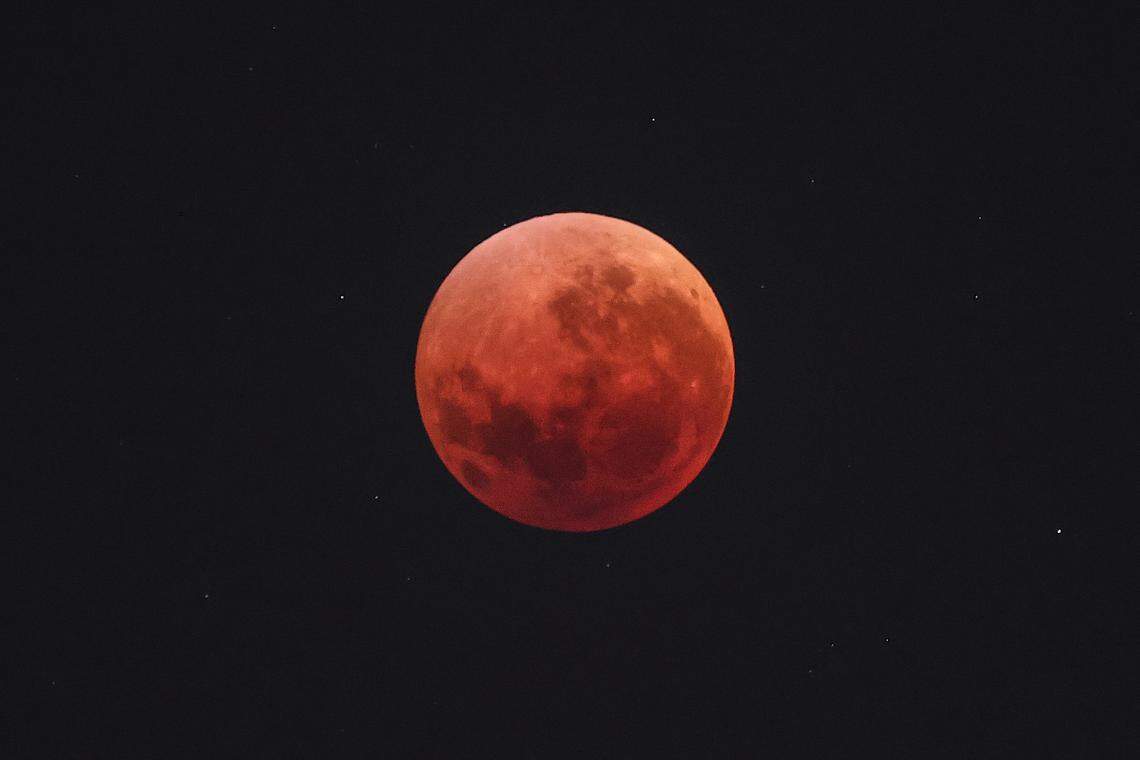
The March full moon will also be a “blood moon,” appearing as a total lunar eclipse becomes visible across Northern America.
How can I watch total lunar eclipse?
The total lunar eclipse will occur at the same time as the third full moon of 2026.
According to NASA, the eclipse will be visible across North America starting early Tuesday, March 3.
During the lunar eclipse, the moon will pass through Earth’s shadow, casting a bloody tint on the moon’s surface.
Once the eclipse starts, the full moon will take on a reddish shade as Earth enters between the sun and the moon, National Geographic said.
“The sight ... will turn the full worm moon a haunting tangerine hue,” the publication said.
California will start to see a partial view of the eclipse at 12:44 a.m. The total lunar eclipse will reach its peak at 3:33 a.m. and end at 6:23 a.m., according to Time and Date.
The last total lunar eclipse to appear over the state was in March 2025.
When is the spring equinox?
The 2026 spring equinox lands on Friday, March 20, at 7:46 a.m., according to Time and Date.
The vernal equinox marks the beginning of spring in the Northern Hemisphere, according to the Old Farmer’s Almanac.
During the March equinox, the Northern Hemisphere and Southern Hemisphere receive roughly the same amount of sunlight since neither hemisphere is tilted more toward or away from the sun, the almanac said.
The Latin word “equinox” translates to “equal night” in English.
“On the equinox, the length of day and night is nearly equal in all parts of the world,” the almanac said.
This story was originally published February 28, 2026 at 5:00 AM with the headline "Planet parade, ‘haunting’ lunar eclipse to appear in CA sky. Here’s when."
